

Quick Answer
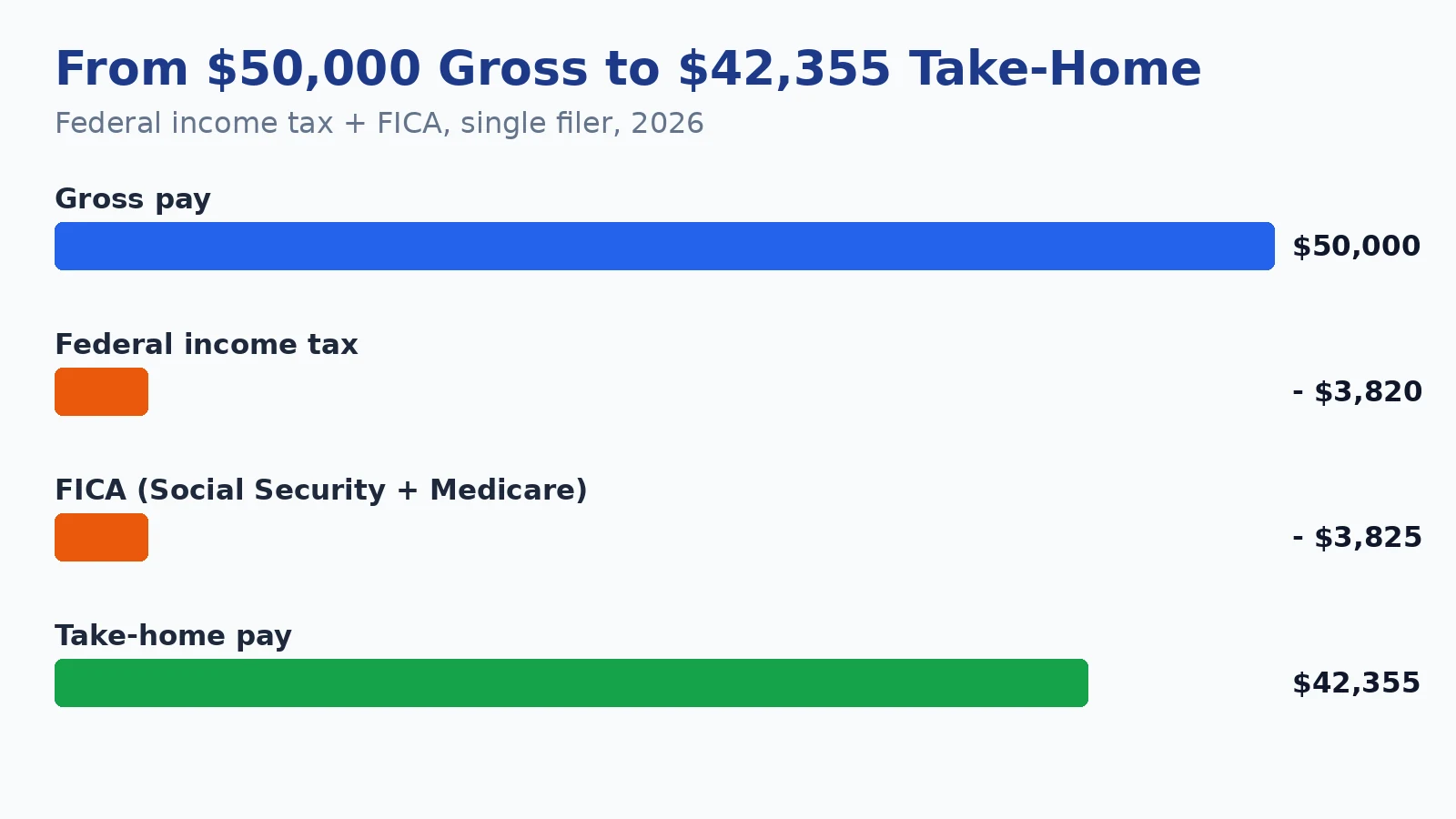
After 2026 federal income tax and FICA, a $50,000 salary leaves you $42,355 a year. That's $3,529.58 a month, or $1,629.04 every two weeks.
A $50,000 salary sounds like $50,000, but $50,000 a year after taxes is really $42,355: $3,529.58 a month, or $1,629.04 every two weeks. That's 84.7% of your gross pay. Before you use those numbers, know what's in them: federal tax only, for a single filer taking the standard deduction. No state income tax, no 401(k) contributions, no health premiums. If any of those apply to you, your real paycheck will be smaller. We walk through each one in the section on why paychecks differ.
This is the second article in our after-tax series. The first covered $25 an hour after taxes ($43,962 take-home, a bit more than this $50,000 salary, since $25 an hour over a full year is $52,000 gross). Want the idea behind the numbers? Our guide to gross pay vs net pay explains what gross and net mean and why they don't match.
Check your own salary
On a different salary? Turn it into an hourly rate first, then run the same tax steps from this article.
The Short Answer: $42,355 a Year
| Period | Gross Pay | Take-Home (Federal Only) |
|---|---|---|
| Year | $50,000.00 | $42,355.00 |
| Month (average) | $4,166.67 | $3,529.58 |
| Biweekly paycheck (26/year) | $1,923.08 | $1,629.04 |
| Week | $961.54 | $814.52 |
| Hour (2,080-hour year) | $24.04 | $20.36 |
One thing about the biweekly number: $1,629.04 assumes 26 paychecks a year. If you're paid semi-monthly, you get 24 checks instead, and each one is $1,764.79. You still end the year with the same $42,355. Only the split changes.
2026 Federal Tax Brackets at a Glance
Here's the key idea: your last dollar decides your bracket, not your whole income. These are the 2026 single-filer brackets we use in this guide:
Up to $12,400
Every dollar in this range is taxed at 10%.
$12,400 – $50,400
Every dollar in this range is taxed at 12%.
$50,400 – $105,700
Every dollar in this range is taxed at 22%.
$105,700 – $201,775
Every dollar in this range is taxed at 24%.
For this salary: $50,000 gross becomes $33,900 taxable, which puts you in the 12% marginal bracket. But your effective federal rate is only 7.6% ($3,820 ÷ $50,000), because your first dollars are taxed at the lower 10% rate.
How the Math Works, Step by Step
Five steps, and you can check every one of them. All of these use 2026 federal rules for a single filer.
| Step | Math | Result |
|---|---|---|
| 1. Gross pay | Salary as offered | $50,000 |
| 2. Taxable income | $50,000 − $16,100 standard deduction | $33,900 |
| 3. Federal income tax | 10% × $12,400 = $1,240, plus 12% × $21,500 = $2,580 | $3,820 |
| 4. FICA | Social Security 6.2% × $50,000 = $3,100, plus Medicare 1.45% × $50,000 = $725 | $3,825 |
| 5. Take-home | $50,000 − $3,820 − $3,825 | $42,355 |
Step 3 is the one that trips people up. Your marginal rate is 12%, the rate on your last dollar. But your effective federal rate is only 7.6% ($3,820 ÷ $50,000). Why the gap? Your first $12,400 of taxable income is taxed at 10%, and only the remaining $21,500 is taxed at 12%. A higher bracket never taxes your whole income at the higher rate. It only touches the dollars inside that bracket. FICA works differently: it applies to the full $50,000, since the whole amount sits below the $184,500 Social Security wage base.
Why Your Paycheck May Look Different
- State income tax. This is the biggest gap in our numbers. Some states don't tax income at all. Others take several percent, and in a high-tax state that can mean several hundred dollars less a month than the federal-only figures here.
- Retirement contributions. A 401(k) contribution leaves your check before you ever see it. It also lowers your taxable income, which trims the federal tax in step 3 a little. Your paycheck shrinks, but the money is still yours.
- Health premiums and other deductions. Insurance, dental, and vision premiums come out of each paycheck, and the amounts vary a lot from one employer to the next.
- Pay frequency. Biweekly pay means 26 checks; semi-monthly means 24. The per-check amount changes, but the yearly total stays the same, as the table above shows.
- Withholding vs actual tax. What your employer withholds is an estimate. The real bill gets settled when you file. If you get a refund or owe a balance, it means the withholding didn't match the true yearly figures. It doesn't mean the math in this article is wrong.
$50,000 vs Nearby Salaries
| Salary | Gross / Year | Federal + FICA | Take-Home / Year | Take-Home / Month |
|---|---|---|---|---|
| $40,000 salary | $40,000 | $5,680.00 | $34,320.00 | $2,860.00 |
| $50,000 salary | $50,000 | $7,645.00 | $42,355.00 | $3,529.58 |
| $60,000 salary | $60,000 | $9,610.00 | $50,390.00 | $4,199.17 |
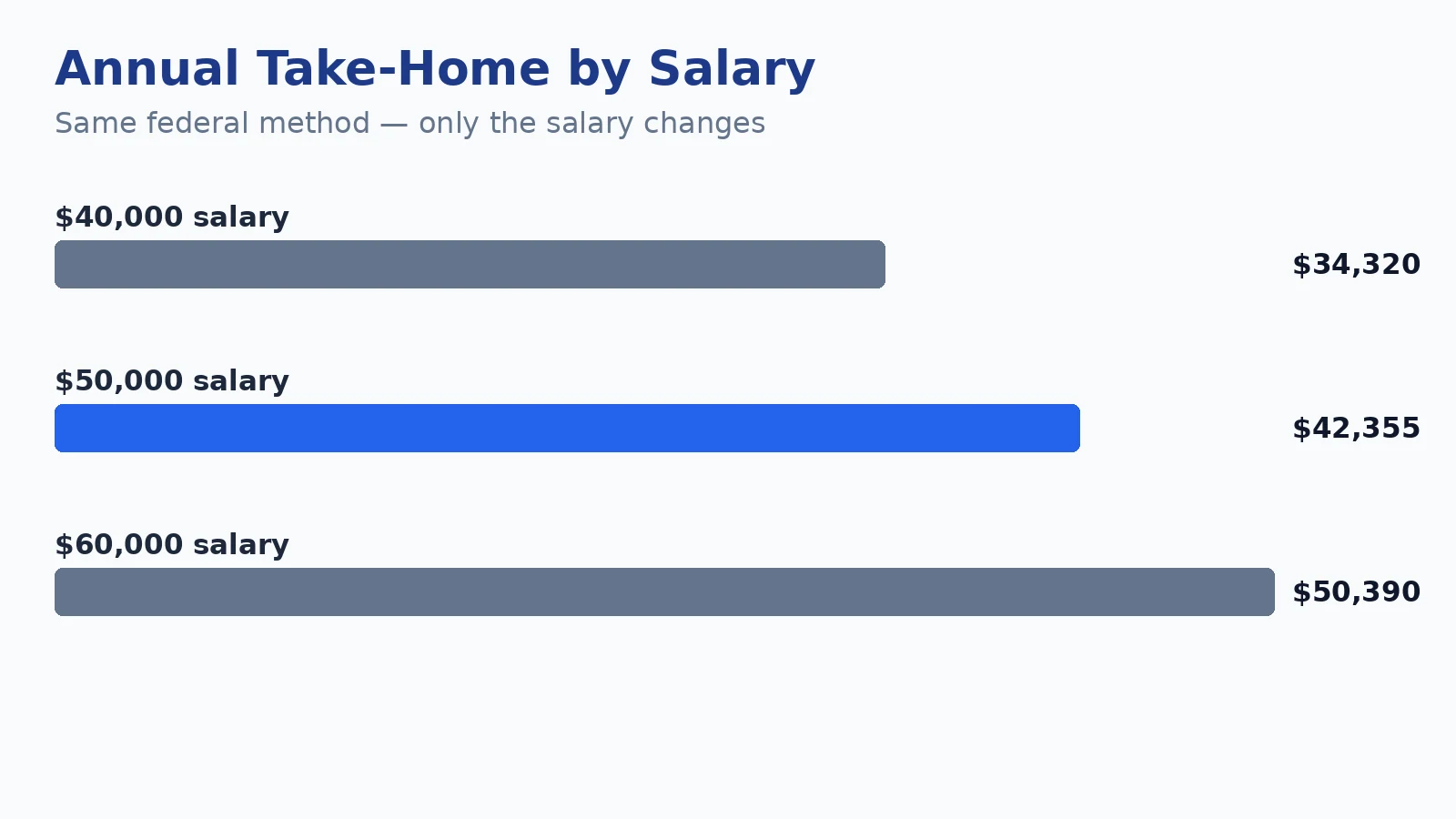
Look at the pattern: each $10,000 raise in this range adds about $8,035 a year to your take-home pay, and the total federal-plus-FICA bite stays near 15 to 16% of gross the whole way. Taxes stay almost flat in this band because everything sits inside the 10% and 12% brackets. For comparison, $25 an hour after taxes comes to $43,962 take-home, more than this $50,000 salary, because that hourly role grosses $52,000. To weigh two offers side by side, hours, commute, and paid time off included, use the salary comparison calculator.
The Overtime Corner
Everything so far assumes a straight salary, no overtime. For salaried workers, overtime is a status question before it's a math question. An exempt employee gets the same flat salary for a 50-hour week. A non-exempt salaried employee gets overtime on top. Our guide to exempt vs non-exempt employees explains which side of the line a job falls on, and the overtime calculator prices the extra hours. If your role is non-exempt, overtime can push take-home well past the $42,355 baseline here.
Is $50,000 a Good Salary?
There's no national answer, only a local one. Take-home of $3,529.58 a month stretches a long way in some places and barely covers rent in others. It all comes down to rent, transport, and household size where you live. What we can give you is an honest starting number: $42,355 a year after federal tax, before state tax and deductions. Stack that number, not the $50,000 gross, against your real monthly costs, and you've got a realistic budget baseline. Anyone who quotes the gross figure as spending money is overstating your income by $7,645 a year.
How to Use the Calculator
Here's how to run your own numbers:
- Step 1 — Enter your annual salary in the salary-to-hourly calculator.
- Step 2 — Set your schedule: tweak the hours per week and paid weeks to match your job.
- Step 3 — Check the receipt: the panel under the tool shows what you entered, the formula, and the result.
- Step 4 — Compare: try the nearby salaries in this guide and watch how a different pay level changes the result.
Limitations
Before you build a budget on any number above, keep these limits in mind:
- State income tax excluded: most states tax income as well, so your real take-home will be lower.
- Retirement and health deductions excluded: 401(k) contributions and health premiums come straight out of your check, and we don't count them here.
- Schedule assumption: our figures use the schedule in this guide. Fewer hours or unpaid weeks change every number.
- Not tax advice: these figures use 2026 federal rules for a single filer taking the standard deduction. Credits, other income, and filing status will change your real return.
Frequently Asked Questions
The questions we hear most about a $50,000 salary after taxes, answered short and straight.
How much is $50,000 a year after taxes?
You keep $42,355 of a $50,000 salary as a single filer in 2026. It's a neat split at this pay level: $3,820 goes to federal income tax and $3,825 to FICA, which leaves you $1,629.04 every two weeks or $3,529.58 a month. State tax, 401(k) contributions, and health premiums aren't in those numbers, so your real check will be lower if any of those apply to you.
How much is $50,000 a year biweekly after taxes?
It's $1,629.04 per check. That's the $42,355 yearly take-home split across 26 paydays, before state tax and anything your employer takes out. If you're paid twice a month instead, you get 24 checks of $1,764.79. Same $42,355 for the year either way, just a different payday rhythm.
How much is $50,000 a month after taxes?
Budget around $3,529.58 a month. We get that by spreading the $42,355 yearly take-home over 12 months. With biweekly pay, most months hold two $1,629.04 checks ($3,258.08), and two months a year hold three. That's why the $3,529.58 average works better for a budget than the two-check months do.
What is the take-home hourly rate for a $50,000 salary?
It works out to $20.36 an hour. Before tax, $50,000 over 2,080 hours is $24.04 an hour, and federal income tax plus FICA take $3.68 of that. Add state income tax and your true hourly rate drops below $20.36.
Does this include state taxes?
No. The $42,355 covers only the two federal pieces, $3,820 of income tax and $3,825 of FICA. We leave state tax out because it varies too much to give one number: some states don't tax wages at all, and others have their own brackets and standard deductions. If your state taxes income, think of $42,355 as your ceiling. Your real take-home will land below it.
Why is my paycheck less than $1,629.04 biweekly?
The $1,629.04 number only strips out federal income tax and FICA, so any other deduction explains the gap. State withholding is the usual suspect, then health premiums and retirement contributions. Garnishments, union dues, and HSA or parking deductions show up on some stubs too. Go line by line through your pay stub and match each one. If the federal withholding itself is running hotter than the $3,820 a year we use here, a W-4 update through payroll is the fix.
Key Takeaways & Action Plan
What to Remember
- $50,000 a year is $42,355 after federal tax: $3,529.58 a month, $1,629.04 every two weeks, $20.36 an hour take-home.
- Marginal is not the same as effective: your top bracket is 12%, but your effective federal rate is 7.6%. Only the dollars inside a bracket pay that bracket's rate.
- These are federal-only figures. State tax, 401(k), and premiums still come out, so budget from the take-home number, not the gross.
- Each $10,000 raise is worth about $8,035 a year in take-home pay at this level.
- $25 an hour beats this salary on take-home ($43,962 vs $42,355), because its gross is $52,000. Always compare take-home, not the headline number.
Sources & Method
Here's how we got the numbers. We used 2026 federal rules for a single filer taking the standard deduction: a $16,100 standard deduction, a 10% bracket up to $12,400 of taxable income, and a 12% bracket up to $50,400, per IRS Revenue Procedure 2025-32. FICA is 7.65% (Social Security 6.2% up to the $184,500 wage base, plus Medicare 1.45%), and the full $50,000 falls below that wage base. Yearly figures use 52 weeks and 2,080 hours; monthly figures are the yearly total divided by 12. State income tax, retirement contributions, health premiums, and overtime are all left out. This article is general information, not tax advice.
Check your own salary
Enter your salary to get its hourly equivalent, then walk through the same five tax steps.
3 Things to Remember
- Take-home is $42,355 a year, which is 84.7% of gross pay.
- Federal tax only, single filer, standard deduction. State income tax is not included.
- 401(k), health premiums, and other benefit deductions aren't included either.
Methodology & Data Verification
- Basis: Pay figures are gross unless a section states take-home; tax figures use 2026 federal rules where shown.
- Method: Full formulas, baselines, and rounding rules are on our calculation methodology page.
- Coverage: U.S. federal rules; state and local rules vary and are not included.
- Review: Last updated October 26, 2026.
- Disclaimer: Estimates for planning only — not tax or legal advice.