

Quick Answer
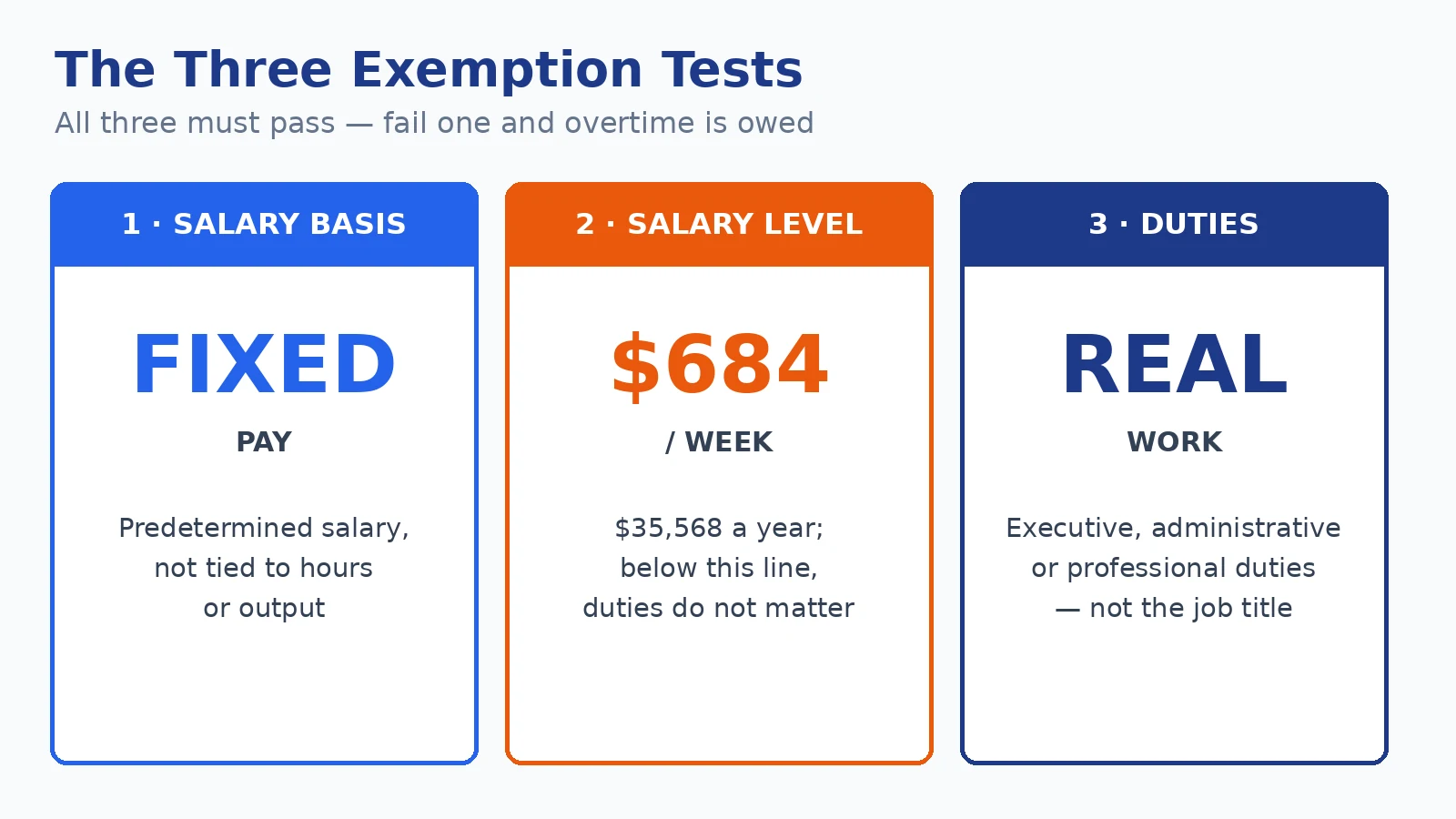
A salary alone doesn't make you exempt from overtime. You have to pass all three FLSA tests: salary basis, at least $684 a week, and real executive, administrative, or professional duties.
A salary doesn't make you exempt from overtime. Under the Fair Labor Standards Act, an employee is exempt only if they pass three tests at once: they're paid on a salary basis, they earn at least $684 a week, and their actual duties fit an executive, administrative, or professional exemption. Fail any one test and overtime is owed, no matter what the job title says and no matter how the offer letter words the role.
This is about real money. A non-exempt employee who works 50 hours gets overtime for the 10 hours past 40. An exempt employee who works the same 50 hours gets exactly the same salary as a 40-hour week. Below, we walk through each test, the salary rule that was announced, thrown out in court, and then formally withdrawn, and worked examples that show which side of the line you fall on.
Working more than 40 hours?
If you're non-exempt, every hour past 40 is paid at time-and-a-half. See what those hours are worth.
The Short Answer: Three Tests, Not One Title
Some employers treat a salary or a "manager" title as proof of exempt status. The law doesn't work that way. The three tests add up — all three have to be met:
| Test | What It Requires | If It Fails |
|---|---|---|
| Salary basis | A predetermined, fixed salary that does not shrink with hours worked or output | Not a true salary — exemption fails |
| Salary level | At least $684 per week ($35,568 per year) | Non-exempt, regardless of duties |
| Duties | Primary duty fits an executive, administrative, or professional exemption | Non-exempt, regardless of pay |
There's also a shortcut for highly compensated employees: total annual compensation of at least $107,432, including at least $684 a week paid on a salary or fee basis, plus office or non-manual work and at least one exempt duty done customarily and regularly.
The Three Tests, Explained
Test 1: Salary basis
An exempt employee gets a set amount each pay period that doesn't change with the hours worked or how much work gets done. Work any part of a week and the full salary for that week is owed. The employer generally can't dock pay for a partial-day absence. Deductions are allowed only in a few narrow cases: full-day absences for personal reasons, full-day absences for sickness under a real sick-leave plan, unpaid leave under the Family and Medical Leave Act, and certain disciplinary suspensions. Repeated improper deductions can kill the exemption altogether and turn the employee non-exempt.
Test 2: Salary level
The salary has to be at least $684 per week, which works out to $35,568 a year or $2,964 a month for a full-year worker. For a sense of scale, $684 a week is $17.10 an hour on a 40-hour week and $19.54 an hour on a 35-hour week. Up to 10% of the level — $68.40 a week — can come from nondiscretionary bonuses, incentives, or commissions paid at least once a year, with a catch-up payment allowed shortly after year-end if the total comes up short. Computer employees have another option: an hourly rate of at least $27.63. And doctors, lawyers, teachers, and outside sales employees aren't subject to the salary basis or salary level tests at all.
Test 3: Duties
The employee's main job has to genuinely fit one of the recognized exemptions. An executive runs an enterprise or a recognized department, supervises two or more full-time employees, and has real say over hiring and firing (or recommendations that carry real weight). An administrative employee does office or non-manual work directly tied to management or general business operations and uses discretion and independent judgment on matters of significance. A professional does work that needs advanced knowledge from prolonged specialized schooling (the learned professions), or work that needs invention, imagination, originality, or talent (the creative professions). In every case, the Department of Labor looks at what the person actually does day to day, not the title on the business card.
What Happened to the $1,128 Rule?
If you followed this topic in 2024, you may remember a different number. In April 2024, the Department of Labor issued a final rule raising the salary level to $844 a week on July 1, 2024, and then to $1,128 a week on January 1, 2025, with more increases scheduled every three years. On November 15, 2024, the U.S. District Court for the Eastern District of Texas threw out the whole rule nationwide, finding it went beyond the Department's authority. The appeals were later dismissed, and in May 2026 the Department formally rescinded the 2024 rule and put the 2019 levels back through a technical amendment. So the $844 and $1,128 figures aren't enforceable, and any source still quoting them as current federal law is out of date. Employers that raised salaries in 2024 to meet the higher thresholds don't have to undo those raises — but the federal floor they have to meet is $684 a week.
Exempt vs Non-Exempt, Side by Side
| Exempt | Non-Exempt | |
|---|---|---|
| Pay structure | Fixed salary, same every week | Hourly or salaried, with overtime on top |
| Overtime (over 40 hrs/week) | None — salary does not change | At least 1.5× the regular rate |
| Hours tracking | Usually not tracked | Hours must be recorded |
| Taxes | Income tax, Social Security, Medicare all apply | Same — exemption is from overtime, not tax |
| Typical roles | Department managers, senior analysts, licensed professionals | Hourly staff, and salaried staff who fail any test |
One thing the table makes plain: "exempt" says nothing about taxes. Both kinds of employees pay the same payroll taxes. The only thing an exemption takes away is the overtime premium, which is exactly why the tests exist and why employers can't hand themselves an exemption by re-titling a job. Also note that federal law has no daily overtime rule. Overtime is weekly, past 40 hours, though some states add daily thresholds of their own.
Worked Examples: The Same Hours, Different Pay
| Worker | Math | Result |
|---|---|---|
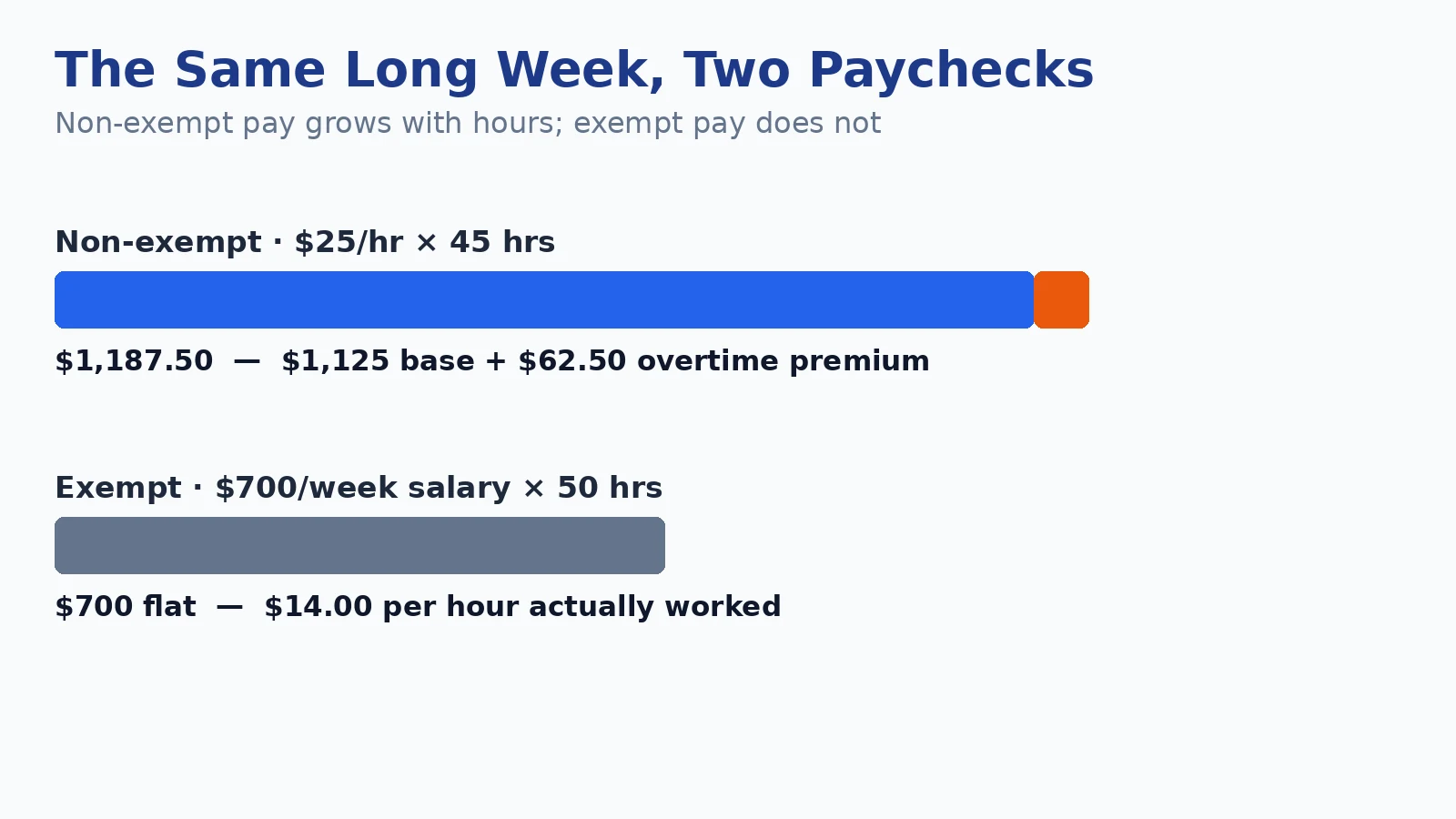
| Non-exempt, $25/hr, 45-hour week | 40 × $25 + 5 × $37.50 | $1,187.50 (overtime premium: $62.50) |
| Exempt, $700/week salary, 50-hour week | Fixed salary, no overtime | $700 — $14.00 per hour actually worked |
| Salaried at $35,000/year | $35,000 ÷ 52 = $673.08/week | Below the $684 floor — non-exempt regardless of duties |
| Salaried at $36,400/year | $36,400 ÷ 52 = $700/week | Level passed — duties now decide |
The 50-hour comparison shows the stakes best: at $25 an hour, a non-exempt 50-hour week pays $1,375 (40 hours at $25 plus 10 hours at $37.50), while a $52,000 salary — the same $25 rate on paper — pays a flat $1,000 for that week. Exempt status can be worth several hundred dollars a week to the employer, which is why the duties test, not the title, decides. To run your own numbers, convert a salary to its hourly equivalent with the hourly to salary calculator and price extra hours with the overtime calculator.
Common Traps and Confusions
- "Manager" on the title. A "shift manager" who spends 80% of the shift doing the same work as the crew, with little real say over hiring or the department, usually doesn't pass the executive duties test — whatever the title says.
- Salary means exempt. Salary is how pay is delivered, not a legal classification. Salaried non-exempt employees are everywhere, and they're owed overtime.
- Exempt means tax-exempt. It doesn't. Overtime exemption and tax withholding are unrelated; "exempt from withholding" on Form W-4 is a different status with its own conditions.
- Meeting the federal floor is always enough. Not where a state sets a higher threshold. Several states — including California, New York, and Washington — require more than $684 a week for exemption, and the higher figure wins. Check the current threshold for your state before trusting the federal number.
- Full-time means exempt. It doesn't. Whether a job is full-time is a separate question from whether it's exempt — our guide to how many hours a week count as full-time explains why the two labels are independent, and holiday pay follows yet another set of rules.
What To Do If You Are Misclassified
Start with three checks you can run yourself: (1) divide your annual salary by 52 — if the result is below $684 a week, the federal salary level test fails outright; (2) compare your actual daily work with the duties described above, not your title; (3) check whether your state sets a higher salary threshold than the federal floor. If any check fails, you may be owed back overtime — generally for the past two years, or three if the violation was willful, plus an equal amount as liquidated damages in many cases. Hang on to your pay stubs and keep a record of hours worked. This article is general information, not legal advice; a labor attorney or the Department of Labor's Wage and Hour Division can look at a specific situation.
How to Use the Calculator
Here's how to price the overtime your classification decides, in four steps:
- Step 1 — Enter your hourly rate in the overtime calculator. If you're salaried but non-exempt, first divide your weekly salary by your scheduled weekly hours to get the rate.
- Step 2 — Enter one real week: your regular hours and the overtime hours you actually worked past 40.
- Step 3 — Set the multiplier: 1.5× is the federal floor for overtime; use a higher figure only if your state law or employer policy promises one.
- Step 4 — Read the weekly total: that's roughly what the exemption line is worth in a heavy week — the number to hold next to any salaried offer or reclassification.
Limitations
- Classification is fact-specific: the duties tests turn on the work you actually do day to day, not your job title or this guide's summaries. Borderline roles need a fact-by-fact look at real duties.
- Federal floor, state overlays: this guide is built on the FLSA baseline. States such as California add daily overtime, different salary tests, and stricter rules, so a federal-only answer can fall short where you live.
- Salary thresholds can move: the standard salary threshold in this guide has been revised and fought over in court in recent years; confirm the figure currently in force before relying on it for a classification decision.
- Not legal advice: this guide explains the framework. Misclassification claims, back-pay exposure, and profession-specific exemptions need an employment lawyer or your state labor agency.
- Examples assume the stated schedule: the worked examples price overtime on the hours shown. Fluctuating schedules, and fluctuating-workweek pay plans in particular, follow different math.
- Employer policy can go past the law: some employers voluntarily pay overtime premiums to exempt staff. Your legal classification alone doesn't decide what your paycheck includes.
Frequently Asked Questions
Short answers to the questions readers ask most about exempt and non-exempt status.
What is the difference between exempt and non-exempt employees?
It comes down to overtime. A non-exempt employee gets at least time-and-a-half for hours past 40 in a workweek. An exempt employee gets no overtime pay, however long the week runs. And exempt status is not a title or a pay style — it is three tests, salary basis, salary level, and duties, and all three have to be met.
Is $684 a week still the salary threshold in 2026?
Yes. The federal salary level for the executive, administrative, and professional exemptions is $684 per week ($35,568 per year). The Department of Labor tried to raise it to $844 in July 2024 and $1,128 in January 2025, but a federal court threw out that rule nationwide in November 2024, and the Department formally put the 2019 levels back in place in May 2026. So if an article still quotes $1,128 as the current federal threshold, it is out of date.
If I am salaried, am I automatically exempt?
No. Salary is just how you get paid; exempt is a legal status. A salaried employee who fails any of the three tests — say, earning $673 a week, below the $684 floor, or doing work that does not fit any duties test — is non-exempt and owed overtime. Plenty of employers keep salaried non-exempt staff on a fixed weekly salary and pay overtime on top of it.
Do exempt employees get overtime pay?
No. An exempt employee gets the same fixed salary whether the week runs 35 hours or 60. That is the real cost of exempt status: a $700-a-week salary pays $700 for a 50-hour week, which works out to $14.00 an hour, while a non-exempt worker at a similar rate would earn overtime for the 10 hours past 40.
Does "exempt" mean exempt from taxes?
No. Exempt here means exempt from overtime pay only. Exempt and non-exempt employees both pay federal income tax, Social Security, and Medicare on what they earn. There is a separate idea — claiming "exempt from withholding" on Form W-4 — that is about income tax withholding, not overtime, and it has its own strict conditions.
What if my employer calls me exempt but I do non-exempt work?
Your duties and your pay decide your status, not your title. If your actual day-to-day work does not fit any duties test, or your salary sits below the federal floor (or a higher state threshold where one applies), you may be misclassified and owed back overtime. This article is general information, not legal advice; a labor attorney or the Department of Labor can look at a specific situation.
Key Takeaways & Action Plan
What to Remember
- Three tests, all required: salary basis, salary level of at least $684 a week, and qualifying duties. Fail one and overtime is owed.
- The current federal floor is $684 a week. The $1,128 figure from the 2024 rule was thrown out in November 2024 and formally withdrawn in May 2026.
- Titles decide nothing. A manager who mostly does crew work, or a salaried worker under $684 a week, is non-exempt.
- Long weeks show the gap: at $25 an hour, a 50-hour week pays $1,375 non-exempt versus a flat $1,000 on a $52,000 salary.
- States can be stricter. Where a state threshold is higher than the federal floor, the higher number wins.
Sources & Method
Tests and thresholds are as published by the U.S. Department of Labor (FLSA regulations Part 541; the Department's overtime advisor confirms the $684-per-week salary level and the $107,432 highly compensated threshold) and the court history of the 2024 rule (thrown out nationwide November 15, 2024, by the U.S. District Court for the Eastern District of Texas; appeals dismissed May 2026; 2019 levels put back by Department technical amendment effective May 15, 2026). Annual figures use 52 weeks; overtime examples use time-and-a-half past 40 hours in a workweek. This article is general information, not legal advice.
Check your own overtime
Put your rate and hours into the overtime calculator to see what a long week is worth on the non-exempt side of the line.
3 Things to Remember
- Salary alone isn't enough — fail any one of the three tests and overtime is owed.
- The salary test is at least $684 a week, paid on a salary basis.
- The duties test looks at your actual duties fitting an executive, administrative, or professional exemption.
Methodology & Data Verification
- Basis: Pay figures are gross unless a section states take-home; tax figures use 2026 federal rules where shown.
- Method: Full formulas, baselines, and rounding rules are on our calculation methodology page.
- Coverage: U.S. federal rules; state and local rules vary and are not included.
- Review: Last updated October 24, 2026.
- Disclaimer: Estimates for planning only — not tax or legal advice.