

Quick Answer
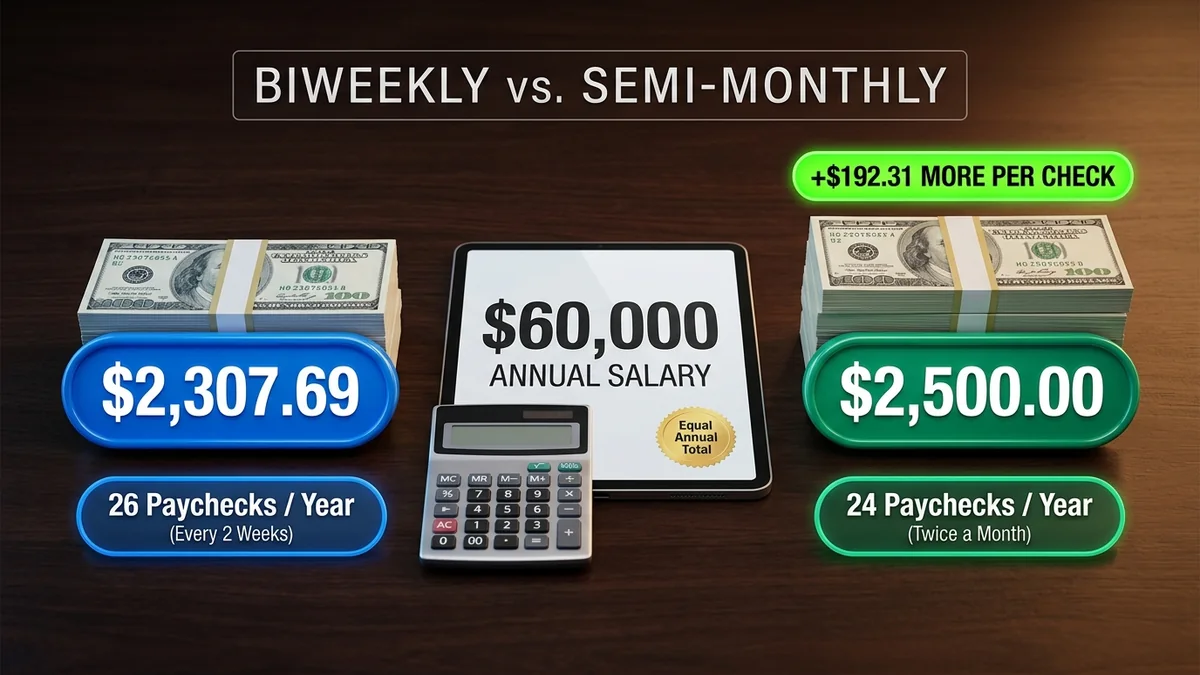
Biweekly pay is 26 paychecks a year; semi-monthly is 24. On a $60,000 salary, that's $2,307.69 per biweekly check versus $2,500 per semi-monthly check.
Reading a job offer, one line trips up a lot of people: Is the position paid biweekly or semi-monthly? Both sound like "getting paid twice a month," but they run on different calendars, give you different-sized checks, and change how money flows through your month.
A lot of people assume 26 biweekly paychecks and 24 semi-monthly paychecks add up to the same deposits each month. Your total annual gross compensation is exactly the same either way, but when the money lands in your checking account changes a lot, from when you pay rent to how overtime gets counted and how you save.
This guide walks through the math of biweekly vs. semi-monthly pay, compares both on a $60,000 salary, explains the "three-paycheck month," covers the FLSA overtime rules, and helps you figure out which schedule suits you better.
Calculate Your Paycheck by Pay Frequency
See what your gross check looks like on biweekly (26 checks), semi-monthly (24 checks), weekly, or monthly pay. You enter your own deductions; the tool doesn't work out taxes.
Biweekly vs. Semi-Monthly at a Glance: The Quick Answer
It comes down to two things: pay frequency count and calendar alignment:
- Biweekly (Every 2 Weeks): You get 26 paychecks per year. Payday comes every two weeks on the same weekday, almost always every other Friday, with exactly 14 days between checks. Ten months have two paychecks, and two months have three.
- Semi-Monthly (Twice a Month): You get 24 paychecks per year. Payday falls twice a month on set dates, usually the 1st and 15th, or the 15th and the last business day of the month. Every month has exactly two paychecks, no exceptions.
Since a semi-monthly schedule splits your salary into 24 checks instead of 26, each semi-monthly paycheck is roughly 8.33% larger than a biweekly paycheck. But by the end of the year, both schedules pay out 100% of your agreed gross salary, down to the penny.
| Payroll Characteristic | Biweekly Schedule | Semi-Monthly Schedule |
|---|---|---|
| Paychecks Per Year | 26 paychecks (27 in leap years) | 24 paychecks |
| Payment Cadence | Every 14 days (typically Friday) | Fixed dates (e.g., 1st & 15th, or 15th & end-of-month) |
| Paycheck Amount ($60k Salary) | $2,307.69 gross per check | $2,500.00 gross per check (+$192.31 / check) |
| Paychecks Per Month | 2 checks in 10 months; 3 checks in 2 months | Exactly 2 checks every single month |
| Base Hours Per Pay Period | Fixed 80 hours (2 workweeks × 40 hrs) | Averages 86.67 hours (varies 80 to 96 hrs) |
| FLSA Overtime Tracking | Seamless (matches 7-day workweeks) | Complex (splits workweeks across cycles) |
Core Definitions: Frequency, Cadence & Calendar Mechanics
To see why the two schedules feel so different, it helps to look at the calendar math behind them.
1. What Is Biweekly Pay?
With biweekly pay, you get paid every other week on a set day. In the US, roughly 43% of private-sector employees are paid biweekly, which makes it the most common pay frequency the US Bureau of Labor Statistics (BLS) tracks.
A standard year has 52 full weeks, and 52 divided by 2 is exactly 26 pay periods. The nice thing about biweekly pay is the rhythm: Friday morning means payday, whether that Friday is the 2nd, the 14th, or the 29th.
2. What Is Semi-Monthly Pay?
Semi-monthly pay runs on calendar dates, not days of the week. Your employer picks two set dates each month. The two usual setups are:
- Mid-Month & End-of-Month: You get paid on the 15th and the last day of the month (the 30th or 31st, or the 28th or 29th in February).
- First & Mid-Month: You get paid on the 1st and the 15th of each month.
Twelve months times two paydays is 24 pay periods a year. If a payday lands on a weekend or a federal bank holiday, employers usually send the deposit on the business day before (if the 15th is a Sunday, payday moves to Friday the 13th).
The Math Breakdown: $60,000 Salary Case Study
Here's what that difference means in real dollars, using a $60,000.00 per year salary for a full-time employee (40 hours a week, 2,080 hours a year).
$60,000 ÷ 26 = $2,307.69 Gross per Check
Base pay for standard 80 working hours across 10 business days.
$60,000 ÷ 24 = $2,500.00 Gross per Check
Base pay for 86.67 annualized working hours per pay period.
Put the two side by side and the difference jumps out: The semi-monthly paycheck is $192.31 higher per pay period ($2,500.00 vs. $2,307.69), an 8.33% edge on each check.
Does the semi-monthly worker earn more over the year? No. Here's the year-end math:
- Biweekly Annual Total: 26 paychecks × $2,307.6923 = $60,000.00
- Semi-Monthly Annual Total: 24 paychecks × $2,500.0000 = $60,000.00
It's all about timing. In the 10 regular months, the biweekly worker gets two checks totaling $4,615.38 a month, while the semi-monthly worker gets two checks totaling $5,000.00 a month (a $384.62 gap). But in the two "three-paycheck months," the biweekly worker gets three checks totaling $6,923.07, which closes the gap completely.
Paycheck Sizes Across Common Salary Brackets
Here's how the two schedules compare at other common salary levels:
| Annual Salary | Biweekly (26 Checks) | Semi-Monthly (24 Checks) | Per-Check Difference | Equivalent Hourly (2,080 Hrs) |
|---|---|---|---|---|
| $40,000 / year | $1,538.46 | $1,666.67 | +$128.21 | $19.23 / hr |
| $50,000 / year | $1,923.08 | $2,083.33 | +$160.25 | $24.04 / hr |
| $60,000 / year | $2,307.69 | $2,500.00 | +$192.31 | $28.85 / hr |
| $75,000 / year | $2,884.62 | $3,125.00 | +$240.38 | $36.06 / hr |
| $90,000 / year | $3,461.54 | $3,750.00 | +$288.46 | $43.27 / hr |
| $100,000 / year | $3,846.15 | $4,166.67 | +$320.52 | $48.08 / hr |
Want the exact numbers for your own pay? Try our Salary to Hourly Calculator, or check your tax deductions in our Paycheck Tax Guide.
The "Three-Paycheck Month" Phenomenon Explained
The best-known perk of biweekly pay is the "Three-Paycheck Month," which personal finance fans call a "magic month." Why does it happen, and when should you expect one? For the exact dates, see our guide to the three-paycheck months in 2027. One pay cycle even gets a rare 27th check that year.
A normal year has 365 days (366 in a leap year). Divide 365 by 7 and you get 52 weeks plus 1 extra day (2 in a leap year). Since biweekly checks go out every 14 days, you get 26 of them across those 52 weeks.
But the year is split into 12 months. If every month had just two paychecks, that would only add up to 24 (12 × 2 = 24). The other two paychecks must be distributed into the calendar. So in any given year on a biweekly schedule:
- 10 months contain exactly 2 paydays.
- 2 months contain exactly 3 paydays.
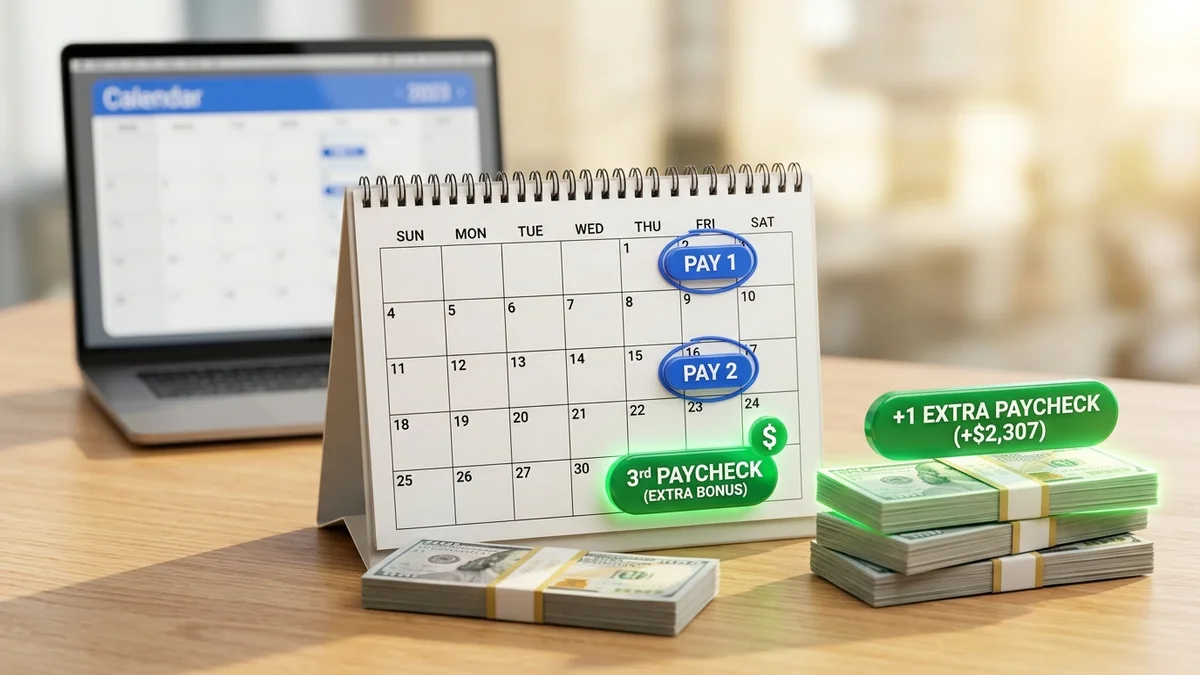
As the calendar graphic above shows, whenever the first payday of a month falls on the 1st, 2nd, or 3rd, that month has three Friday paydays (for example, Friday October 2, Friday October 16, and Friday October 30, 2026). Which months those are depends on your employer's payroll calendar and whether paydays fall on odd or even weeks.
Budgeting & Cash Flow: How Pay Frequency Impacts Monthly Bills
Your budget has to fit your pay schedule. Semi-monthly pay lines up neatly with fixed monthly bills, while biweekly pay gives you a real shot at building savings on autopilot if you plan for it.

Strategy A: The Two-Paycheck Biweekly Budget (Wealth Accelerator)
The smartest move for biweekly earners is to build your entire regular monthly budget around two paychecks ($4,615.38 gross on a $60,000 salary). Fit your rent or mortgage, groceries, car payment, insurance, and utilities inside those two checks.
When a three-paycheck month comes around, treat that third check ($2,307.69 each) as 100% discretionary surplus. Your regular bills are already covered by the first two checks, so the whole third check can go toward something that moves the needle:
- Emergency Buffer: Build up a 3-to-6 month emergency fund in a high-yield savings account.
- Debt Liquidation: Throw a lump sum at credit card or car loan balances.
- Retirement Investing: Max out your Roth IRA for the year, or bump up your 401(k) contributions.
- Holiday & Vacation Sinking Funds: Cover yearly property taxes, insurance premiums, or holiday travel in cash, no debt needed.
Stick with this and you set aside an extra +$4,615.38 in gross earnings each year, without tightening your belt the other ten months.
Strategy B: The Semi-Monthly Predictability Model
If up-and-down cash flow stresses you out, semi-monthly pay is easier to live with. Almost every recurring bill, rent, mortgage, car loan, credit card, runs on a monthly cycle.
With semi-monthly pay, your first check on the 1st or 15th covers your biggest fixed bill (housing), and the second covers living costs, debt payments, and savings. You never have to worry about a bill landing in a gap between 14-day cycles.
Hourly Workers vs. Salaried Employees: FLSA Overtime Rules
One of the biggest reasons companies pick one schedule over the other is federal labor law, and it mostly affects hourly, non-exempt workers under the Fair Labor Standards Act (FLSA).
The 7-Day Workweek Rule (29 CFR § 778.104)
Under federal law, overtime (1.5× your regular hourly rate) has to be worked out on a fixed and regularly recurring workweek of seven consecutive 24-hour periods (168 hours total). An employer can't average your hours across weeks or across a month to dodge overtime pay.
Why Biweekly Is Superior for Hourly Workers
A biweekly pay period always holds exactly two complete 7-day workweeks (14 days = 80 standard work hours). That makes tracking shifts, meal breaks, and overtime simple for payroll and for you:
- Week 1: 40 regular hours + 5 overtime hours (paid at 1.5× rate)
- Week 2: 40 regular hours + 0 overtime hours
- Total Paycheck: 80 regular hours + 5 overtime hours
For more on working out non-exempt overtime, see our guide on Calculating Pay with an Overtime Calculator.
The Nightmare of Semi-Monthly Hourly Payroll
Semi-monthly pay periods don't split neatly into 7-day workweeks. A period running from the 1st to the 15th has 15 days, which is two full 7-day workweeks plus one stray day. Worse, the 15th often lands mid-week, say a Wednesday afternoon.
When that happens, payroll has to split a workweek down the middle: Monday through Wednesday goes on this check, Thursday and Friday on the next. If you log overtime on Friday, the system has to go back and rework whether you crossed the overtime line, which is how mistakes, late pay, and compliance headaches happen.
That's why most companies put hourly non-exempt workers on a biweekly schedule, saving semi-monthly pay for salaried exempt executives and professionals.
Pros and Cons Matrix: Employee & Employer Perspectives
Each schedule has its upsides and downsides. Here's how they stack up for employees and employers:
Biweekly (26 Checks / Year)
- Consistent, predictable payday (e.g., every other Friday)
- Two "magic months" each year with three paychecks
- Clean FLSA overtime tracking for hourly workers
- Paychecks are ~8.33% smaller than semi-monthly checks
- Paydays drift away from fixed monthly bills (rent due on the 1st)
- Employers pay for 2 extra payroll runs a year
Semi-Monthly (24 Checks / Year)
- Larger individual paychecks (+$192.31 on $60k salary)
- Lines up with monthly mortgage, rent, and bill due dates
- Lower payroll and software costs for employers
- Simpler month-end accounting
- Paydays float across different days of the week
- Messy and error-prone for hourly overtime tracking
Which Pay Schedule Is Better? Decision Framework
There's no single winner here. The better schedule depends on how you're paid and how you handle money:
You Will Prefer a Biweekly Schedule If:
- You are an hourly employee: Your hours and overtime are calculated cleanly without awkward midweek timecard cutoffs.
- You value day-of-the-week routine: You prefer knowing that direct deposit always hits your account every other Friday morning like clockwork.
- You are a disciplined saver: You can cover your regular living costs with two paychecks and put the two yearly "bonus" checks toward savings or paying off debt.
You Will Prefer a Semi-Monthly Schedule If:
- You are a salaried exempt employee: Your income is fixed and unaffected by weekly hour tracking.
- You prioritize steady monthly cash flow: You prefer having an extra ~$190 to $320 in every single check to handle bills as they arrive throughout the month.
- You dislike calendar drift: You prefer having your rent money deposited reliably on the 1st and mid-month bills covered on the 15th.
Common Payroll Schedule Misconceptions to Avoid
When you're sizing up a pay package, watch out for these five common payroll traps:
Misconception 1: "Biweekly and semi-monthly pay are the exact same thing."
They're not. Biweekly pays 26 times a year; semi-monthly pays 24. Treat them as the same thing and your monthly budget comes up short.
Misconception 2: "Multiplying a biweekly check by 2 equals your monthly income."
Doubling a biweekly check only counts 24 paychecks a year, so you miss a whole month of pay (those two extra third checks). For your true average monthly pay, multiply your biweekly check by 26 and divide by 12.
Misconception 3: "Semi-monthly pay means you make more money."
Each semi-monthly check is about 8.33% bigger, but your yearly total is the same. Someone on $60,000 gets $60,000 either way.
Misconception 4: "The third biweekly paycheck is 'free bonus' money."
The third check is just wages you already earned, spread thin across the last 10 months because biweekly checks are smaller. It feels like a bonus, but it's part of your regular pay.
Misconception 5: "Benefit deductions cost more on a biweekly schedule."
Employers adjust deductions to fit the pay schedule. Say your health insurance costs $2,400 a year: on semi-monthly pay you'd see $100 per check ($2,400 ÷ 24), and on biweekly pay $92.31 per check ($2,400 ÷ 26). Same total for the year.
How to Use the Calculator
See both schedules priced on your own pay in four steps:
- Step 1 — Enter your pay in the paycheck calculator: your annual salary, or your hourly rate and the hours you work in a typical week.
- Step 2 — Set the frequency to biweekly: note the per-check amount and the 26-paycheck year it builds.
- Step 3 — Switch the frequency to semi-monthly: the annual total stays the same, but each of the 24 checks is larger — compare the two per-check figures directly.
- Step 4 — Find your three-paycheck months: on the biweekly setting, the calendar shows which two months carry a third check — the months this guide suggests treating as savings or debt-paydown months.
Limitations
- No schedule pays more over a full year: biweekly and semi-monthly only re-slice the same annual salary — 26 smaller checks or 24 larger ones. Any per-check advantage disappears across the year.
- Deductions do not split evenly: some come out per check (401(k) percentages, garnishments), some are monthly, and some stop when an annual cap is reached — so per-check net is not simply annual net divided by 26 or 24.
- Withholding tables differ by frequency: payroll annualizes each check using tables written for that pay period, so the same salary can withhold slightly different amounts on different schedules.
- Some years have a 27th biweekly payday: an extra weekday in the calendar occasionally adds a paycheck to a biweekly year, shifting deduction timing and budgeting for that year.
- Your employer's calendar rules: actual paydays move for weekends and bank holidays, and processing cut-offs decide which hours land in which check. This guide explains the pattern, not your company's specific calendar.
- Comparisons here are gross: the schedule differences in this guide are shown before taxes and deductions; the net difference between schedules is smaller and depends on your own withholding.
Frequently Asked Questions About Pay Schedules
Here are straight answers to the questions people ask most about biweekly and semi-monthly pay:
What is the primary difference between biweekly and semi-monthly pay?
It comes down to how many checks you get and when they arrive. Biweekly pay comes every two weeks on a set day (usually Friday), which adds up to 26 paychecks a year. Semi-monthly pay comes twice a month on set dates (like the 1st and 15th, or the 15th and the last day of the month), which adds up to exactly 24 paychecks a year.
Do you make more money on a semi-monthly or biweekly schedule?
No. Your yearly gross pay is the same on both schedules. Someone on a $60,000 salary earns exactly $60,000 over 12 months either way. The difference is that semi-monthly splits your pay into 24 checks instead of 26, so each semi-monthly check is roughly 8.33% bigger ($2,500.00 vs. $2,307.69 gross on $60,000).
Why do biweekly employees get three paychecks in certain months?
There are 52 weeks in a year, and 52 divided by 2 is 26, so a biweekly schedule has 26 pay periods. But there are only 12 months, and 12 times 2 paychecks is 24. Those leftover 2 paychecks have to land somewhere, so two months each year get three paychecks instead of two. People call them "magic months".
Why do employers prefer biweekly pay for hourly workers?
Biweekly pay lines up neatly with Fair Labor Standards Act (FLSA) overtime rules. Under 29 CFR § 778.104, overtime is figured on a fixed 7-day workweek, and a biweekly period holds exactly two 7-day workweeks (80 base hours). Semi-monthly periods run 13 to 16 days and often split a workweek in half mid-week, which makes the overtime math harder.
Which pay schedule is easier for personal household budgeting?
For most households, semi-monthly is a little easier to budget, because rent or mortgage is usually due on the 1st and other bills land mid-month, and your pay arrives on those same fixed dates. That said, a biweekly earner who budgets regular expenses around two checks can put the two extra third paychecks each year straight toward savings or paying off debt.
How does pay frequency affect overtime pay for hourly workers?
Pay frequency does not change your right to overtime: under the FLSA, overtime is calculated on a fixed 7-day workweek, not on the pay period. A biweekly schedule lines up neatly because each pay period contains exactly two workweeks, so overtime is easy to spot. A semi-monthly period often splits a workweek in half, so your employer must still calculate overtime workweek by workweek — which can mean overtime hours land on a different paycheck than the week you worked them. If a semi-monthly check looks short, compare it against your workweek totals, not just the pay-period dates.
Key Takeaways & Action Plan
Whichever schedule your employer uses, knowing how your pay lands helps you stay on top of your cash flow. Here's your action plan:
Mastering Your Pay Schedule: Summary Checklist
- Count Your Paychecks: Check whether your offer letter says 26 checks (biweekly) or 24 checks (semi-monthly), so you know your real gross pay per check.
- Locate Your 3-Paycheck Months: If you're paid biweekly, mark the two three-paycheck months on your calendar now and plan what to do with them: pay off debt or save.
- Align Your Monthly Bills: On a biweekly schedule, keep a one-paycheck cushion in your checking account so a drifting payday never leaves you short on rent.
- Verify Hourly Overtime Rules: If you're non-exempt, make sure your employer tracks overtime on a strict 7-day workweek, the way the FLSA requires.
Calculation Methodology & Payroll Standards
Every paycheck figure in this guide starts from the standard full-time baseline of 2,080 hours (40 hours a week × 52 weeks). Biweekly pay splits your annual salary into 26 equal checks; semi-monthly splits it into 24. Overtime follows the federal Fair Labor Standards Act rules in 29 CFR § 778.104. To run your own numbers or model deductions, browse the Calculator Directory or read our Calculation Methodology.
3 Things to Remember
- Same annual pay, different check size: $2,307.69 biweekly versus $2,500 semi-monthly on $60,000.
- Biweekly pay creates two three-paycheck months a year — in those months the biweekly worker gets $6,923.07, making up the monthly difference.
- Budget fixed bills (rent, groceries, car, insurance, utilities) within the two regular checks, and treat the third check as extra.
Methodology & Data Verification
- Basis: Pay figures are gross unless a section states take-home; tax figures use 2026 federal rules where shown.
- Method: Full formulas, baselines, and rounding rules are on our calculation methodology page.
- Coverage: U.S. federal rules; state and local rules vary and are not included.
- Review: Last updated October 17, 2026.
- Disclaimer: Estimates for planning only — not tax or legal advice.