

Quick Answer
Work in order: start with gross pay, subtract pre-tax deductions, then FICA, then 2026 federal withholding, then state tax — what remains is your net pay.
There's nothing quite like opening your first paycheck at a new job. You've done the math on your hourly rate or salary, payday comes, and you expect a nice round number. Then the direct deposit lands on Friday morning and hundreds of dollars are just gone. Your pay stub is a blur of acronyms: FIT, FICA OASDI, FICA MED, SIT, and Pre-Tax Sec 125. Here's how to calculate taxes on your paycheck, line by line, so you can see exactly where every dollar went.
A lot of people assume payroll taxes are one flat fee, or some black box they can't understand. They're not. Withholding follows set IRS rules based on your gross pay, your pre-tax deductions, payroll taxes, and progressive tax brackets.
This guide walks through a 5-step framework that accounts for every dollar on a typical paycheck. We follow one real example all the way through — a $25-an-hour worker paid biweekly — explain the key difference between 401(k) and health insurance deductions that most calculators get wrong, lay out the 2026 federal tax brackets, and show you how to check your own pay stub.
Model Your Gross Paycheck
Use our free Paycheck Calculator to model your gross pay and try out pre-tax and post-tax deductions on any schedule. Note: the tool estimates gross pay only and does not calculate tax withholdings.
The "Paycheck Shock": Where Does Your Money Actually Go?
When you agree to an hourly wage or a salary, you're agreeing to your gross compensation — the total your employer pays before anything comes out. But your household budget runs on net take-home pay.
The gap between gross and net isn't one deduction. It breaks down into three parts:
Benefits you choose that come out before taxes: health insurance, dental, vision, HSA/FSA contributions, and traditional 401(k) plans.
Federal payroll taxes you can't opt out of: 6.2% for Social Security (up to the annual wage cap) plus 1.45% for Medicare on all covered earnings.
Progressive income taxes, withheld based on your Form W-4, standard deduction, filing status, and state of residence.
The 5-Step Paycheck Tax Calculation Framework
To work out your net take-home pay, follow these five steps in order:
The order matters: each step sets up the taxable wages for the next one.
Here's how it plays out in real life. Our example is a single employee earning $25.00 per hour, working 40 hours per week, paid on a biweekly schedule (26 paychecks per year). You can compare how the numbers scale in our guides on $23 an hour and $45 an hour.
Step 1: Calculate Gross Pay per Paycheck ($25/Hour Example)
Gross pay is everything you earned before anything comes out. For an hourly worker, multiply your hourly wage by the hours you worked in the pay period:
$25.00/hour × 80 regular hours = $2,000.00 Gross Biweekly Pay
Over all 26 biweekly paychecks, $2,000.00 a check adds up to a $52,000.00 annual gross salary ($2,000 × 26). If you're paid semi-monthly (24 checks a year) or monthly (12 checks a year), use our free Hourly Wage Converter to find your exact gross check amount.
Step 2: Subtract Pre-Tax Deductions (Medical vs. 401k Rules)
Pre-tax deductions are benefits you pay for straight out of your paycheck, before income tax is figured. But here's the payroll rule most websites and generic calculators get wrong: the IRS doesn't treat all pre-tax deductions the same.
- Section 125 "Cafeteria" Plans (Medical, Dental, Vision, HSA, FSA): These deductions are fully exempt from both Federal Income Tax (FIT) and FICA payroll taxes (Social Security and Medicare). Pay $100 toward health insurance, and that $100 is invisible to federal, state, and FICA taxes alike.
- Retirement Contributions (Traditional 401(k), 403(b), 457): Traditional retirement contributions are exempt from Federal Income Tax (and most state income taxes), but they are still subject to mandatory FICA taxes. You still pay the 7.65% Social Security and Medicare tax on every dollar you put into a 401(k).
For our example, our $25-an-hour worker signs up for two standard workplace benefits each biweekly pay period:
- Employer Health Insurance Premium (Section 125): $100.00 per check
- Traditional 401(k) Contribution (5% of Gross): $100.00 per check ($2,000 × 5%)
- Total Pre-Tax Deductions: $200.00 per check

Step 3: Calculate Mandatory FICA Taxes (Social Security & Medicare)
FICA stands for the Federal Insurance Contributions Act. It's a mandatory federal payroll tax that funds two programs: Social Security (OASDI) and Medicare (Hospital Insurance). Unlike federal income tax, FICA has no standard deduction or zero bracket — it applies from your very first dollar of wages.
Medical premiums under Section 125 are exempt from FICA, but 401(k) contributions aren't. So our worker's FICA Taxable Wage Base is:
Now the two FICA pieces:
- Social Security Tax (6.2%):
6.2% on wages up to the 2026 Social Security wage base limit of $184,500.$1,900.00 × 6.2% = $117.80 per check($3,062.80 annually). - Medicare Tax (1.45%):
1.45% on all covered wages, with no annual ceiling. (Note: single filers earning over $200,000 pay an extra 0.9% Additional Medicare Tax, but that doesn't apply here).$1,900.00 × 1.45% = $27.55 per check($716.30 annually).
Total Annual FICA = $145.35 × 26 paychecks = $3,779.10 per year
Step 4: Calculate 2026 Federal Income Tax Withholding
Federal income tax (FIT) withholding comes from the IRS percentage method tables (IRS Publication 15-T), based on your Form W-4. Both the Section 125 medical insurance ($100) and the traditional 401(k) contribution ($100) are exempt from federal income tax, so the Income Taxable Wage Base is $1,800.00 per paycheck ($2,000 − $200).
Here's the biweekly withholding under the IRS Percentage Method, for a Single filer claiming the standard deduction:
- Annualize Taxable Wages: $1,800.00 per check × 26 pay periods = $46,800.00 annual taxable wages.
- Subtract the 2026 Standard Deduction: The IRS standard deduction for single filers is $16,100.00.
Taxable Income = $46,800.00 − $16,100.00 = $30,700.00. - Apply 2026 Federal Progressive Tax Brackets:
- 10% on the first $12,400.00 = $1,240.00
- 12% on the remaining $18,300.00 ($30,700 − $12,400) = $2,196.00
- Total Annual Federal Income Tax: $1,240.00 + $2,196.00 = $3,436.00
- De-Annualize to the Paycheck Level:
$3,436.00 ÷ 26 pay periods = $132.15 Federal Income Tax per paycheck
Marginal Rate (12%) vs. Effective Federal Tax Rate (6.61%)
Our worker's top dollar sits in the 12% marginal bracket, but their effective federal tax rate is only 6.61% of their gross income ($3,436 ÷ $52,000). The standard deduction keeps the first $16,100 untaxed entirely, and the next $12,400 is taxed at only 10%.

2026 Federal Tax Brackets Reference Table (Single & MFJ)
Here are the 2026 federal tax brackets for single filers and married filing jointly (MFJ), after the standard deduction ($16,100 for single; $32,200 for MFJ):
| Tax Rate | Single Filer Taxable Income | Married Filing Jointly (MFJ) | How the Rate Applies |
|---|---|---|---|
| 10% | $0 to $12,400 | $0 to $24,800 | Applies to your first tier of taxable income |
| 12% | $12,401 to $50,400 | $24,801 to $100,800 | Covers the majority of middle-class earnings |
| 22% | $50,401 to $105,700 | $100,801 to $211,400 | Applies to upper-middle individual wages |
| 24% | $105,701 to $201,050 | $211,401 to $402,100 | Professional and upper-tier earnings |
Step 5: Account for State & Local Income Taxes
State and local income tax depends a lot on where you live:
- No-Income-Tax States (0%): Work in Alaska, Florida, Nevada, New Hampshire, South Dakota, Tennessee, Texas, Washington, or Wyoming, and you pay $0.00 in state income tax on your wages.
- Flat-Rate States: Some states charge one flat rate on all taxable wages — Pennsylvania (3.07%), Indiana (3.05%), Arizona (2.5%), or Illinois (4.95%), for example. On the $1,800 state-taxable wage from Step 4 — in most states both pre-tax deductions lower state taxable wages, just like federal — a 4% state tax withholds $72.00 per paycheck.
- Progressive Tax States: States like California, New York, New Jersey, and Oregon use brackets from 1% to over 9%, plus local taxes on top (like New York City or Philadelphia city wage taxes).
The Complete Paycheck Breakdown: Gross to Net Pay Table
Here's the full line-by-line breakdown of our $25-an-hour worker's biweekly paycheck, in a no-tax state versus a state with a 4% income tax:
| Paycheck Line Item | Category | No State Tax (e.g., TX, FL) | Moderate 4% State Tax |
|---|---|---|---|
| Gross Biweekly Pay (80 hrs @ $25) | Gross Earnings | +$2,000.00 | +$2,000.00 |
| Health Insurance Premium (Sec 125) | Pre-Tax (FIT & FICA exempt) | -$100.00 | -$100.00 |
| Traditional 401(k) Retirement (5%) | Pre-Tax (FIT exempt only) | -$100.00 | -$100.00 |
| Social Security Tax (6.2% on $1,900) | Mandatory FICA | -$117.80 | -$117.80 |
| Medicare Tax (1.45% on $1,900) | Mandatory FICA | -$27.55 | -$27.55 |
| Federal Income Tax Withholding | Mandatory FIT | -$132.15 | -$132.15 |
| State Income Tax Withholding | State Tax (SIT) | $0.00 | -$72.00 |
| Net Take-Home Pay (Direct Deposit) | Net Cash | $1,522.50 | $1,450.50 |
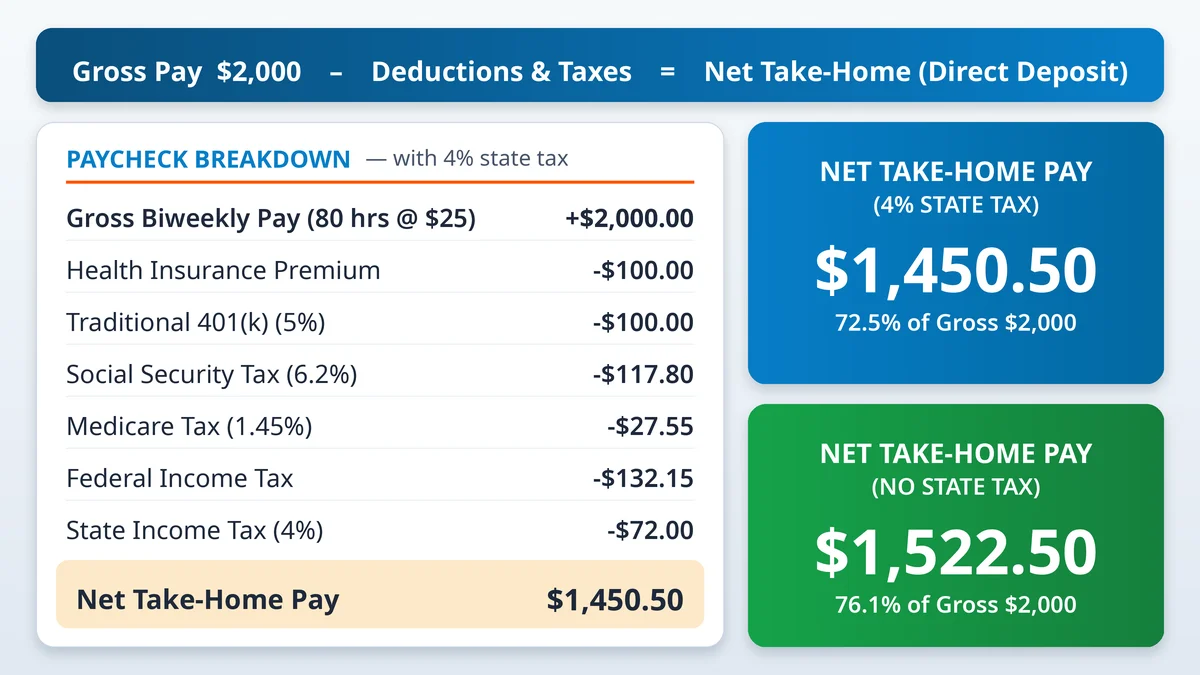
With no state income tax, our worker keeps $1,522.50 per biweekly paycheck (76.1% of gross pay). With a 4% state income tax, take-home pay is $1,450.50 per paycheck (72.5% of gross pay). Try your own numbers with our free Paycheck Calculator.
Why Bonuses and Overtime Checks Seem Taxed Higher
People often say bonuses and big overtime checks get "eaten by taxes." Two payroll quirks cause that:
- The 22% Flat Supplemental Withholding Rule: The IRS lets employers withhold a flat 22% federal tax on supplemental income (bonuses, commissions, awards). If your regular marginal bracket is only 10% or 12%, that flat 22% makes your bonus check feel like it got hammered.
- The Annualization Illusion on Overtime Checks: Payroll software figures tax on each check by pretending you earn that much all year. Pick up 20 hours of overtime and your gross check jumps from $2,000 to $3,000, and the software assumes you make $78,000 a year — so it withholds at a higher rate for that one pay cycle.
The Reality at Tax Time: Withholding is only an estimate. When you file your annual Form 1040, all your income gets added up together. If too much tax came out of your bonus or overtime checks, every overpaid dollar comes back to you as a refund.
Common Form W-4 Mistakes That Distort Your Paycheck
Your employer's payroll runs off what you put on Form W-4. Watch out for these three common mistakes:
Mistake 1: Leaving Step 2 blank when you or your spouse work multiple jobs.
If you work two jobs, or you're married filing jointly and your spouse works too, both employers assume they're your only income and apply the full standard deduction. Check the box in Step 2(c) or use the multiple jobs worksheet, or you could face a surprise tax bill in April.
Mistake 2: Claiming child tax credits twice on two separate W-4 forms.
Claim the Child Tax Credit ($2,000 per qualifying child) on only one W-4 in Step 3 — usually the highest-paying job. Splitting or doubling it across two jobs means too little tax gets withheld.
Mistake 3: Never updating your W-4 after life transitions.
Getting married or divorced, buying a home, having a child, or picking up freelance income all change your tax picture. Review your W-4 once a year so your withholding keeps up.
How to Use the Calculator
Build the gross side of this guide's example first, then run the five tax steps on it:
- Step 1 — Enter your hourly rate and hours: the $25 rate and 80 biweekly hours from this guide's example, or your own rate and schedule.
- Step 2 — Add your pre-tax deductions: enter your health premium and 401(k) amounts ($100 and $100 per check in the example) to see how they reshape the gross figures.
- Step 3 — Read the gross breakdown: pay per check and per year before taxes — $2,000 per biweekly check in the example.
- Step 4 — Finish the net number with the 5 steps above: apply FICA to the FICA wage base, federal withholding using the bracket table, then your state tax, to land on your take-home pay.
Limitations
- The calculator does not compute your taxes: it models gross pay and deductions; your actual withholding comes from IRS Publication 15-T tables and your W-4, which is why this guide works the tax steps separately.
- One example profile: the worked numbers assume a single filer taking the standard deduction on a biweekly schedule — married filing jointly, head of household, extra jobs, or a different pay frequency all change the result.
- Withholding is an estimate, not the final tax: credits, other income, and adjustments settle on your annual return, so a perfectly calculated paycheck can still end in a refund or a balance due.
- State and local rules vary widely: some states do not follow the federal treatment of pre-tax deductions, and local taxes (such as New York City's) stack on top of state tax.
- FICA has edges the example never reaches: Social Security stops at the $184,500 wage base for 2026, and the 0.9% Additional Medicare Tax begins above $200,000 — neither appears in a $52,000 example.
- Post-tax items sit outside the five steps: Roth contributions, garnishments, and union dues come out after taxes and are not modeled in the framework above.
Frequently Asked Questions About Paycheck Taxes
How do I calculate the taxes taken out of my paycheck?
Start with your gross pay for the period, then subtract your pre-tax deductions — health insurance and a traditional 401(k), for example — to get your taxable wages. Then work out FICA: Social Security is 6.2% of gross pay up to the $184,500 wage cap in 2026, and Medicare is 1.45% of all gross pay. Next comes federal income tax withholding, from IRS Publication 15-T and your Form W-4 filing status. Finally, add state and local income tax. Take all of that, plus any post-tax deductions, off your gross pay, and what's left is your take-home pay.
Does traditional 401(k) reduce Social Security and Medicare taxes?
No. Traditional 401(k) and 403(b) contributions lower the wages your federal and state income tax is figured on, but they do NOT lower your FICA taxes (Social Security and Medicare). FICA is figured on your gross wages before retirement contributions come out. Section 125 cafeteria benefits are different — employer-sponsored medical, dental, and vision premiums lower both your income taxes and your FICA taxes.
Why is my take-home pay so much less than my salary?
Your take-home pay is a good chunk lower than your salary because your employer has to hold back taxes and benefit costs from every paycheck. That usually means federal income tax withholding (10% to 22% for most workers), FICA payroll taxes (7.65% combined for Social Security and Medicare), state and local income taxes (0% to over 9%), plus health insurance premiums and retirement contributions. Put together, those lines often take 20% to 32% of your gross pay.
Will working overtime put me in a higher tax bracket and make me lose money?
No, that's a myth. The US taxes income in progressive marginal brackets. When overtime pay pushes you into a higher bracket, only the dollars above that bracket's line get taxed at the higher rate. Everything below it is still taxed at the lower rates. So working overtime always leaves you with more take-home pay overall, even if a bit more tax comes out of that one check.
Why was my bonus taxed at a higher rate than my normal paycheck?
Employers usually withhold a flat 22% federal tax on bonuses and other supplemental wages, no matter what your normal bracket is. If your usual marginal rate is only 10% or 12%, that can feel like a huge penalty on payday. But when you file your annual tax return, the bonus just joins your total taxable income for the year, and any extra withholding comes back to you as a refund.
How can I change how much tax is withheld from my paycheck?
File a new Form W-4 with your employer — you can do this at any time, not just at hiring. To reduce withholding, claim the dependents and other credits you qualify for in Step 3; to increase withholding (for example, to cover a side income), enter an extra amount per pay period in Step 4(c). Most employers apply the change within one or two pay periods. If you are unsure of the right amount, use the IRS Tax Withholding Estimator and then check the result against your next pay stub.
Key Takeaways & Paycheck Audit Checklist
Paycheck Tax Calculation Checklist
- Sequential Withholding: Taxes are figured after pre-tax benefits come off your gross pay.
- FICA Rules: Section 125 medical deductions cut your FICA taxes; 401(k) contributions don't.
- Effective vs. Marginal: Your marginal bracket only covers your top dollar — your effective federal tax rate is a good deal lower.
- W-4 Accuracy: Keep your W-4 current so you don't end up with a surprise tax bill or a needlessly big refund.
Ready to check your next paycheck or model a raise? Use our free Paycheck Calculator, work out extra shift pay with our Overtime Calculator, or switch between wages and salaries with our Hourly Wage Converter.
3 Things to Remember
- Pre-tax deductions, such as 401(k) contributions and medical premiums, lower the pay that tax is calculated on.
- FICA and federal withholding are separate lines — FICA covers Social Security and Medicare, while federal withholding follows the 2026 brackets.
- State tax is the last step and it varies by state, so the federal steps alone do not give your final take-home pay.
Methodology & Data Verification
- Basis: Pay figures are gross unless a section states take-home; tax figures use 2026 federal rules where shown.
- Method: Full formulas, baselines, and rounding rules are on our calculation methodology page.
- Coverage: U.S. federal rules; state and local rules vary and are not included.
- Review: Last updated November 3, 2026.
- Disclaimer: Estimates for planning only — not tax or legal advice.