

Quick Answer
No federal law defines full-time work at 40 hours. The health coverage law counts 30 hours, labor statistics counts 35, and most employers use 40.
Ask how many hours a week counts as full-time and you'll get a confident answer, 40, that no federal law actually contains. The Fair Labor Standards Act, the main U.S. wage law, does not define full-time employment at all. Open a different rulebook and full-time is 30 hours (health coverage law), 35 hours (labor statistics), or 40 hours (most employers' policy). Here's what each standard means, who it applies to, and what your schedule means for your pay and benefits.
The label controls real money: whether your employer has to offer you health insurance, whether you earn paid time off and retirement benefits, and how a salary converts into an hourly rate. Two people working identical 32-hour weeks can hold different statuses at different companies, and both setups can be entirely lawful.
Working more than 40 hours?
Your full-time label doesn't decide overtime. Your hours do. Estimate your overtime pay with the overtime calculator.
The Short Answer: Four Different Numbers
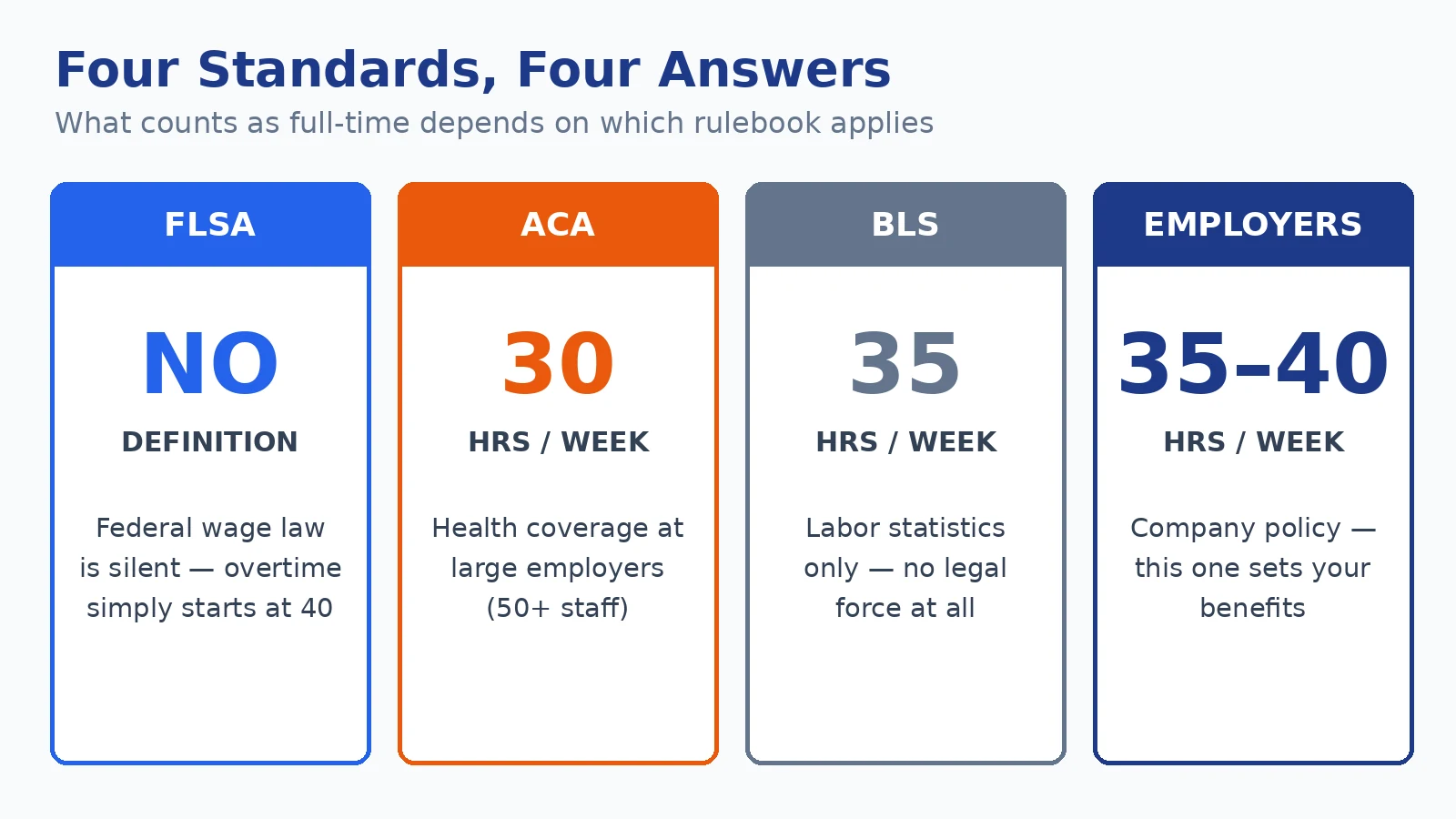
"Full-time" has four answers in the United States, and each one is right in its own context:
| Standard | Full-Time Is | What It Controls |
|---|---|---|
| FLSA (federal wage law) | Not defined | Minimum wage and overtime only |
| ACA (health coverage law) | 30 hrs/week average | Whether a large employer must offer you health insurance |
| BLS (labor statistics) | 35+ hrs/week | Government statistics — nothing legal |
| Most employers (company policy) | 35–40 hrs/week | Your PTO, retirement plan, and other company benefits |
Below, we take each standard in turn, then show what the different schedules pay over a full year.
The FLSA: No Definition at All
The Fair Labor Standards Act sets the federal minimum wage, overtime rules, and recordkeeping requirements, and says nothing about full-time or part-time status. The U.S. Department of Labor puts it plainly in its official guidance: "The FLSA does not define full-time employment or part-time employment. This is a matter generally to be determined by the employer." The same guidance adds that whether an employee is considered full-time or part-time doesn't change how the FLSA applies.
What the FLSA does set is the 40-hour overtime threshold: covered, non-exempt employees must receive at least one and a half times their regular rate for every hour worked beyond 40 in a single workweek. A workweek is a fixed period of 168 hours, seven consecutive 24-hour periods, and it doesn't have to start on a Monday. Overtime begins at 40, so the 40-hour mark hardened into the customary full-time schedule. But it's still an overtime trigger, not a definition. An employer may lawfully call 32 hours a week full-time, and the Department of Labor has no objection.
Put plainly, your full-time status doesn't exist under federal wage law. Your protections, minimum wage, overtime, and the rest, follow the hours you actually work and your exempt or non-exempt classification, never the label on your offer letter.
The ACA 30-Hour Rule (Health Coverage)
The closest thing to a federal definition comes from the Affordable Care Act. For health coverage purposes, a full-time employee is one who averages at least 30 hours of service per week, or 130 hours per calendar month. Those two figures are the same line drawn two ways: 30 hours × 52 weeks ÷ 12 months is exactly 130.
This definition has one job, deciding who must be offered health insurance, and it applies only to Applicable Large Employers (ALEs), generally those with 50 or more full-time-equivalent employees. An ALE must offer affordable, minimum-value coverage to its full-time employees or face IRS penalties (for 2026, $3,340 per full-time employee under the main penalty provision). Employers with variable schedules measure hours using either a monthly method or a look-back method that averages hours over 3 to 12 months, so a fluctuating schedule doesn't switch coverage on and off week by week.
Here's what the ACA rule doesn't do: it doesn't require an employer to call you full-time for any other purpose. A 32-hour employee at a large company is entitled to a health coverage offer under the ACA while still counting as part-time for that company's PTO and retirement policies. Both classifications can be true at once.
The BLS 35-Hour Line (Statistics Only)
When government reports describe the workforce, they use the Bureau of Labor Statistics convention: employees who usually work 35 hours or more per week are full-time, and those who work 1 to 34 hours are part-time. That's where most "average full-time worker" statistics in news coverage come from.
The BLS line carries no legal force. It creates no rights, triggers no benefits, and binds no employer. It's simply a consistent yardstick for measuring the labor market: useful context when you compare your schedule with national figures, and irrelevant to what your employer owes you.
How Employers Actually Set Full-Time
With no federal definition to follow, each employer sets its own threshold in its handbook or offer letters. Here are the most common choices:
- 40 hours, the traditional standard, still the most common, matching the overtime threshold.
- 37.5 hours, five 8-hour days with an unpaid 30-minute lunch, common in offices, banks, and government.
- 35 hours, five 7-hour days, seen in some professional and public-sector roles.
- 32 hours, a growing choice, including four-day-week employers, comfortably above the ACA line.
Your employer's threshold is the one that decides whether you qualify for company benefits: paid time off accrual, retirement plan participation, life and disability insurance, and holiday pay policies. It's also where related hour-counting rules show up. Eligibility for federal family and medical leave (FMLA), for example, requires 1,250 hours worked in the previous 12 months at a covered employer, no matter how the employer labels the job. When you size up an offer, the full-time threshold in the handbook is a financial term of the job, worth as much attention as the salary.
What Your Hours Mean for Your Pay
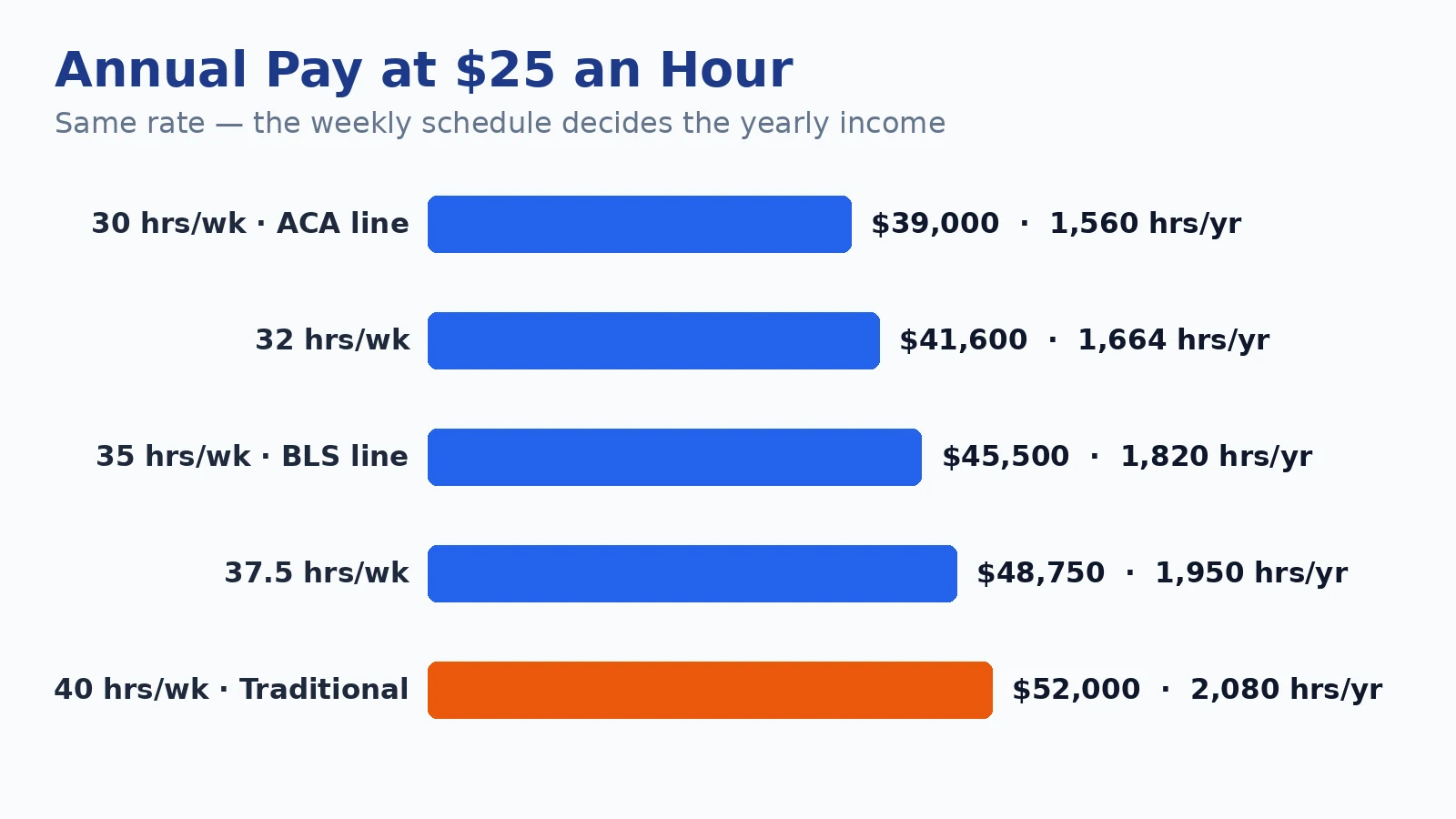
The same hourly rate is a different income at every schedule. Take $25 an hour:
| Hours per Week | Hours per Year | Annual Pay at $25/hr |
|---|---|---|
| 30 (ACA full-time line) | 1,560 | $39,000 |
| 32 | 1,664 | $41,600 |
| 35 (BLS full-time line) | 1,820 | $45,500 |
| 37.5 | 1,950 | $48,750 |
| 40 (traditional) | 2,080 | $52,000 |
The reverse conversion matters just as much. A $60,000 salary is worth $30.77 an hour on a 37.5-hour schedule (1,950 hours a year) but only $28.85 an hour if the job actually runs 40 hours a week (2,080 hours). Before you compare two salaries, convert both at the hours each job truly requires. Our guide to how many work hours are in a year covers the full calendar math, including holidays and PTO, and the hourly to salary calculator runs any combination. To weigh hours, commute, and paid time off together, run both offers through the salary comparison calculator. For what those gross figures become after deductions, see gross pay vs net pay.
Full-Time Status vs Overtime: Two Separate Questions
Since 40 is both the customary full-time schedule and the overtime threshold, the two ideas get mixed up a lot. They're independent:
- Overtime follows hours, not labels. Any non-exempt employee, full-time, part-time, or temporary, earns time-and-a-half beyond 40 hours in a workweek.
- Full-time status follows policy, not hours alone. Your benefits tier comes from your employer's threshold and the ACA's 30-hour rule, not from whether you crossed 40 this week.
- Exemption is a third question. Whether overtime applies at all also depends on the exempt/non-exempt classification, duties and salary tests, not hours or labels.
One more benefits connection: full-time schedules are also what earn paid holidays at most employers. Our holiday pay guide explains how those policies typically work and what the law does and doesn't require.
How to Use the Calculator
See what your own schedule pays over a year, in four steps:
- Step 1 — Enter your hourly rate (the $25 rate used throughout this guide, or your own) into the hourly to salary calculator.
- Step 2 — Set your real weekly hours: try the schedule you actually work, 30, 35, 37.5, or 40 hours.
- Step 3 — Keep paid weeks at 52 for a standard full-time year, then read the annual figure: $45,500 at 35 hours, $52,000 at 40.
- Step 4 — Rerun at the other thresholds: the same rate at the ACA's 30-hour line and the BLS 35-hour line shows how much of your income comes from the schedule, not the wage.
Limitations
- No calculator can assign your status: full-time has no single federal definition. The FLSA doesn't define it, the ACA's 30-hour rule covers only health coverage at large employers, and your own employer's handbook decides your benefits.
- Benefit thresholds differ by benefit: an employer can set one hour threshold for PTO and another for retirement-plan eligibility, so one "full-time" label may not describe your whole package.
- The ACA rule is narrower than it sounds: it applies only to employers with 50 or more full-time-equivalent staff, and only to the offer of health coverage, not to pay, leave, or other benefits.
- Annual figures assume 52 fully paid weeks: unpaid leave, seasonal schedules, and gaps between jobs all pull the real annual total below the converted figure.
- Status is not overtime: whether you're owed time-and-a-half depends on hours worked past 40 in a workweek and on exempt status, never on the full-time or part-time label.
- Other rules use their own hour counts: programs like FMLA leave (1,250 hours in 12 months) and some state paid-leave laws use separate tests that this guide's four standards don't capture.
Frequently Asked Questions
Short answers to the questions readers ask most about full-time hours.
How many hours a week is considered full-time?
There's no single legal answer. The Fair Labor Standards Act (FLSA) doesn't define full-time at all. It leaves that call to employers. The Affordable Care Act counts 30 hours a week as full-time for health coverage at large employers, the Bureau of Labor Statistics counts 35 or more hours for its statistics, and most employers set their own full-time threshold at 35 to 40 hours. When it comes to your benefits, your employer's policy is the definition that counts.
Is 32 hours a week full-time?
It can be. Under the ACA, 32 hours a week counts as full-time, since the threshold is an average of 30 hours, so a large employer has to offer you health coverage. For company benefits like PTO and retirement plans, it comes down to your employer's own definition: some companies set full-time at 32 hours, while others want 35 or 40. Check your employee handbook or offer letter to see which threshold applies to you.
Is 40 hours a week legally required to be full-time?
No. No federal law defines full-time as 40 hours. The 40-hour figure in the FLSA is the overtime threshold: non-exempt employees must be paid at least time-and-a-half for hours worked beyond 40 in a single workweek. Overtime starts at 40, so the 40-hour week became the usual full-time schedule. But that's a custom and an overtime rule, not a legal definition of full-time work.
How many hours a week is part-time?
Part-time has no federal legal definition either. The Bureau of Labor Statistics classifies anyone working 1 to 34 hours a week as part-time for statistical purposes. In practice, part-time usually means fewer than 30 to 35 hours a week, and part-time roles are less likely to come with benefits like health coverage, PTO, and retirement plans, although the ACA still requires large employers to offer health coverage from 30 hours a week.
Does being called part-time change your overtime rights?
No. Overtime rights under the FLSA depend on the hours you actually work and on whether your job is exempt, never on the full-time or part-time label. A part-time employee scheduled for 25 hours who works 45 hours in a week is owed overtime pay for the 5 hours beyond 40, at the same time-and-a-half rate as any full-time employee. Employers can't take overtime rights away by changing a job title or classification label.
How many hours a year is full-time?
At the standard 40 hours a week, full-time is 2,080 hours a year (40 × 52). Other common schedules give different totals: 37.5 hours a week is 1,950 hours a year, 35 hours is 1,820, and the ACA's 30-hour line is 1,560. These annual figures are what turn an hourly rate into a salary. $25 an hour is $52,000 a year at 40 hours a week, but $45,500 at 35 hours.
Key Takeaways & Action Plan
What to Remember
- No federal law defines full-time. The FLSA leaves it to employers, and 40 hours is only the overtime threshold.
- For health coverage, 30 hours is full-time at large employers (50+ staff) under the ACA, even if your company calls you part-time.
- Your handbook holds your answer: most employers set full-time at 35–40 hours, and that threshold controls PTO and retirement benefits.
- Hours decide income: at $25 an hour, a 35-hour week pays $45,500 a year and a 40-hour week pays $52,000. Same rate, $6,500 apart.
- Labels never change overtime rights. Hours worked and exempt status do.
Sources & Method
We took the definitions straight from the source: the U.S. Department of Labor (FLSA guidance: full-time and part-time employment are not defined by the FLSA), the Internal Revenue Service (ACA full-time employee standard: an average of 30 hours of service per week or 130 per month, applicable to employers with 50 or more full-time-equivalent employees; 2026 employer penalty figure $3,340), and the U.S. Bureau of Labor Statistics (full-time convention: 35 or more hours per week). Annual figures use 52 weeks: hours per week × 52, and pay at the stated hourly rate before deductions.
Convert your own schedule
Put your rate and weekly hours into the hourly to salary calculator to see your annual pay at any full-time schedule.
3 Things to Remember
- The Fair Labor Standards Act, the main U.S. wage law, doesn't define full-time employment at all.
- Health coverage law (ACA) counts 30 hours; labor statistics (BLS) counts 35.
- Most employers use 40 hours as their full-time standard, but that's a policy choice, not a federal definition.
Methodology & Data Verification
- Basis: Pay figures are gross unless a section states take-home; tax figures use 2026 federal rules where shown.
- Method: Full formulas, baselines, and rounding rules are on our calculation methodology page.
- Coverage: U.S. federal rules; state and local rules vary and are not included.
- Review: Last updated October 23, 2026.
- Disclaimer: Estimates for planning only — not tax or legal advice.