

Quick Answer
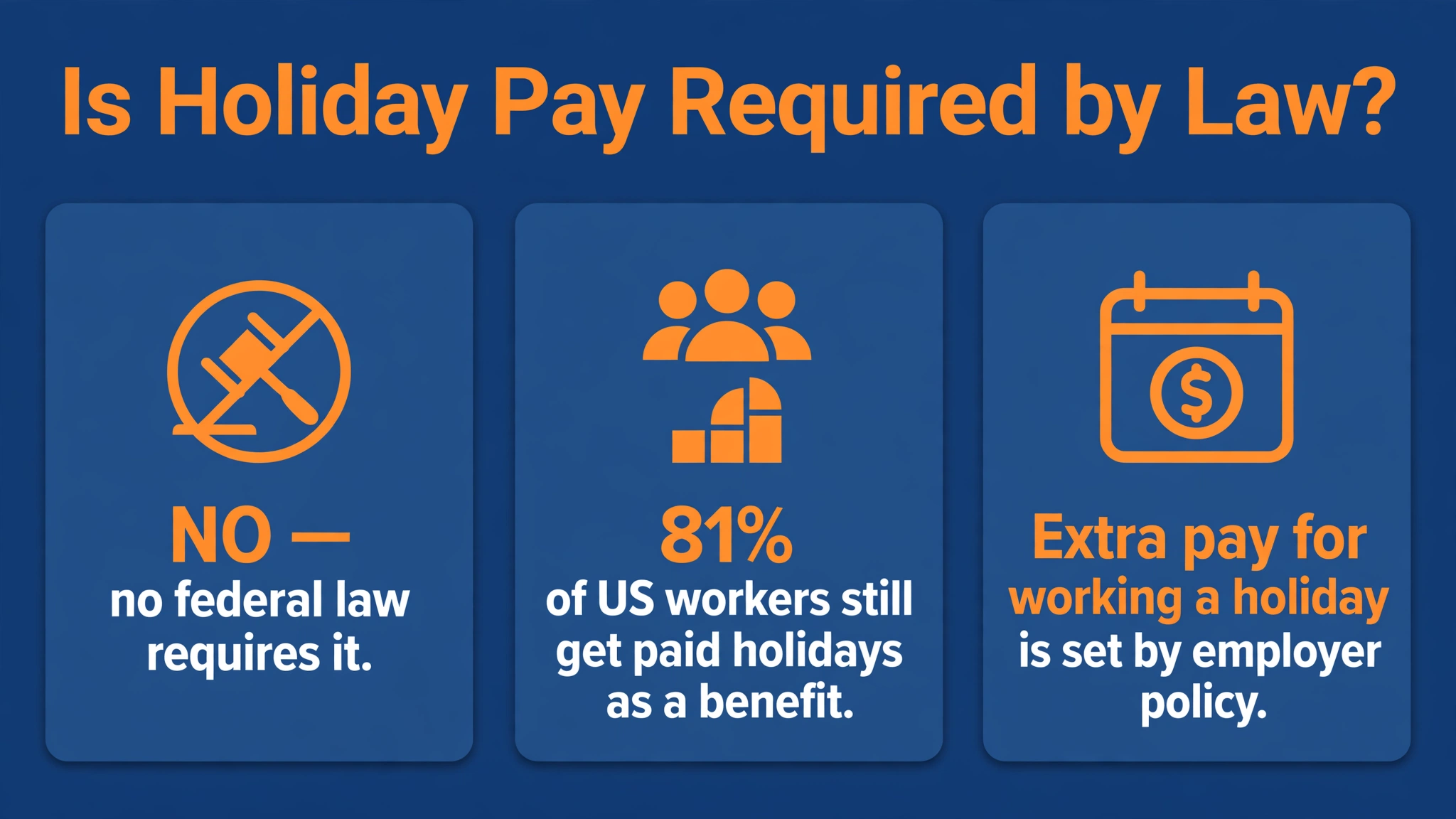
There’s no federal law that says your employer has to pay you for holidays — but most do anyway, usually as time-and-a-half or a paid day off.
Here’s the thing most people don’t know about holiday pay: no federal law requires it. Not the paid day off, not time-and-a-half on Christmas, not double time on Thanksgiving. Most workers still get something, though, because employers offer it on their own. With Thanksgiving (Thursday, November 26, 2026) and Christmas (Friday, December 25, 2026) coming up, we’ll walk through how holiday pay works, what the usual rates look like, and how to figure out what a holiday shift is worth to you.
I build the calculators at Hourly Wage Converter, and holiday pay is one of the things people ask us about most. The questions almost always start from the same wrong idea about the law — so we’ll start there, then get practical: the three forms holiday pay takes, the 2026–2027 holiday calendar with checked dates, worked examples at real pay rates, and what to do if your employer offers nothing at all.
Price Your Holiday Shift
Pop in your hourly rate and holiday hours to see what time-and-a-half or double time actually pays.
The Short Answer: Holiday Pay in 60 Seconds
- Not required by law: the Fair Labor Standards Act (FLSA) doesn’t make private employers pay for holidays you take off, or pay extra for the ones you work.
- Still very common: about 81% of private-sector workers get paid holidays, according to the Bureau of Labor Statistics. It’s a perk, not a right.
- Typical premium: when employers do pay extra for working a holiday, it’s usually time-and-a-half (1.5×) or double time (2×) your regular rate.
- Overtime is separate: the only premium federal law actually guarantees is 1.5× for hours you work past 40 in a week — and paid time off doesn’t count toward those 40 hours.
- The big 2026 dates: Thanksgiving falls on Thursday, November 26, and Christmas Day on Friday, December 25. Christmas Eve isn’t a federal holiday.
- The exceptions: federal employees get holiday premium pay by law, and a few states (Rhode Island is the best known) require premium pay for holiday work in some jobs.
Is Holiday Pay Mandatory? What the Law Actually Says
The Fair Labor Standards Act sets the minimum wage, overtime, and most pay rules for American workers — and it says nothing at all about holidays. The U.S. Department of Labor puts it plainly: the FLSA "does not require payment for time not worked, such as vacations or holidays," and holiday pay is generally a matter of agreement between an employer and an employee.
That one line catches people off guard every November and December, in three ways:
- Your employer can schedule you on any holiday — Thanksgiving, Christmas, the Fourth of July — at your regular rate, as long as your hours and pay still follow the normal minimum-wage and overtime rules.
- If your employer closes for a holiday, federal law doesn’t make them pay hourly workers for that day. Your paycheck just gets smaller, unless a policy, contract, or salary arrangement says otherwise.
- Time-and-a-half on a holiday is a perk or a deal you negotiated, not a law. If your employer pays it, the promise comes from their own handbook, your offer letter, or a union contract — and the details (which holidays, which roles, how much) are whatever that document says.
A couple of groups sit outside this rule. Federal government employees get paid holidays and premium pay for holiday work under federal law. Workers on certain federal contracts (under the Service Contract Act or Davis-Bacon Act) can have holiday terms written into their contract’s wage determination. And at the state level, mandates are rare but real: Rhode Island, for example, requires most employers to pay time-and-a-half for work on Sundays and holidays. Everywhere else, the handbook is the rulebook — so read it.
How Holiday Pay Works: The Three Forms
When people say "holiday pay," they usually mean one of three different things — and it matters which one your employer offers, because they pay out very differently.
1. Paid time off on the holiday
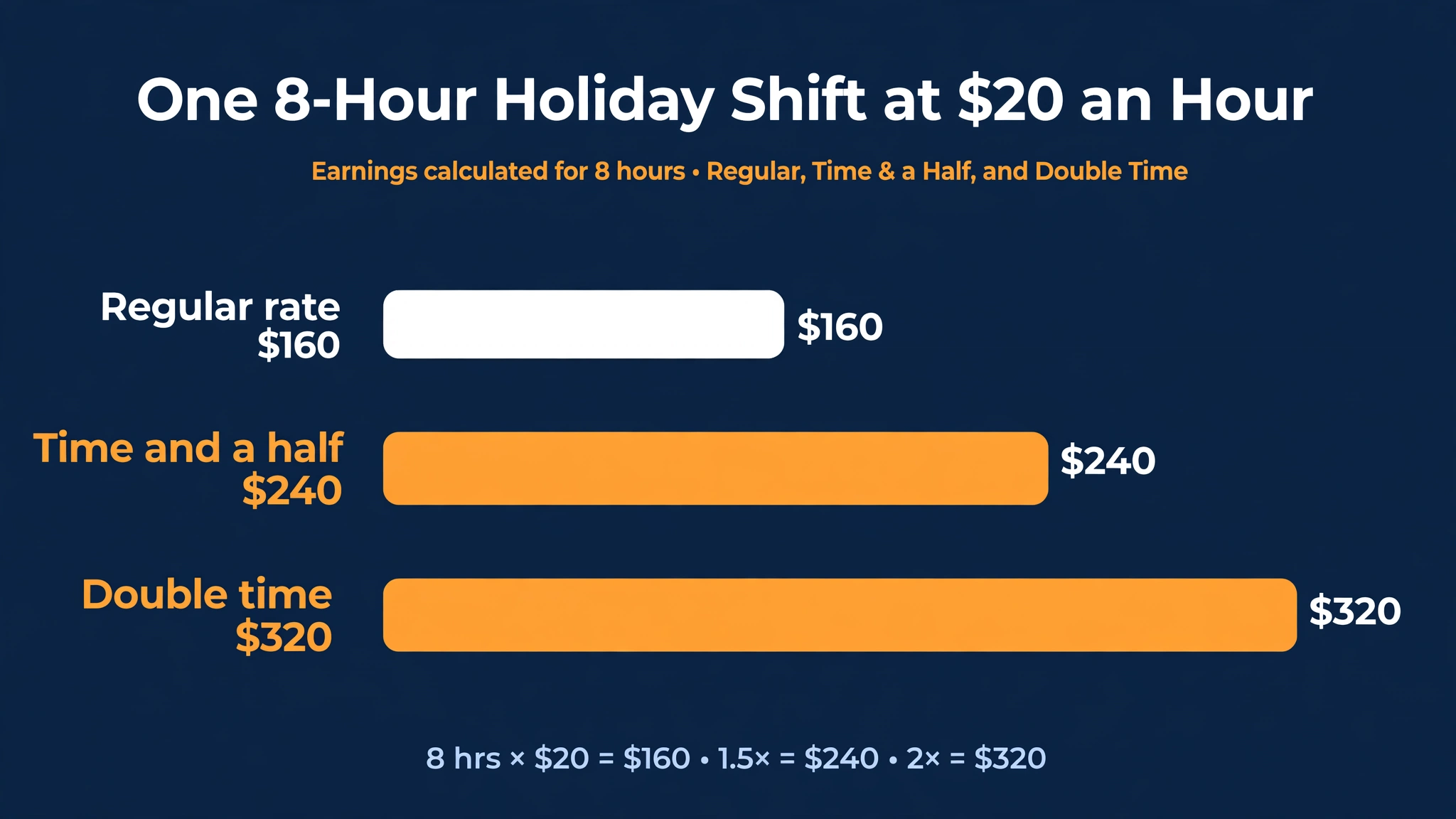
This is the most common one: the business closes (or your department does), you stay home, and you still get paid your normal wages for the day. At $20 an hour on an 8-hour schedule, one paid holiday is worth $160 without you working a minute. If you’re salaried, it just looks like your paycheck carrying on as usual.
2. A premium rate for working the holiday
If the business stays open and you work, lots of employers pay a premium — on top of the day off, or instead of it. The usual multipliers are time-and-a-half (1.5×) and double time (2×). Some employers stack the premium on a paid day off you’ve banked; most pay one or the other. Your policy decides, which is how two people doing the same job at different companies can earn $160 or $320 for the same Christmas shift.
3. A floating holiday
Some employers hand out one or more "floating holidays" — paid days you can take whenever you choose — instead of, or on top of, fixed company holidays. They’re common in workplaces where people observe different holidays, and they’re the usual fix when a fixed holiday lands on your scheduled day off.
How holiday pay interacts with overtime
This is where paychecks get confusing, so hold on to one rule: only hours you actually work count toward the 40-hour overtime threshold. Say that in Christmas week you work Monday to Thursday (32 hours), take Friday — Christmas Day — as a paid holiday (8 hours), and your paycheck shows 40 hours. You still haven’t earned any overtime, because only 32 of those hours were worked. Now say you work the Friday holiday too: that’s 40 worked hours. Work Saturday as well and you hit 48 worked hours, so 8 hours have to be paid at 1.5× under the FLSA — whatever holiday premium is in play. One catch: an employer can usually count a voluntary holiday premium toward the overtime it owes, so premium and overtime don’t always stack. For the full breakdown, see our step-by-step overtime pay guide and our explainer on the 2026 overtime tax deduction.
Upcoming Holidays: Late 2026 and the 2027 Federal Calendar
There are 11 federal holidays. Private employers don’t have to observe any of them — but most company holiday schedules are built from this list, so it’s probably the calendar your own policy follows. The dates and weekdays below are checked for 2026 and 2027.
| Holiday | Date | Federal holiday? |
|---|---|---|
| Veterans Day | Wednesday, November 11, 2026 | Yes |
| Thanksgiving Day | Thursday, November 26, 2026 | Yes |
| Day after Thanksgiving | Friday, November 27, 2026 | No — many employers close anyway |
| Christmas Eve | Thursday, December 24, 2026 | No |
| Christmas Day | Friday, December 25, 2026 | Yes |
| New Year's Day | Friday, January 1, 2027 | Yes |
Here’s the full 2027 federal list: New Year’s Day (Friday, January 1), Martin Luther King Jr. Day (Monday, January 18), Presidents Day (Monday, February 15), Memorial Day (Monday, May 31), Juneteenth (Saturday, June 19 — observed Friday, June 18), Independence Day (Sunday, July 4 — observed Monday, July 5), Labor Day (Monday, September 6), Columbus Day (Monday, October 11), Veterans Day (Thursday, November 11), Thanksgiving (Thursday, November 25), and Christmas Day (Saturday, December 25 — observed Friday, December 24). "Observed" dates are the days federal offices close when a holiday falls on a weekend — plenty of private employers follow the same pattern.

How to Calculate Holiday Pay (Worked Examples)
Once you know your multiplier, the math is easy. Here’s the formula:
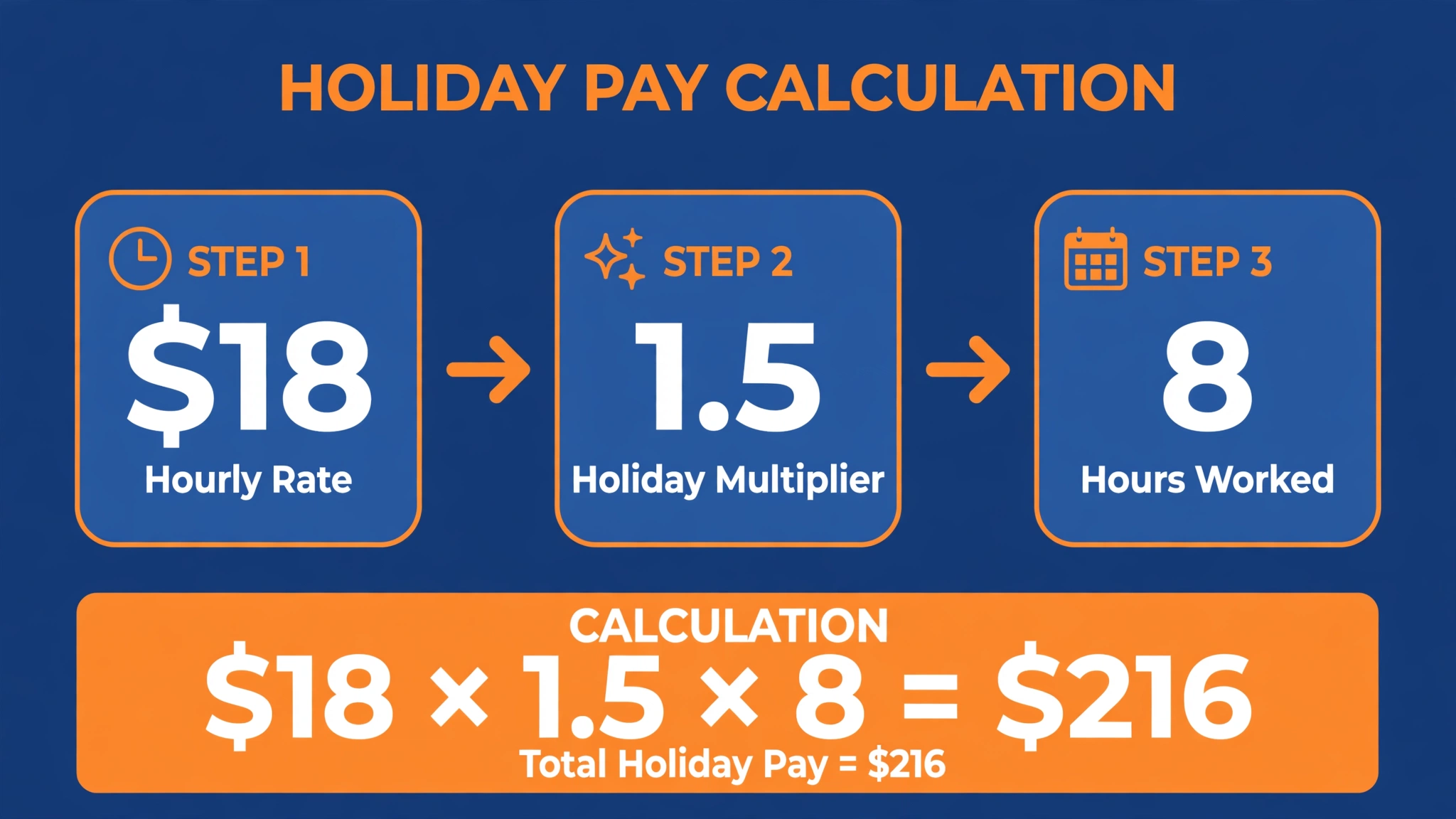
Holiday pay = hourly rate × multiplier × holiday hours worked (for a premium), or hourly rate × scheduled hours (for a paid day off).
Example 1: Time-and-a-half on Thanksgiving
Say you earn $18 an hour and work an 8-hour Thanksgiving shift at time-and-a-half. Your premium rate is $18 × 1.5 = $27 an hour, so the shift pays $27 × 8 = $216. That same shift at your regular rate would pay $144 — so the holiday premium puts an extra $72 in your day. (Our guide to whether premium pay is taxed at a higher rate explains why the bigger check can look over-taxed, and why it evens out at filing time.)
Example 2: Double time on Christmas
Say you earn $25 an hour, and your employer pays double time for Christmas Day. An 8-hour shift pays $25 × 2 × 8 = $400, against $200 on a normal day. If your employer gives you the day off paid instead, the day is still worth $200 — without working at all.
Example 3: What a paid holiday is worth on salary
Salaried workers rarely see holiday pay as a line item on a pay stub, but it’s worth real money. On a $62,400 salary, the standard daily rate is $62,400 ÷ 260 workdays (52 weeks × 5 days) = $240 a day. Eleven paid holidays a year are worth about $2,640 of your pay — something to keep in mind when you’re comparing job offers with different holiday schedules.
Example 4: Part-time proration
Say you work 24 hours a week at $16 an hour, and your employer prorates holiday pay to match your schedule. Your share is 24 ÷ 40 = 60%, so an 8-hour holiday pays 4.8 hours: 4.8 × $16 = $76.80. Not every employer prorates — some pay part-timers the full day, some pay nothing — but proration is the most common middle ground.
Who Gets Holiday Pay — and Who Usually Does Not
- Salaried full-time employees: the most likely to get the full package — paid holidays off, and often a premium or a substitute day if they have to work one.
- Hourly full-time employees: usually get paid holidays once any probation period in the handbook is done; retail, healthcare, hospitality, and logistics often add 1.5× or 2× for working them, because the place has to stay staffed.
- Part-time employees: the most mixed group — prorated pay is common, full pay happens, and no pay is perfectly legal. The handbook decides.
- Temporary, seasonal, and gig workers: usually no holiday pay at all. Independent contractors sit outside employee benefit policies entirely (and outside the FLSA’s employee protections).
- Federal employees and many union members: holiday terms are set by law or by the union contract — usually the most generous, and the most clearly spelled out.
One thing to watch: lots of employers make you work your scheduled shift before and after a holiday to qualify for the paid day — a rule aimed at unexcused long weekends. It’s legal, it’s common, and it’s exactly the kind of detail buried on a handbook page nobody reads until December.
If Your Employer Does Not Offer Holiday Pay
First, make sure it’s actually true. Holiday terms hide in three places: the employee handbook, your offer letter or contract, and any union agreement. If a document promises a premium or a paid day and your paycheck doesn’t show it, that’s a promise you can hold them to — show payroll the document and ask for a correction in writing.
If the policy genuinely offers nothing, you still have a few options. Ask about a floating holiday or shift swap — managers say yes to those far more often than they say yes to cash. If you’re comparing job offers, factor the holiday schedule in: eleven paid holidays are worth roughly 4% of a salary, which can quietly beat a slightly higher offer with none. And check your state labor department: a few states have premium-pay or reporting rules for certain industries, and state law can give you rights federal law doesn’t.
One hard truth before we wrap up: in most states, refusing a scheduled holiday shift has no special federal protection — it’s treated like refusing any other shift. If you can’t work a holiday, bring it up early and in writing. A swap arranged in October is a request; the same ask on December 23rd is a problem.
How to Use the Calculator
Here’s how to price your own holiday shift in four steps:
- Step 1 — Put your hourly rate (the $18 rate from Example 1, or your own) into the overtime calculator.
- Step 2 — Enter your hours: your regular weekly hours, with the holiday hours you work entered as overtime hours.
- Step 3 — Set your employer’s multiplier: 1.5 for time-and-a-half or 2.0 for double time, whichever one your handbook promises.
- Step 4 — Read the overtime line: that’s what the holiday hours pay at the premium — $216 for an 8-hour shift at $18 and 1.5×, against $144 at the regular rate.
Limitations
- The calculator can’t tell you what you’re owed: holiday pay comes from your employer’s policy, contract, or union agreement — no federal law requires it, so the tool prices a shift. It doesn’t prove you have a right to be paid for one.
- Only worked hours count toward overtime: paid holiday hours you take off don’t move you toward the 40-hour threshold, so a week with a paid holiday in it can pay less overtime than the same paid hours would suggest.
- Premium and overtime don’t always stack: an employer can usually count a voluntary holiday premium toward overtime it owes, so the combined figure can come out lower than the two premiums added together.
- Eligibility rules vary by employer: probation periods, prorating for part-time schedules, and work-the-shift-before-and-after rules can all change what a holiday actually pays you.
- State rules are the exception, not the norm: a few states (Rhode Island is the best known) require premium pay for some holiday work; most take the same hands-off approach as the federal rules described here.
- Gross pay only: the examples and the calculator show pay before taxes and deductions — what actually lands in your account for the holiday shift will be smaller.
Frequently Asked Questions About Holiday Pay
Here are the six questions readers ask us most — each one also appears in the page’s structured data.
Is holiday pay mandatory in the US?
No. No federal law makes private employers pay holiday pay. The Fair Labor Standards Act (FLSA) treats holidays like ordinary workdays: your employer doesn’t have to give you the day off, pay you for a day you don’t work, or pay a premium for working one. Whether you get holiday pay comes down to your employer’s policy, your employment contract, or a union agreement. Federal government employees are the main exception, and a few state rules — Rhode Island is the best known — require premium pay for holiday work in some jobs.
How much is time and a half on $18 an hour?
Time and a half on $18 an hour is $27 an hour: $18 × 1.5 = $27. An 8-hour holiday shift at that rate pays $216, against $144 at your regular rate — a $72 premium for the day. You can run your own rate and hours through our overtime calculator to get your exact number.
Do part-time employees get holiday pay?
Not by law — nothing in federal law guarantees holiday pay to part-time or full-time staff. Plenty of employers do offer it to part-time workers, prorated to their schedule. A common formula pays the share of the holiday that matches your hours: if you work 24 hours a week (60% of a 40-hour schedule), you might get 60% of the full-time benefit — 4.8 hours of holiday pay instead of 8. Your employee handbook is where the actual rule lives.
What if a holiday falls on my day off?
Federal law gives you no right to a substitute day or extra pay when a holiday lands on your scheduled day off. Plenty of employers offer an alternate day off anyway (sometimes called a floating holiday), especially for salaried staff — but that’s a policy choice, not a legal requirement. Check your handbook or ask HR before the holiday, not after.
Is Christmas Eve a paid holiday?
Christmas Eve — Thursday, December 24 in 2026 — isn’t a federal holiday, so there’s no general right to pay for it. Some employers close early, give the full day, or treat it as a bonus holiday; others run a normal schedule. Christmas Day itself (Friday, December 25, 2026) is a federal holiday, though even then, private employers aren’t required by federal law to close or pay a premium.
Does holiday pay count toward overtime?
Only hours you actually work count toward the 40-hour overtime threshold. Paid holiday hours you took off don’t count. If you work on the holiday, those hours count like any others — and once your worked hours pass 40 in a workweek, overtime at 1.5× your regular rate applies to every hour over 40. A holiday premium your employer pays voluntarily can usually be counted toward overtime they owe, so the two don’t always stack on top of each other.
Key Takeaways & Action Plan
- No law guarantees it: federal law doesn’t require holiday pay — for most workers, the employee handbook is the document that matters. Read yours before the holidays, not after.
-
Know your multiplier: 1.5× and 2× are your employer’s choice, and only hours you actually work count toward overtime’s 40-hour line. -
Do the math before you volunteer: an 8-hour shift at $18 an hour and time-and-a-half pays $216 — run your own rate through the overtime calculator. -
Mark the calendar: Thanksgiving is Thursday, November 26, 2026, and Christmas Day is Friday, December 25 — while Christmas Eve isn’t a federal holiday at all. -
No premium? Check twice: look in your contract and your state’s rules, and ask about floating holidays — the answer is often better than you’d expect.
See the Holiday in Your Paycheck
See what your holiday hours and premium do to a full paycheck — gross pay per check, before taxes and deductions.
Calculation Methodology & Sources
The legal summary follows U.S. Department of Labor guidance on the Fair Labor Standards Act (holiday pay "is generally a matter of agreement between an employer and an employee"; the FLSA does not require payment for time not worked). The 81% figure is the Bureau of Labor Statistics estimate of private-industry workers with paid holidays. We checked the holiday dates and weekdays against the federal holiday schedule for 2026–2027, including weekend "observed" dates. The worked examples use the standard formulas from the calculation section; the salaried daily rate divides annual salary by 260 workdays (52 × 5). This article is general education, not legal or tax advice — your handbook, contract, and state rules decide what you actually get paid. To model a paycheck with holiday hours, use our Paycheck Calculator or browse the Calculator Directory.
3 Things to Remember
- The FLSA doesn’t require private employers to pay for holidays off, or to pay a premium for working one.
- It’s still very common — about 81% of private-sector workers get paid holidays, according to the Bureau of Labor Statistics.
- When employers do pay extra for working a holiday, it’s usually time-and-a-half (1.5×) or double time (2×) — and the 2026 dates are Thanksgiving, November 26, and Christmas, December 25.
Methodology & Data Verification
- Basis: Pay figures are gross unless a section states take-home; tax figures use 2026 federal rules where shown.
- Method: Full formulas, baselines, and rounding rules are on our calculation methodology page.
- Coverage: U.S. federal rules; state and local rules vary and are not included.
- Review: Last updated October 23, 2026.
- Disclaimer: Estimates for planning only — not tax or legal advice.