

Quick Answer
Full-time, $45 an hour works out to $93,600 a year gross. That's $1,800 a week and $7,800.00 a month, before taxes.
At $45.00 an hour, you're earning close to $94,000 a year full-time, well above what the typical American worker makes and not far off six figures. Maybe you're weighing an offer in specialized nursing, a skilled trade, construction management, or a consulting contract. Either way, the headline rate only tells you so much. The real questions are simpler: how much is $45 an hour annually, what actually lands in your bank account after 2026 taxes, and how far does it stretch?
Here's what makes $45 an hour interesting. It's the point where tax planning starts to matter almost as much as the rate itself. At this level, your pay reaches into the 22% federal tax bracket, state taxes can swing your take-home by thousands, and the gap between a W-2 job and a 1099 contract gets hard to ignore.
This guide walks through all of it: the pay math for every pay period, what unpaid leave and overtime do to your yearly total, 2026 federal and state taxes, a simple pre-tax retirement move that saves real money, and a 50/30/20 monthly budget that fits this income.
Calculate Your Exact $45/Hour Pay
Try your own schedule, factor in unpaid vacation weeks, and see your gross pay across all seven pay cycles. It's free.
$45 an Hour at a Glance: The Quick Answer
Work a standard full-time schedule, 40 hours a week for all 52 weeks of the year (2,080 hours), and $45 an hour comes to $93,600.00 a year before taxes and any benefit deductions.
Here's what that $93,600 looks like at each pay frequency, before anything comes out:
Where Does $45 an Hour Put You in the US Economy?
The U.S. Bureau of Labor Statistics (BLS) puts the national median wage at $24.51 an hour — $50,980 a year (May 2025). At $93,600 a year, you're well clear of that, in roughly the top 20% to 25% of individual earners nationwide. The median line sits just above where $23 an hour lands over a full year ($47,840), and our $23-an-hour guide breaks that rate down paycheck by paycheck.
In lower-cost parts of the country (the Midwest, the South, the Mountain West), $93,600 goes a long way. A household can buy a home, run two cars, invest steadily, and still handle a surprise bill without panic. Even in pricier coastal cities (Seattle, Chicago, or Washington D.C.), $45 an hour gives a single person a solid, self-sufficient footing.
The Exact Math: How $45 an Hour Converts Across Every Pay Period
Payroll runs on a simple standard: 2,080 hours in a full-time year (40 hours a week × 52 weeks). Here's how $45 an hour plays out from there:
Calculation: $45.00 × 40 hours × 52 weeks = $93,600.00 gross annual pay
| Pay Period | Calculation Formula | Gross Amount | Payroll Frequency Notes |
|---|---|---|---|
| Hourly Rate | Base contracted rate | $45.00 | Straight-time rate per hour |
| Daily (8 Hours) | $45.00 × 8 hours | $360.00 | Standard full-time day |
| Weekly | $45.00 × 40 hours | $1,800.00 | 52 pay periods per year |
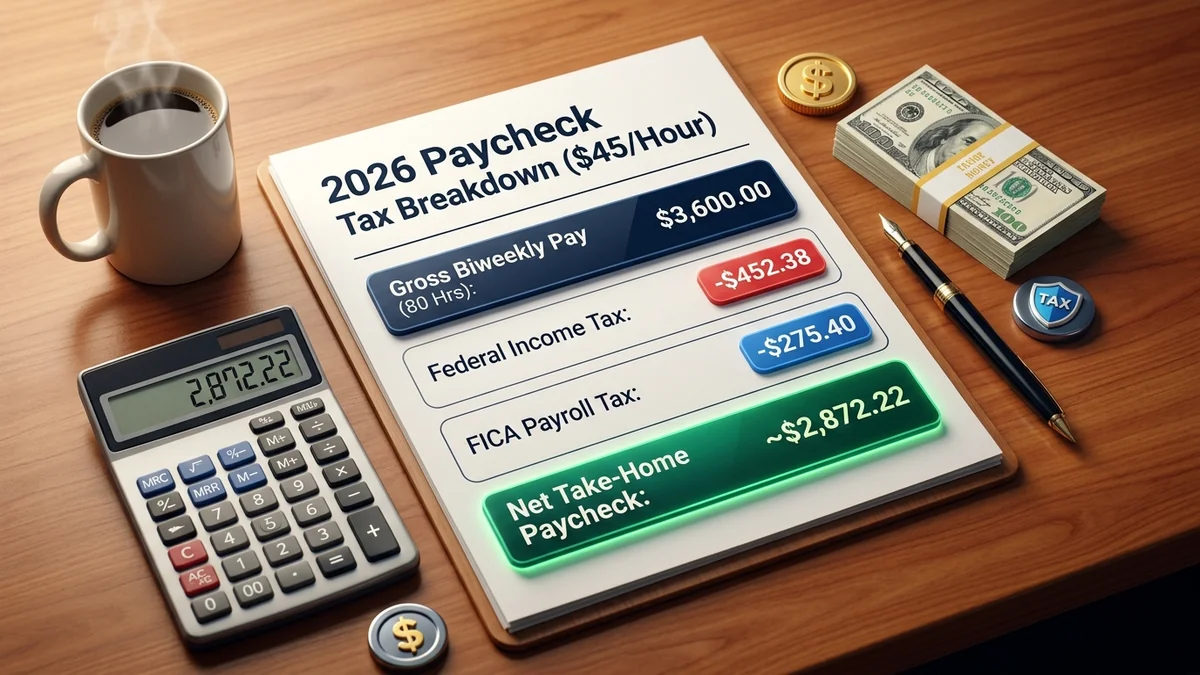
| Biweekly | $45.00 × 80 hours (or $93,600 ÷ 26) | $3,600.00 | Paid every two weeks (26 checks/year) |
| Semi-Monthly | $93,600.00 ÷ 24 | $3,900.00 | Paid twice per month (24 checks/year) |
| Monthly Average | $93,600.00 ÷ 12 | $7,800.00 | Derived from annual (not weekly × 4) |
| Quarterly | $93,600.00 ÷ 4 | $23,400.00 | 4 quarters per calendar year |
| Annual Total | $45.00 × 2,080 hours | $93,600.00 | Standard full-time benchmark |

Unpaid Leave vs. Paid Time Off (Crucial for $45/hr Contractors)
That $93,600 number assumes every one of the 52 weeks is paid. If you're a W-2 employee with paid time off, vacation days, and paid holidays, that's exactly what happens: your days off are paid at your normal rate, so your gross pay stays at $93,600.
But plenty of people earning $45 an hour work as 1099 contractors, travel nurses, or technical consultants with no paid leave at all. At this rate, each unpaid week off costs you $1,800 in gross pay (40 hours × $45):
52 Paid Weeks (Includes PTO)
40 hours/week · 0 unpaid weeks
Standard baseline compensation
50 Paid Weeks (2 Unpaid Weeks Off)
40 hours/week · 2 weeks unpaid leave
-$3,600.00 drop in gross annual pay
Take four unpaid weeks across the year, say summer travel plus the winter holidays, and you're down to 1,920 working hours and $86,400.00 gross. When you're comparing contract roles with no PTO, subtract the time off you'll actually take, so you know what the year really pays.
Overtime Math: Pushing $45/Hour Past Six Figures ($100k+)
Under the Fair Labor Standards Act (FLSA), eligible hourly workers get overtime pay at 1.5 times their regular rate (time-and-a-half) for any hours past 40 in a week.
Every hour worked past 40 earns you an additional $67.50 in gross compensation.
At $67.50 an hour for overtime, it doesn't take much extra work to pass six figures ($100,000+):
- Base Annual Earnings (40 hrs/week): 2,080 hours × $45.00 = $93,600.00
- Gap to Reach $100,000: $100,000 − $93,600 = $6,400.00
- Overtime Hours Needed: $6,400 ÷ $67.50/hour = 94.8 total overtime hours per year
- Weekly Overtime Requirement: 94.8 hours ÷ 52 weeks = just 1.83 hours per week!
Less than two extra hours a week, and you're officially a six-figure earner. Here's what steady overtime does to the yearly total:
| Weekly Schedule | Regular Weekly Pay | Overtime Weekly Pay | Total Weekly Gross | Annual Gross (52 Weeks) |
|---|---|---|---|---|
| 40 Hours (0 OT) | $1,800.00 | $0.00 | $1,800.00 | $93,600.00 |
| 44 Hours (4 hrs OT) | $1,800.00 | +$270.00 | $2,070.00 | $107,640.00 |
| 46 Hours (6 hrs OT) | $1,800.00 | +$405.00 | $2,205.00 | $114,660.00 |
| 48 Hours (8 hrs OT) | $1,800.00 | +$540.00 | $2,340.00 | $121,680.00 |
Just 4 overtime hours a week adds $270 a week ($14,040 a year), taking your salary to $107,640.00. Push it to 8 hours and your gross income reaches $121,680.00. Want to test weekend or holiday shifts? Try our free Overtime Calculator, and see how to calculate pay with an overtime calculator.
Part-Time Schedules at $45 an Hour (20, 25, 30 & 35 Hours)
Not everyone on $45 an hour works full-time. Per diem nurses, dental hygienists, and technical contractors often work shorter weeks at this rate. Here's what $45 an hour adds up to across part-time schedules over 52 paid weeks:
| Weekly Hours | Schedule Description | Weekly Gross | Monthly Average | Annual Gross Pay |
|---|---|---|---|---|
| 20 Hours / Week | Half-Time Schedule (1,040 hrs/yr) | $900.00 | $3,900.00 | $46,800.00 |
| 25 Hours / Week | Light Part-Time (1,300 hrs/yr) | $1,125.00 | $4,875.00 | $58,500.00 |
| 30 Hours / Week | Substantial Part-Time (1,560 hrs/yr) | $1,350.00 | $5,850.00 | $70,200.00 |
| 35 Hours / Week | Compressed Full-Time (1,820 hrs/yr) | $1,575.00 | $6,825.00 | $81,900.00 |
| 40 Hours / Week | Standard Full-Time (2,080 hrs/yr) | $1,800.00 | $7,800.00 | $93,600.00 |
How Much Is $45 an Hour After 2026 Taxes? (Take-Home Breakdown)
Gross pay is what you earn. Take-home pay is what actually hits your bank account. At $93,600 a year, your income reaches into the 22% marginal federal tax bracket. Here's an example 2026 tax breakdown for a single filer taking the standard deduction (these are estimates based on the assumptions shown, not tax advice):
1. Mandatory 2026 Federal Income Tax & FICA Breakdown
- Gross Annual Income: $93,600.00
- 2026 Standard Deduction (Single Filer): $16,100.00
- Taxable Income: $93,600.00 − $16,100.00 = $77,500.00
- 2026 Federal Income Tax Calculation (Progressive Brackets):
- 10% Bracket on the first $12,400.00 = $1,240.00
- 12% Bracket on $12,401 to $50,400 ($38,000.00) = $4,560.00
- 22% Bracket on remaining $27,100.00 ($77,500 − $50,400) = $5,962.00
- Total 2026 Federal Income Tax: $1,240.00 + $4,560.00 + $5,962.00 = $11,762.00
- Effective Federal Income Tax Rate: $11,762.00 ÷ $93,600.00 = ~12.57%
- Mandatory FICA Payroll Taxes (7.65% on full gross):
- Social Security (6.2%): $93,600.00 × 6.2% = $5,803.20
- Medicare (1.45%): $93,600.00 × 1.45% = $1,357.20
- Total FICA Withholdings: $7,160.40
- Total Mandatory Federal Withholdings (Income Tax + FICA): $11,762.00 + $7,160.40 = $18,922.40
Marginal Rate vs. Effective Rate: Understanding the 22% Bracket
Landing in the 22% tax bracket does not mean all your income gets taxed at 22%. Only the dollars above $50,400 of taxable income are taxed at 22%. Your effective federal income tax rate is just 12.57%.
2. State Tax Variations & Net Take-Home Pay
State tax is where take-home pay really starts to differ at this income level. Here's how yearly, monthly, and biweekly net pay compare across three common state tax setups:
| State Tax Tier | Representative States | Annual Net Pay | Monthly Net | Biweekly Net Check |
|---|---|---|---|---|
| No State Income Tax (0%) | Texas, Florida, Washington, Tennessee, Nevada, Wyoming, Alaska, South Dakota | ~$74,677.60 | ~$6,223.00 | ~$2,872.00 |
| Moderate State Tax (~4.5%) | Illinois, Pennsylvania, North Carolina, Arizona, Indiana, Michigan, Ohio | ~$70,465.00 | ~$5,872.00 | ~$2,710.00 |
| Higher State Tax (~6.5%) | California, New York, New Jersey, Oregon, Minnesota, Massachusetts | ~$68,593.00 | ~$5,716.00 | ~$2,638.00 |
Estimates reflect 2026 federal brackets, standard deduction, and FICA for a single filer with no dependents. Learn how to verify your pay stub line by line in our guide on how to calculate taxes on a paycheck.
Smart Tax Strategy at $45/Hour: The 22% Bracket 401(k) Advantage
Your top $27,100 of taxable income is taxed at 22% federally, and that's exactly why pre-tax retirement accounts like a Traditional 401(k) or traditional IRA pay off here. Every dollar you put in comes straight off the income taxed at 22%:
Immediate Federal Tax Savings: $9,360.00 × 22% = $2,059.20 in saved taxes!
Put in $9,360 a year ($780 a month, or $360 every two weeks) and you save $2,059.20 in federal income tax right away. Your take-home pay only falls by about $5,700, but your retirement account grows by the full $9,360, since the contribution cuts your taxable income for the year (any employer match is on top of that).
W-2 Employee vs. 1099 Contractor at $45/Hour: The Self-Employment Tax Hit
Plenty of $45-an-hour roles come as 1099 contract or freelance work. One thing to get straight first: $45 an hour on a 1099 is not the same as $45 an hour on a W-2:
W-2 Employee ($45.00 / Hour)
- Employer pays 50% of FICA taxes ($7,160.40)
- Paid time off, paid holidays, and sick leave
- Subsidized group healthcare and 401(k) matching
- Overtime pay at 1.5× for eligible non-exempt roles (exempt employees are not entitled to overtime)
1099 Contractor ($45.00 / Hour)
- Must pay full 15.3% Self-Employment Tax ($13,226+)
- Zero paid time off or holiday compensation
- Must purchase private health insurance ($400–$600/mo)
- No overtime premiums; all extra hours at straight rate
Between the double FICA hit (15.3% self-employment tax), no benefits, and no paid time off, a $45-an-hour 1099 contract works out to roughly a $36.00 to $38.00 an hour W-2 job. That's why contractors usually ask for a 20% to 25% premium ($55–$60 an hour). You can compare offers side by side with our Salary Comparison Calculator.
A Realistic 50/30/20 Monthly Budget on $45 an Hour
With take-home pay averaging $5,872.00 to $6,223.00 a month, there's real room to enjoy life and still build savings. Here's how a balanced 50/30/20 budget shakes out on $45 an hour:

• Housing/Mortgage/Rent: ~$1,800 – $2,200 (Well below the 30% gross cap of $2,340)
• Utilities & Internet: ~$250 – $280
• Groceries & Household Goods: ~$450 – $500
• Transportation & Car Insurance: ~$400 – $450
• Dining Out & Socializing: ~$450 – $550
• Entertainment, Shows & Streaming: ~$150 – $200
• Fitness, Personal Care & Hobbies: ~$250 – $300
• Travel & Vacation Fund: ~$750 – $850
• Emergency Fund / Liquid Savings: ~$350 – $400
• Roth IRA / Brokerage Investing: ~$580 (Maxes $7,000 annual Roth IRA)
• Extra Principal or Goal Savings: ~$245 – $265
Home Purchase Affordability at $45/Hour: Mortgage lenders generally want principal, interest, taxes, and insurance under 28% to 30% of gross monthly income, which is about ~$2,200 to $2,340 a month here. On $93,600 a year, that usually means qualifying for a home priced between $320,000 and $360,000 with a typical 10% to 20% down payment, depending on interest rates and local property taxes.
Common Paycheck Math & Tax Mistakes on $45/Hour
These are the traps that trip people up most often at $45 an hour:
Mistake 1: Multiplying weekly pay by 4 to project monthly income ($7,200 vs. $7,800).
$1,800 a week times 4 is $7,200.00. But a year has 52 weeks, so the average month is 4.333 weeks long, and your real average monthly gross is $7,800.00. Budget on 4 weeks and you're missing $600 a month.
Mistake 2: Bracket panic—assuming moving into the 22% bracket lowers your net pay.
Tax brackets work in steps. Only the taxable income above $50,400 is taxed at 22%, so earning one more dollar always leaves you with more take-home pay, never less.
Mistake 3: Overlooking self-employment tax on 1099 consulting contracts.
Take a $45-an-hour 1099 role without planning for the 15.3% self-employment tax and the missing PTO, and the quarterly estimated tax bill will sting.
Mistake 4: Confusing biweekly (26 checks) with semi-monthly (24 checks).
Biweekly pay means $3,600.00 gross every 2 weeks. Semi-monthly means $3,900.00 gross twice a month. Both add up to $93,600 a year, but a biweekly check covers 80 hours, not half a month.
Mistake 5: Failing to optimize pre-tax retirement accounts.
Skipping the 401(k) at $45 an hour wastes real tax savings. Every pre-tax dollar you put in takes 22 cents off your federal tax bill.
How to Use the Calculator
Run your own numbers in four steps:
- Step 1 — Enter your hourly rate ($45, or the rate you are negotiating) into the hourly-to-salary calculator.
- Step 2 — Match the schedule to the offer: hours per week and paid weeks per year — a salaried-style offer with paid holidays is not the same year as hourly work with unpaid weeks.
- Step 3 — Check the receipt: the results panel shows the annual total with its weekly, biweekly, and monthly splits, so you can line it up against a salary offer.
- Step 4 — Run the comparison: enter the salary from any competing offer (divided back to an hourly figure if needed) and compare annual gross before you weigh benefits.
Limitations
- Federal-only take-home: the tax breakdown uses 2026 federal rules for a single filer with the standard deduction, where $93,600 of gross pay reaches into the 22% bracket. State and local taxes are excluded and would reduce take-home further.
- FICA applies to the full wage: at $93,600, earnings sit well below the 2026 Social Security wage base of $184,500, so the full 7.65% payroll tax applies to every dollar — there is no late-year FICA relief at this income.
- W-2 vs. 1099 is not apples-to-apples: the contractor comparison in this guide cannot price everything an employee rate quietly includes — the employer share of payroll taxes, unemployment insurance, and benefits a contractor must fund alone.
- Full-year, full-time assumption: the $93,600 headline assumes 40 paid hours for all 52 weeks. A mid-year start, unpaid leave, or a four-day schedule produces a different year.
- Overtime eligibility narrows at this level: many roles paying $45 an hour are exempt, so the overtime scenarios only apply if your role is genuinely non-exempt and the hours are worked.
- Estimates, not tax advice: retirement contributions, credits, and a second income can move your real liability well away from this single-filer sketch.
Frequently Asked Questions About $45 an Hour Annually
How much is $45 an hour annually?
Work 40 hours a week for all 52 weeks, and $45 an hour adds up to about $93,600 a year before taxes. That's 2,080 hours at $45. Take 2 weeks off without pay, though, and you're down to 50 paid weeks, which puts your gross pay at $90,000.
How much is $45 an hour per month?
On a 40-hour week, $45 an hour averages $7,800.00 a month before taxes, which is just $93,600 divided by 12. Don't make the classic mistake of multiplying your $1,800 weekly pay by 4. That gives you $7,200, and you'd be shorting yourself by $600 a month ($7,200 across the year), because months average 4.33 weeks, not 4.
How much is $45 an hour on a biweekly paycheck?
On $45 an hour, paid every two weeks, that's 26 paychecks a year, and each one is $3,600.00 gross for 80 hours ($45 × 80). After 2026 federal income tax and FICA (7.65%), a single filer taking the standard deduction in a state with no income tax takes home about $2,872 per check.
How much is $45 an hour after taxes?
Take a single filer claiming the 2026 standard deduction ($16,100). Federal income tax comes to $11,762.00, which works out to an effective federal rate of about 12.57%, and FICA adds another $7,160.40. That leaves about $74,677.60 a year (~$6,223/month) in states with no income tax, like Texas or Florida. In moderate-tax states (~4.5%), it's about $70,465 (~$5,872/month), and in higher-tax states (~6.5%), roughly $68,593 (~$5,716/month).
How much overtime do you need at $45 an hour to make six figures ($100,000+)?
Your overtime rate at $45 an hour is $67.50 an hour ($45 × 1.5). The gap between $93,600 and $100,000 is $6,400, so you'd need 95 overtime hours over the whole year. That's under 2 hours a week (1.83 hours, to be exact). Put in 4 overtime hours a week and you add $14,040 a year, taking your gross pay to $107,640.
How much more tax does a 1099 contractor pay than a W-2 employee at $45 an hour?
A W-2 employee at $45 an hour pays 7.65% in FICA, which is $7,160.40 on $93,600, because the employer picks up the other half. A 1099 contractor pays the full 15.3% self-employment tax on 92.35% of net earnings, which comes to about $13,225 on the same $93,600 before business-expense deductions. That's roughly $6,065 more. Contractors can shrink that gap with deductible business expenses and by deducting half of their self-employment tax from income, but it's the main reason a $45 contractor rate and a $45 employee rate aren't the same thing.
Key Takeaways & Next Steps
Core Summary for $45/Hour Earners
- Annual Gross Baseline: $45 an hour works out to $93,600.00 a year on 2,080 hours (40 hours a week × 52 weeks).
- Monthly Average: That's $7,800.00 gross a month (months average 4.33 weeks, not 4).
- 2026 Net Take-Home Pay: After federal income tax ($11,762.00) and FICA ($7,160.40), take-home pay runs from ~$68,593 to ~$74,678 a year (~$5,716 to ~$6,223 a month), depending on your state.
- Overtime to Six Figures: Overtime pays $67.50 an hour, and 4 extra hours a week takes gross pay to $107,640.
- Tax Optimization: Putting 10% ($9,360) into a Traditional 401(k) saves $2,059 in federal tax right away, straight out of the 22% bracket.
Want to run your own numbers? Use the Hourly Wage Converter for your schedule, the Paycheck Calculator to check your pay stubs, or the Salary Comparison Calculator to weigh a salaried offer. They're all free.
3 Things to Remember
- Full-time gross pay is $93,600 a year, or $7,800.00 a month before taxes.
- Weekly pay × 4 understates a month — $1,800 a week × 4 gives $7,200, which is $600 a month short of the true average.
- Gross pay is not take-home pay — 2026 federal and FICA taxes still come out before you are paid.
Methodology & Data Verification
- Basis: Pay figures are gross unless a section states take-home; tax figures use 2026 federal rules where shown.
- Method: Full formulas, baselines, and rounding rules are on our calculation methodology page.
- Coverage: U.S. federal rules; state and local rules vary and are not included.
- Review: Last updated October 17, 2026.
- Disclaimer: Estimates for planning only — not tax or legal advice.