

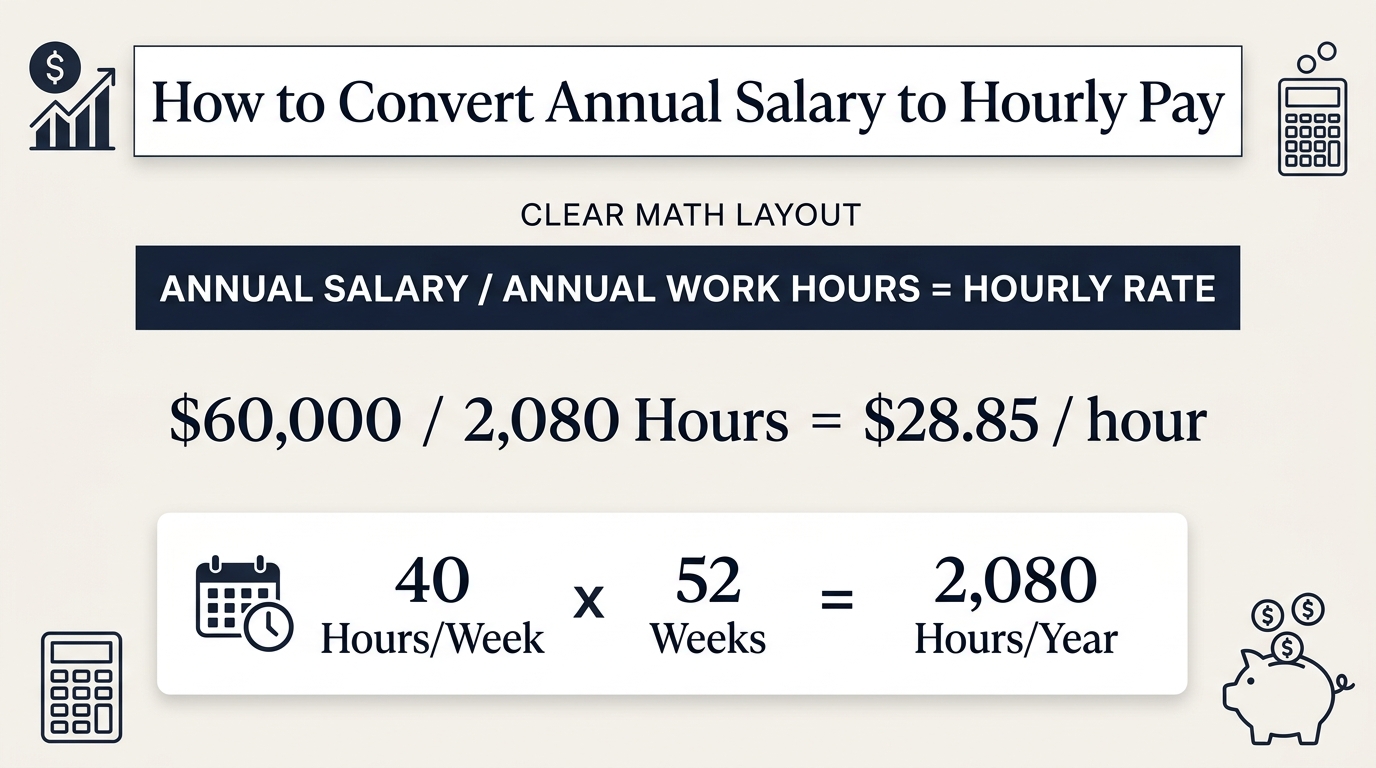
If you know your annual salary but want to understand what you are actually making per hour, you can convert your salary into an hourly rate by dividing your annual gross salary by the total number of hours you work in a year. In a standard full-time American work schedule of 40 hours per week across 52 weeks, dividing your annual salary by 2,080 hours gives you your baseline hourly equivalent. For example, an annual salary of $60,000 divided by 2,080 hours equals approximately $28.85 per hour.
However, the 2,080-hour number is only a starting benchmark. Your true hourly value changes substantially if your position requires 45 or 50 hours each week, if you take unpaid leave, or if your compensation includes bonuses and paid time off (PTO). In this comprehensive guide, we will break down the exact mathematical formulas, schedule adjustments, real-world salary comparisons, and common payroll pitfalls so you can accurately measure what your time is really worth.
Convert Your Salary to an Hourly Rate
Enter your annual salary and weekly work schedule to calculate your exact gross hourly rate, paycheck breakdown, and overtime rate instantly.
How Do You Calculate Hourly Rate From Salary?
To calculate your hourly rate from an annual salary, divide your annual gross salary by your total scheduled annual working hours.
Hourly Rate = Annual Gross Salary ÷ Annual Work Hours
Note: This calculation estimates your gross hourly equivalent before federal, state, and local income taxes, FICA withholdings, and employee deductions are subtracted.
Convert Your Salary to an Hourly Rate
Example calculation using a standard full-time employment benchmark:
The Salary-to-Hourly Formula
Converting an annual salary into an hourly wage is a straightforward mathematical division, but getting an accurate real-world figure requires clearly defining both the numerator (your compensation) and the denominator (your committed work hours).
ANNUAL WORK HOURS
= HOURLY RATE
For standard full-time salaried employment based on 40 hours per week across 52 weeks in a calendar year:
Annual Salary ÷ 2,080 Hours = Hourly Rate
When running this calculation, the two components represent:
- Annual Gross Salary (Numerator): The total contracted cash compensation paid to you by your employer over the course of 12 months, before any payroll withholdings or tax deductions.
- Annual Work Hours (Denominator): The total number of hours you are contracted to work in that same 12-month period. In North America, the traditional full-time standard is 2,080 hours (40 hours × 52 weeks).
You can also quickly test custom figures on our Hourly Wage Converter or jump straight to the dedicated Salary to Hourly Calculator.
Why 2,080 Hours Is Used to Calculate an Hourly Rate
If you have ever received an official job offer or reviewed payroll documentation, you will almost certainly see the number 2,080. Where does this specific number come from, and why is it universally accepted across payroll systems?
The math is simple:
This assumes a standard schedule of five 8-hour working days per week across all 52 calendar weeks in a year (8 × 5 × 52 = 2,080).

However, it is critical to understand that 2,080 is an accounting baseline, not a universal law of work. While payroll departments use 2,080 hours to standardize compensation packages, actual employee working schedules frequently vary:
- Unpaid Leave: If you take 2 weeks of unpaid leave during the year, you only work 50 paid weeks (2,000 hours). If your annual salary is fixed at $60,000, your effective hourly rate during active working weeks is
$60,000 ÷ 2,000 = $30.00/hour. - 35-Hour Workweeks: Many corporate, legal, and European companies consider 35 hours per week full-time. Across 52 weeks, that equals 1,820 annual hours. A $60,000 salary at 35 hours per week yields
$60,000 ÷ 1,820 = $32.97/hour. - Overtime Schedules: If an exempt salaried position requires 45 hours every week, you are working 2,340 hours per year. That same $60,000 salary drops to
$60,000 ÷ 2,340 = $25.64/hour.
How to Calculate Hourly Rate Step by Step
To calculate your true hourly rate from any annual salary without guesswork, follow this 5-step process:
Step 1: Identify Your Annual Gross Salary
Determine your total base salary for the year before deductions. Exclude discretionary bonuses unless you want to calculate your total compensation rate. Example: $60,000.
Step 2: Determine Your Average Weekly Working Hours
Count the actual hours you work in a typical week. Standard full-time is 40 hours, but enter your real schedule if you work 35, 45, or 50 hours. Example: 40 hours per week.
Step 3: Determine Your Paid Weeks Per Year
Count the number of paid weeks in the year. If you receive paid time off (PTO), count all 52 weeks. If you take unpaid time off, subtract those weeks from 52. Example: 52 paid weeks.
Step 4: Calculate Your Annual Scheduled Hours
Multiply your weekly hours by your paid weeks: Weekly Hours × Paid Weeks = Annual Hours. Example: 40 × 52 = 2,080 annual hours.
Step 5: Divide Annual Salary by Annual Scheduled Hours
Divide your annual gross salary by your total annual hours: $60,000 ÷ 2,080 = $28.846. Round to two decimal places: $28.85 per hour.
Salary-to-Hourly Examples
To help you quickly benchmark your compensation, here is what common annual salaries translate to under the standard 2,080-hour full-time schedule (40 hours per week across 52 weeks). Each figure represents gross earnings before taxes and voluntary deductions:
Annual Salary to Hourly Conversion Table
This reference chart covers 16 popular annual salary benchmarks, showing the equivalent hourly wage alongside weekly, biweekly (26 pay periods), and monthly pay equivalents:
| Annual Salary | Annual Hours | Hourly Equivalent | Weekly Pay | Biweekly Pay (26x) | Monthly Pay (12x) | Detailed Guide |
|---|---|---|---|---|---|---|
| $30,000 | 2,080 hrs | $14.42 / hr | $576.92 | $1,153.85 | $2,500.00 | Explore Guides |
| $35,000 | 2,080 hrs | $16.83 / hr | $673.08 | $1,346.15 | $2,916.67 | Explore Guides |
| $40,000 | 2,080 hrs | $19.23 / hr | $769.23 | $1,538.46 | $3,333.33 | $40k Salary Guide |
| $45,000 | 2,080 hrs | $21.63 / hr | $865.38 | $1,730.77 | $3,750.00 | Explore Guides |
| $50,000 | 2,080 hrs | $24.04 / hr | $961.54 | $1,923.08 | $4,166.67 | $50k Salary Guide |
| $55,000 | 2,080 hrs | $26.44 / hr | $1,057.69 | $2,115.38 | $4,583.33 | Explore Guides |
| $60,000 | 2,080 hrs | $28.85 / hr | $1,153.85 | $2,307.69 | $5,000.00 | $60k Salary Guide |
| $65,000 | 2,080 hrs | $31.25 / hr | $1,250.00 | $2,500.00 | $5,416.67 | Explore Guides |
| $70,000 | 2,080 hrs | $33.65 / hr | $1,346.15 | $2,692.31 | $5,833.33 | Explore Guides |
| $75,000 | 2,080 hrs | $36.06 / hr | $1,442.31 | $2,884.62 | $6,250.00 | $75k Salary Guide |
| $80,000 | 2,080 hrs | $38.46 / hr | $1,538.46 | $3,076.92 | $6,666.67 | Explore Guides |
| $90,000 | 2,080 hrs | $43.27 / hr | $1,730.77 | $3,461.54 | $7,500.00 | Explore Guides |
| $100,000 | 2,080 hrs | $48.08 / hr | $1,923.08 | $3,846.15 | $8,333.33 | $100k Salary Guide |
| $125,000 | 2,080 hrs | $60.10 / hr | $2,403.85 | $4,807.69 | $10,416.67 | Explore Guides |
| $150,000 | 2,080 hrs | $72.12 / hr | $2,884.62 | $5,769.23 | $12,500.00 | Explore Guides |
| $200,000 | 2,080 hrs | $96.15 / hr | $3,846.15 | $7,692.31 | $16,666.67 | Explore Guides |
Note: Figures assume a 40-hour workweek across 52 paid weeks per year. All conversions represent gross earnings before payroll deductions and tax withholdings.
How Different Work Schedules Change Your Hourly Rate
A crucial principle in personal finance is that an annual salary alone does not tell you your true compensation rate. Two employees earning the exact same $60,000 annual salary can have drastically different hourly values depending on the hours required by their employers.
Consider how a fixed $60,000 annual salary changes in value across different weekly work hours:
| Weekly Work Schedule | Annual Hours (52 Weeks) | Effective Hourly Rate | Difference vs 40-Hr Benchmark |
|---|---|---|---|
| 20 hrs / week (Part-Time) | 1,040 hrs | $57.69 / hr | +$28.84 / hr (+100%) |
| 30 hrs / week | 1,560 hrs | $38.46 / hr | +$9.61 / hr (+33.3%) |
| 35 hrs / week (Standard Full-Time in some sectors) | 1,820 hrs | $32.97 / hr | +$4.12 / hr (+14.3%) |
| 40 hrs / week (Standard Baseline) | 2,080 hrs | $28.85 / hr | Baseline benchmark |
| 45 hrs / week (Overtime/Extended) | 2,340 hrs | $25.64 / hr | -$3.21 / hr (-11.1%) |
| 50 hrs / week (High-Demand Salaried) | 2,600 hrs | $23.08 / hr | -$5.77 / hr (-20.0%) |
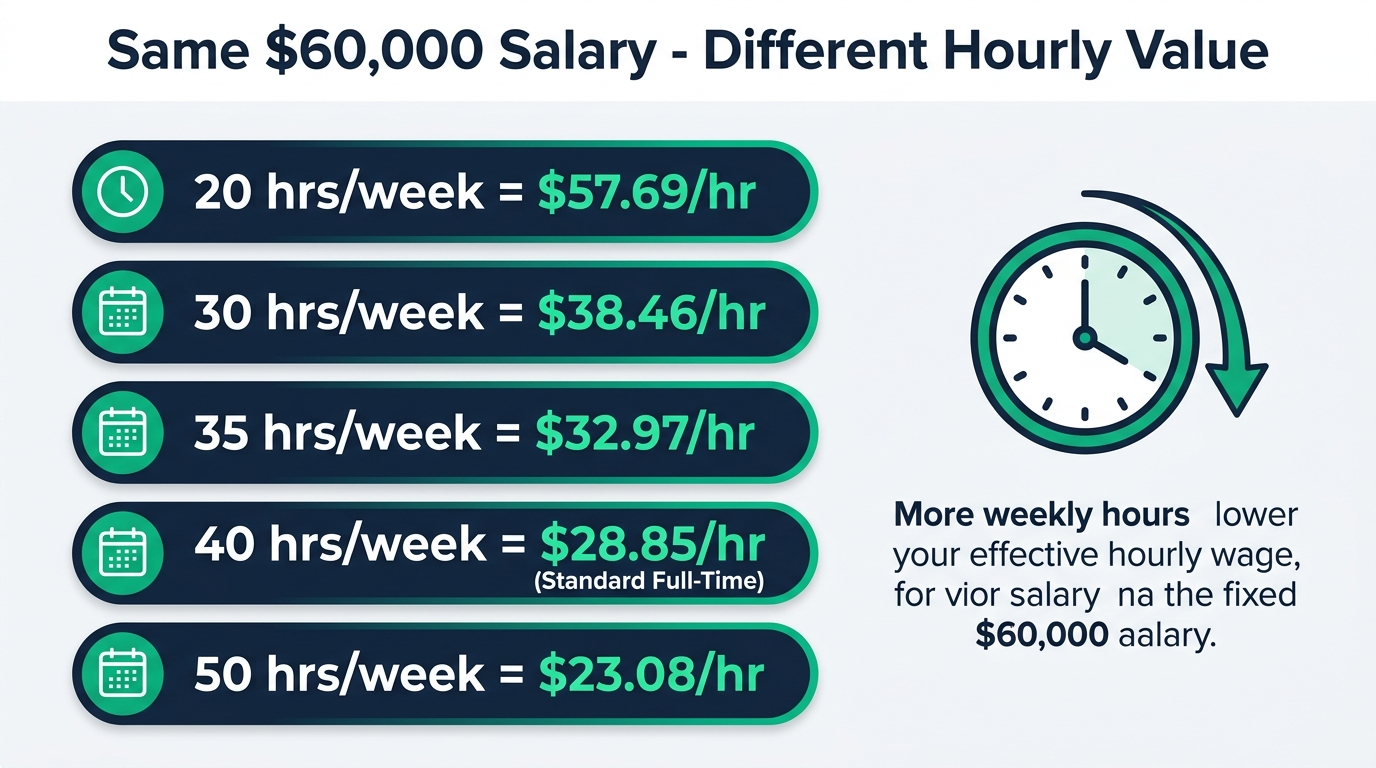
Notice the dramatic shift: if an exempt employee earning $60,000 regularly logs 50 hours each week instead of 40, their effective hourly earnings decline from $28.85 down to $23.08. You are giving your employer 520 additional hours of uncompensated labor each year—equivalent to working three full months without pay!
How Unpaid Time Off Changes Your Effective Rate
Unpaid time off creates an interesting mathematical dynamic depending on whether you are analyzing an hourly wage or a fixed annual salary:
Standard Full-Time Year
Two Weeks Unpaid Leave
If you are contracted for an annual salary of $60,000 and your agreement allows you to work only 50 weeks (for example, academic or seasonal salaried professionals), your hourly earnings while working rise from $28.85 to $30.00 per hour. Conversely, if an hourly worker takes two unpaid weeks off, their annual earnings fall from $52,000 to $50,000 as explained in our guide on how to convert hourly pay to annual salary.
How PTO and Paid Vacation Affect the Calculation
One of the most frequent points of confusion among employees is whether to subtract paid vacation days or paid time off (PTO) when converting an annual salary into an hourly rate.
Never subtract paid vacation or PTO from the standard 2,080-hour baseline when determining your salaried hourly wage. Paid time off is already funded by your employer as part of your total annual salary. When you take a paid vacation day, you receive your full paycheck as normal.
To see the difference clearly, compare the two types of leave:
- Paid Vacation / PTO: You take 3 weeks off. You still receive all 26 biweekly paychecks throughout the year. Your annual salary remains $60,000, and your standard payroll hourly rate remains $28.85 based on 2,080 paid hours.
- Unpaid Time Off: You take 3 weeks of unpaid leave. Your employer withholds pay for those 3 weeks. You only receive pay for 49 weeks. Your gross compensation drops accordingly.
How Overtime Changes the Real Value of a Salary
Under United States federal law governed by the Fair Labor Standards Act (FLSA), employees are classified as either exempt or non-exempt from overtime regulations:
- Exempt Salaried Employees: Most executive, administrative, professional, and outside sales employees who meet the salary basis and job duties tests are exempt from overtime. Regardless of whether they work 40, 50, or 60 hours in a workweek, they receive their fixed salary with no extra pay. For these workers, working additional hours directly reduces their effective hourly earnings.
- Non-Exempt Salaried Employees: Employees who do not meet the FLSA exemption criteria must receive 1.5 times their regular hourly rate for all hours worked beyond 40 in a single workweek.
If you are a non-exempt employee with a base salary of $60,000 ($28.85/hr regular rate) and work 5 overtime hours per week:
5 Extra Hours / Week = $216.40 / week
Annual Overtime Earnings = $216.40 × 52 Weeks = $11,252.80
Total Gross Annual Compensation = $60,000 + $11,252.80 = $71,252.80
To model custom overtime scenarios with time-and-a-half or double-time multipliers, use our free Overtime Calculator.
Gross Hourly Rate vs. Take-Home Hourly Rate
When you calculate that a $60,000 salary equals $28.85 per hour, it is critical to recognize that this is your gross hourly equivalent—not the actual amount that lands in your bank account every payday.
Before your paycheck is deposited, statutory and voluntary withholdings reduce your gross earnings:
- Federal Income Tax: Progressive tax brackets ranging from 10% to 37% based on your filing status and taxable income.
- State and Local Income Taxes: Ranging from 0% in states with no income tax (such as Texas, Florida, and Washington) to over 10% in states like California and New York.
- FICA Taxes: Mandatory federal payroll withholdings comprising 6.2% for Social Security (up to the annual wage cap) and 1.45% for Medicare.
- Pre-Tax Deductions: Contributions toward employer-sponsored health, dental, and vision insurance premiums, Health Savings Accounts (HSA), Flexible Spending Accounts (FSA), and traditional 401(k) or 403(b) retirement plans.
- Post-Tax Deductions: Roth 401(k) contributions, union dues, disability insurance, or wage garnishments.
On a $60,000 annual salary ($28.85 gross hourly), an employee with average federal and state taxes and modest healthcare contributions typically takes home approximately $21.50 to $23.20 per hour net. To estimate your specific net paycheck, test your numbers on our Paycheck Calculator.
Salary vs. Hourly Pay: Real-World Offer Comparison
Evaluating competing compensation packages is where understanding your hourly rate gives you a decisive advantage. A higher headline annual salary does not always equal higher compensation for your time.
Corporate Salaried Position
Flexible Professional Position

Although Offer A advertises a higher gross salary ($60,000 vs. $55,000), Offer B actually pays more per hour of your life ($30.22/hr vs. $28.85/hr) because it requires 260 fewer working hours per year. Those 260 saved hours represent over six full weeks of personal time that could be dedicated to family, freelancing, education, or rest.
When comparing job offers, always consider the complete compensation package:
- Health & Retirement Benefits: An employer offering full premium coverage and a 6% 401(k) match can easily add $8,000 to $12,000 in annual value.
- Paid Time Off (PTO): Four weeks of PTO vs two weeks represents a meaningful difference in actual working hours.
- Commute Time & Costs: A remote job saves 5 to 10 hours of unpaid commuting every week and thousands of dollars in gas, transit, and car depreciation. Compare total committed time using our Salary Comparison Calculator.
Common Salary-to-Hourly Calculation Mistakes
Avoid these six frequent payroll and calculation errors when converting your annual salary to an hourly rate:
Automatically Assuming Everyone Works 2,080 Hours
While 2,080 is the standard baseline, never blindly use it if your job requires 35, 45, or 50 hours each week. Always divide your salary by your real contracted hours to avoid misrepresenting your hourly earnings.
Confusing Paid Time Off With Unpaid Time Off
Do not deduct paid vacation, holidays, or sick leave from your annual hours. Paid time off is included in your annual salary compensation. Only deduct unpaid weeks away from work.
Treating Gross Hourly Pay as Take-Home Pay
Gross hourly equivalents do not account for taxes, Social Security, Medicare, or insurance deductions. Expect your actual take-home rate to be 20% to 30% lower than your gross calculation.
Ignoring Uncompensated Salaried Overtime
If you are an exempt salaried worker routinely working 50-hour weeks without overtime pay, your real hourly value is 20% lower than the 40-hour standard. Always calculate your effective rate based on reality.
Overlooking Overtime Eligibility Rules
Many salaried workers mistakenly believe that having a salary automatically makes them ineligible for overtime. If your job duties do not meet executive or professional exemption criteria under the FLSA, you are entitled to 1.5× overtime pay.
Evaluating Base Salary in Complete Isolation
Failing to account for health insurance, retirement matches, bonuses, and commute expenses gives you an incomplete financial picture. Total compensation matters more than base salary alone.
Find Your Exact Hourly Rate in Seconds
Do not waste time doing complex manual math on scratch paper. Enter your annual salary, adjust your weekly hours, and instantly view your hourly, weekly, biweekly, and monthly gross compensation.
Frequently Asked Questions
Here are detailed, expert answers to the most common questions regarding converting annual salary into an hourly wage:
How do I calculate my hourly rate from annual salary?
To calculate your hourly rate from an annual salary, divide your annual gross salary by the total number of hours you work in a year. For a standard full-time schedule of 40 hours per week across 52 weeks (2,080 annual hours), simply divide your annual salary by 2,080. For example, a $60,000 annual salary divided by 2,080 hours equals approximately $28.85 per hour before taxes and payroll deductions.
What is $50,000 a year per hour?
A $50,000 annual salary equals approximately $24.04 per hour based on the standard full-time baseline of 2,080 annual work hours (40 hours per week × 52 weeks). On a weekly basis, that is approximately $961.54 gross, and biweekly it equals $1,923.08 across 26 paychecks. If you work 35 hours per week (1,820 annual hours), $50,000 equals $27.47 per hour.
What is $60,000 a year per hour?
Using a standard 40-hour workweek and 52 paid weeks per year (2,080 scheduled hours), a $60,000 annual salary equals approximately $28.85 per hour. That translates to $1,153.85 per week, $2,307.69 biweekly, and an average of $5,000 per month before payroll deductions. If your schedule requires 45 hours each week (2,340 hours), your effective rate drops to $25.64 per hour.
What is $75,000 a year per hour?
A $75,000 annual salary equals approximately $36.06 per hour under the standard 2,080-hour full-time assumption (40 hours per week for 52 weeks). This equates to $1,442.31 per week, $2,884.62 biweekly across 26 pay periods, and $6,250.00 gross per month before federal, state, and local taxes.
What is $100,000 a year per hour?
A $100,000 annual salary equals approximately $48.08 per hour when working 40 hours per week across 52 weeks (2,080 hours). On a weekly schedule, this represents $1,923.08 gross, $3,846.15 every two weeks (biweekly), and $8,333.33 per month before taxes and deductions. If you work 50 hours per week (2,600 hours), that same six-figure salary equals $38.46 per hour.
Does PTO affect my hourly rate?
Paid time off (PTO)—such as paid vacation days, paid holidays, and paid sick leave—does not lower your gross annual salary or your standard salaried hourly rate because you continue to receive your full regular pay while away. However, taking unpaid time off does change the math: if you take 2 unpaid weeks and work 50 weeks instead of 52 (2,000 hours), your effective rate during active working hours increases to $30.00 per hour on a $60,000 salary ($60,000 ÷ 2,000).
Is salary-to-hourly based on gross or net income?
Standard salary-to-hourly conversions always compute gross pay equivalents before taxes and statutory deductions. Your net take-home hourly rate will be lower once federal income tax, state and local taxes, Social Security (6.2%), Medicare (1.45%), health insurance premiums, and 401(k) contributions are withheld from each paycheck.
What if I work more than 40 hours a week?
If you are an exempt salaried employee who regularly works 45 or 50 hours per week without additional compensation, your effective hourly earnings decrease because you are dividing the same fixed salary across more working hours. If you are non-exempt under the Fair Labor Standards Act (FLSA), you are legally entitled to 1.5 times your regular rate for all hours worked beyond 40 in a workweek.
How do I convert a monthly salary to an hourly rate?
To convert a monthly salary to an hourly rate, first annualize your salary by multiplying the monthly amount by 12, then divide that total by your annual scheduled hours (typically 2,080 for full-time work). Alternatively, divide your monthly salary by the average number of hours worked per month (approximately 173.33 hours for a 40-hour workweek). For example, a $5,000 monthly salary ($60,000/year) divided by 173.33 hours equals $28.85 per hour.
How do I convert a biweekly salary to an hourly rate?
To convert biweekly salary to an hourly rate, divide your gross biweekly paycheck amount by the number of hours in the pay period (typically 80 hours for a standard full-time two-week schedule). For example, a biweekly paycheck of $2,307.69 divided by 80 hours equals approximately $28.85 per hour.
Key Takeaways
Core Summary Points
- Divide Salary by Annual Hours: Your basic gross hourly rate equals your annual salary divided by your total scheduled working hours for the year.
- The 2,080 Benchmark: A standard full-time American schedule of 40 hours per week across 52 weeks totals 2,080 annual hours ($60,000 ÷ 2,080 = $28.85/hr).
- Work Hours Determine Real Value: Working 45 or 50 hours each week on a fixed salary lowers your effective hourly earnings significantly.
- PTO Is Included: Paid time off is funded as part of your annual salary; do not subtract paid vacation when determining your standard salaried hourly rate.
- Evaluate Total Compensation: When comparing job offers, calculate the effective hourly rate and factor in benefits, commute, and flexibility alongside base salary.
How We Calculate Hourly Rates
Our standard salary-to-hourly calculation divides annual gross salary by total scheduled annual hours. For full-time employees, the benchmark is 40 hours per week over 52 weeks (2,080 annual hours). Users can adjust weekly hours, paid weeks, and overtime factors to reflect nonstandard schedules. All results represent gross earnings before taxes and statutory withholdings. For complete payroll mathematics and rounding rules, see our full Calculation Methodology.