
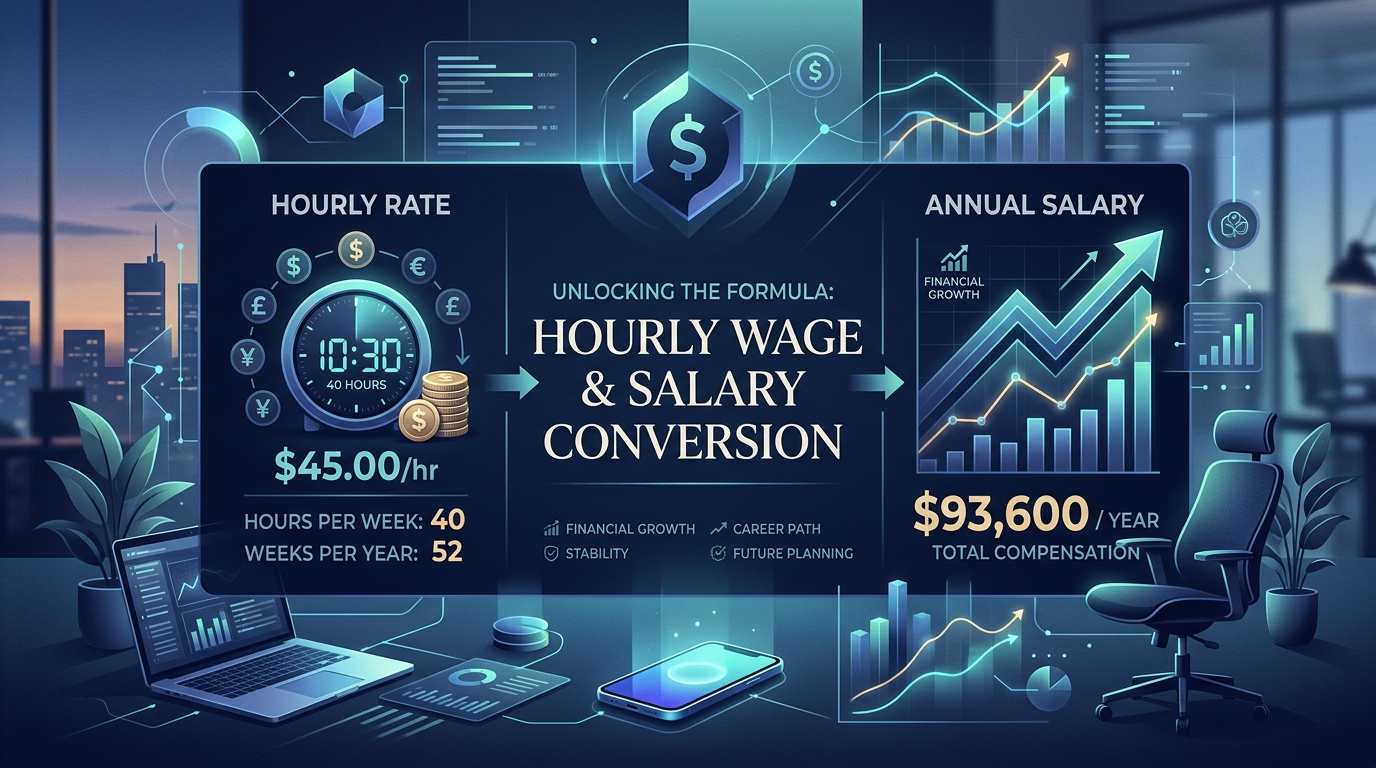
Converting an hourly wage to an annual salary is one of the most important financial calculations you will make. Whether you are reviewing a new job offer, comparing competing compensation packages, asking for a raise, or budgeting your household expenses for the year ahead, understanding how an hourly rate translates into annual earnings gives you total clarity over your financial life.
Calculate Your Annual Salary
Enter your hourly wage, hours per week, and weeks worked per year to estimate your annual salary instantly with custom overtime and leave settings.
How Do You Convert Hourly Pay to Annual Salary?
To convert hourly pay to annual salary, multiply your hourly wage by the number of hours you work each week and the number of weeks you work each year.
Annual Salary = Hourly Rate × Hours Worked Per Week × Weeks Worked Per Year
Note: This is an estimated gross-income calculation before federal, state, and local taxes, insurance, or retirement deductions are subtracted.
Calculate Your Annual Salary
See how your exact hourly wage scales across a full working year:
What Is Hourly Pay?
Before jumping into multi-tier calculations, it is essential to understand the core payroll terms used by employers, recruiters, and tax authorities:
- Hourly Wage (Hourly Rate): The fixed amount of money an employer pays you for each single hour of labor performed. For example, if you earn $25.00 for every hour on the clock, your hourly rate is $25.00.
- Hours Worked: The total number of hours logged during a pay cycle. In a standard full-time job, this is commonly 40 hours per week, but part-time schedules often range from 15 to 35 hours.
- Gross Earnings: The total amount of compensation earned before any taxes, payroll withholdings, healthcare deductions, or retirement contributions are taken out.
- Annual Salary: The total gross compensation you earn over an entire 12-month calendar year. Salaried employees typically receive a fixed annual figure regardless of minor fluctuations in weekly hours, whereas hourly workers earn directly according to recorded time.
Your annual income depends not only on your base rate of pay, but on how consistently you work throughout all 52 calendar weeks of the year. Here is the direct progression from an hourly wage to an annual salary:
The Hourly-to-Annual Salary Formula
To convert an hourly wage into an annual salary, the core mathematical equation is straightforward:
Standard Full-Time Example: $25.00 × 40 × 52 = $52,000 per year
The Standard 2,080 Hours Baseline Explained
In payroll accounting, Human Resources, and government labor statistics across North America, 2,080 hours is recognized as the standard full-time working baseline:
Therefore, a quick shortcut used by recruiters and hiring managers is simply multiplying your hourly wage by 2,080:
Hourly Rate × 2,080 = Estimated Annual Salary
For example, if you earn $30 an hour: $30 × 2,080 = $62,400 per year. Conversely, if you want to find the hourly rate behind a salary, divide by 2,080: $60,000 ÷ 2,080 = $28.85 per hour. You can test your own figures in our free Salary to Hourly Calculator.
How to Calculate Annual Salary Step by Step
Follow these five clear steps to compute your exact annual income with complete accuracy:
-
Step 1: Identify your base hourly pay rate.
Locate your regular hourly wage on your pay stub, employment contract, or job offer letter. For our working example, we will use $25.00 per hour. -
Step 2: Determine your regular weekly hours.
Determine how many hours you work during an average workweek. For standard full-time employees, this is typically 40 hours per week. Part-time employees might work 20, 25, or 30 hours. -
Step 3: Determine the number of paid weeks in the year.
A full calendar year has 52 weeks. If your job includes paid vacation, paid sick time, and paid federal holidays, you receive pay for all 52 weeks. -
Step 4: Multiply your hourly wage by weekly hours and annual weeks.
Multiply your rate by your weekly hours to get your weekly gross pay, then multiply by 52:
$25.00/hour × 40 hours/week = $1,000.00 weekly gross pay
$1,000.00 × 52 paid weeks = $52,000.00 annual gross salary -
Step 5: Adjust for unpaid time off or leave.
If your job does not offer paid time off and you take 2 weeks off during the summer or holidays, you only work 50 paid weeks:
$25.00/hour × 40 hours/week × 50 paid weeks = $50,000.00 annual gross salary
Adjusting for unpaid weeks prevents budgeting shortfalls and gives you an honest, reliable projection of your real take-home capacity.
Hourly Pay to Annual Salary Examples
To see how work schedules and hourly rates interact in real-world scenarios, let us examine three common worker profiles:
Example 1: Standard Full-Time Office Worker
Hourly Rate: $25.00 / hour
Schedule: 40 hours / week, 52 paid weeks (includes 2 weeks paid PTO).
Weekly: $1,000 | Biweekly: $2,000 | Monthly: $4,333.33
Example 2: Part-Time Retail or Service Worker
Hourly Rate: $20.00 / hour
Schedule: 25 hours / week, 50 paid weeks (2 unpaid weeks off).
Weekly: $500 | Biweekly: $1,000 | Monthly: $2,083.33
Example 3: Shift Healthcare Worker with Overtime
Base Hourly Rate: $35.00 / hour | Overtime Rate (1.5×): $52.50 / hour
Schedule: 36 regular hours + 8 overtime hours per week, 52 paid weeks.
Overtime Pay: 8 hrs × $52.50 = $420.00 / week
Total Weekly Gross: $1,680.00 × 52 weeks = $87,360 / year
Overtime hours add $21,840 annually above baseline regular earnings!
Hourly-to-Annual Salary Conversion Table
Use this comprehensive conversion table to quickly look up common hourly pay rates and their estimated annual gross equivalents based on a standard 40-hour workweek over 52 paid weeks (2,080 annual hours):
| Hourly Rate | Weekly Gross (40 hrs) | Biweekly (26 checks) | Monthly Average | Annual Gross Salary |
|---|---|---|---|---|
| $10.00 / hr | $400.00 | $800.00 | $1,733.33 | $20,800.00 |
| $12.00 / hr | $480.00 | $960.00 | $2,080.00 | $24,960.00 |
| $15.00 / hr | $600.00 | $1,200.00 | $2,600.00 | $31,200.00 |
| $18.00 / hr | $720.00 | $1,440.00 | $3,120.00 | $37,440.00 |
| $20.00 / hr | $800.00 | $1,600.00 | $3,466.67 | $41,600.00 |
| $21.00 / hr | $840.00 | $1,680.00 | $3,640.00 | $43,680.00 |
| $22.00 / hr | $880.00 | $1,760.00 | $3,813.33 | $45,760.00 |
| $24.00 / hr | $960.00 | $1,920.00 | $4,160.00 | $49,920.00 |
| $25.00 / hr | $1,000.00 | $2,000.00 | $4,333.33 | $52,000.00 |
| $26.00 / hr | $1,040.00 | $2,080.00 | $4,506.67 | $54,080.00 |
| $28.00 / hr | $1,120.00 | $2,240.00 | $4,853.33 | $58,240.00 |
| $30.00 / hr | $1,200.00 | $2,400.00 | $5,200.00 | $62,400.00 |
| $35.00 / hr | $1,400.00 | $2,800.00 | $6,066.67 | $72,800.00 |
| $40.00 / hr | $1,600.00 | $3,200.00 | $6,933.33 | $83,200.00 |
| $50.00 / hr | $2,000.00 | $4,000.00 | $8,666.67 | $104,000.00 |
| $60.00 / hr | $2,400.00 | $4,800.00 | $10,400.00 | $124,800.00 |
| $75.00 / hr | $3,000.00 | $6,000.00 | $13,000.00 | $156,000.00 |
| $100.00 / hr | $4,000.00 | $8,000.00 | $17,333.33 | $208,000.00 |
These figures assume 40 hours per week and 52 weeks per year before taxes and deductions. Want to customize your own hours? Use our interactive Hourly Wage Converter.
How Work Hours Affect Annual Salary
A common error is assuming that every employee works exactly 40 hours every week. In reality, work schedules vary substantially across industries, from part-time retail to extended manufacturing shifts. Because annual salary is directly tied to the total hours worked, even small changes in weekly hours produce massive shifts in yearly earnings.
The table below shows how the exact same $25.00 per hour rate produces vastly different annual earnings depending on scheduled weekly hours:
| Schedule Type | Hours / Week | Weeks / Year | Total Annual Hours | $25.00/hr Annual Pay |
|---|---|---|---|---|
| Part-Time (Half Time) | 20 hrs | 52 wks | 1,040 hrs | $26,000.00 |
| Part-Time (Substantial) | 30 hrs | 52 wks | 1,560 hrs | $39,000.00 |
| Standard Full-Time | 40 hrs | 52 wks | 2,080 hrs | $52,000.00 |
| Extended Schedule* | 45 hrs | 52 wks | 2,340 hrs | $58,500.00* |
| Heavy Schedule* | 50 hrs | 52 wks | 2,600 hrs | $65,000.00* |
*Schedules exceeding 40 hours per week typically qualify for overtime pay premiums. Under the FLSA, eligible employees working 45 or 50 hours must be paid 1.5× time and a half for those extra hours, resulting in substantially higher earnings than the straight-time calculations above.
How Unpaid Time Off Changes Annual Pay
Many hourly workers do not receive paid vacation or paid sick days. If you take time off for family events, travel, illness, or company holiday shutdowns without pay, your annual compensation will be reduced accordingly.
To accurately reflect unpaid time off, subtract your unpaid weeks from 52 before calculating:
Here is how unpaid time off alters annual gross pay at a rate of $25.00 per hour (40 hours/week):
52 Weeks Paid (Full Year)
40 hours/week · 0 unpaid weeks
Standard baseline compensation
50 Weeks Paid (2 Weeks Unpaid)
40 hours/week · 2 unpaid weeks off
-$2,000.00 reduction in annual earnings
Paid Time Off (PTO) vs. Unpaid Leave: It is crucial to remember that paid vacation, paid sick leave, and paid company holidays do not reduce your gross annual salary. If you receive two weeks of paid vacation, you are still paid for 52 weeks, so your annual gross salary remains $52,000. You only subtract time off that is completely unpaid.
How Overtime Affects Annual Income
Under United States federal law (the Fair Labor Standards Act) and state labor regulations, non-exempt hourly employees who work more than 40 hours in a given workweek must be paid at an overtime rate of at least 1.5 times (time and a half) their regular hourly wage.
Base: $25.00/hour → Overtime Rate: $37.50/hour ($25.00 × 1.5)
When calculating annual earnings with overtime, calculate regular hours and overtime hours separately, then sum them together:
Consider an employee earning $25.00 per hour who works 45 hours each week (40 regular hours + 5 overtime hours) across 52 weeks:
- Regular Earnings: 40 hours × $25.00 = $1,000.00 per week ($52,000.00 per year)
- Overtime Earnings: 5 hours × $37.50 = $187.50 per week ($9,750.00 per year)
- Total Gross Annual Compensation: $1,000.00 + $187.50 = $1,187.50 per week, or $61,750.00 per year
Just 5 extra hours of weekly overtime boosts annual income by nearly $10,000! You can simulate different overtime hours and multipliers (such as 2.0× double time) using our dedicated Overtime Calculator.
Gross Salary vs. Take-Home Pay
One of the most frequent points of confusion for employees is confusing an annual gross salary with their actual net take-home pay. An annual gross salary of $52,000 does not mean you will deposit $52,000 into your bank account over the year.
Gross pay represents your total compensation before mandatory taxes and voluntary payroll deductions are withheld by your employer. The deductions subtracted from your paycheck typically include:
- Federal Income Tax: Progressive tax brackets ranging from 10% to 37% depending on your taxable income, filing status (single, married, head of household), and W-4 withholding allowances.
- FICA Taxes (Social Security & Medicare): A mandatory federal payroll withholding totaling 7.65% (6.2% for Social Security up to the annual wage cap, plus 1.45% for Medicare).
- State and Local Income Taxes: State taxes range from 0% (in states like Texas, Florida, Washington, and Nevada) to over 10% in states like California and New York, plus local municipal taxes where applicable.
- Pre-Tax Employee Benefits: Employee contributions toward health, dental, and vision insurance premiums, Health Savings Accounts (HSA), Flexible Spending Accounts (FSA), and traditional 401(k) retirement plans.
- Post-Tax Deductions: Roth 401(k) contributions, union dues, wage garnishments, or life insurance.
Because tax brackets, state rates, and insurance premiums vary wildly from person to person, no wage converter can provide a single, universal "after-tax take-home pay" figure without knowing your personal filing details. To see how deductions impact an individual paycheck, test your numbers with our free Paycheck Calculator.
Hourly vs. Annual Salary: Which Is Better?
When considering job offers, candidates often wonder whether it is better to be an hourly worker or an exempt salaried employee. Neither pay structure is universally superior; each carries distinct legal rights, protections, and financial advantages.
Job Offer A: Hourly
- Guaranteed pay for every minute worked
- Overtime premium (1.5×) over 40 hours
- Clear separation of work and personal time
- Unpaid holidays or reduced hours lower income
Job Offer B: Salaried
- Consistent, predictable monthly paycheck
- Paid vacation, holidays, and sick days included
- Health benefits and bonuses often higher
- Exempt from overtime; 50-hr weeks uncompensated
Notice that while Job Offer B appears higher on the surface ($55,000 vs. $52,000), if the salaried job requires 45 hours per week of work without overtime, your effective hourly rate actually drops to $23.50 per hour! You can run direct side-by-side job offer comparisons with commute times and PTO using our Salary Comparison Calculator.
Common Mistakes When Converting Hourly Pay
Avoid these seven critical traps when calculating your annual earnings:
Mistake 1: Assuming everyone works exactly 2,080 hours.
Many jobs are structured around 35, 37.5, or 45 hours per week. Assuming 2,080 hours without checking your actual offer letter can distort your annual projections by thousands of dollars.
Mistake 2: Ignoring unpaid vacation and holiday shutdowns.
If your employer closes during Christmas week or you plan two weeks of unpaid summer travel, you will only be paid for 50 or 51 weeks. Always deduct unpaid weeks from your 52-week multiplier.
Mistake 3: Counting overtime as guaranteed base salary.
Overtime hours can be cut at any time by company management. Never budget your primary mortgage or living expenses around overtime pay that is not guaranteed in writing.
Mistake 4: Confusing gross earnings with take-home pay.
Budgeting your rent or car payment based on your gross $52,000 salary rather than your after-tax take-home pay leads directly to cash flow shortfalls.
Mistake 5: Multiplying a biweekly paycheck by 2 to estimate monthly pay.
There are 52 weeks in a year, which means there are 26 biweekly paychecks—not 24! Two months every year will have three paychecks instead of two. Multiplying a biweekly check by 2 undercounts your annual salary by an entire month's worth of income.
Mistake 6: Overlooking seasonal hour fluctuations.
In retail, hospitality, landscaping, or construction, hours swell during peak seasons and plummet during off-peak months. Use an annualized weighted average rather than multiplying your best week by 52.
Mistake 7: Comparing hourly and salary jobs without evaluating benefits.
A $28/hour contract job with zero healthcare, no 401(k) match, and no paid time off often yields less net value than a $25/hour position offering comprehensive benefits and 3 weeks of paid leave.
Use an Hourly-to-Annual Salary Calculator
Manual calculations are helpful for understanding the fundamentals, but interactive calculators make testing multiple pay scenarios effortless. Whether you want to test unpaid weeks, adjust overtime multipliers, or convert between weekly, biweekly, and monthly checks, our calculator handles the math in real time.
Calculate Your Hourly-to-Annual Salary in Seconds
Do not waste time doing manual math on paper. Enter your exact hourly wage, adjust your hours and unpaid leave, and get instant, accurate gross pay projections across every pay cycle.
Frequently Asked Questions
Here are detailed, expert answers to the most common questions regarding converting hourly pay to annual salary:
How do I convert hourly pay to annual salary?
To convert hourly pay to annual salary, multiply your hourly wage by the number of hours you work each week, and then multiply that number by the number of paid weeks you work each year. For a standard full-time schedule of 40 hours per week across 52 weeks (2,080 total hours), simply multiply your hourly rate by 2,080. For example, $25 per hour multiplied by 2,080 hours equals an estimated gross annual salary of $52,000 before taxes and payroll deductions.
How much is $20 an hour per year?
At a standard full-time schedule of 40 hours per week and 52 paid weeks per year (2,080 annual working hours), earning $20 an hour equals $41,600 per year before taxes. This breaks down to approximately $800 gross per week, $1,600 biweekly across 26 paychecks, or an average of $3,466.67 per month before deductions. If you take 2 weeks of unpaid vacation, working 50 paid weeks, annual gross pay becomes $40,000.
How much is $25 an hour per year?
Earning $25 an hour equals an annual gross salary of $52,000 based on the conventional full-time baseline of 40 hours per week over 52 paid weeks (2,080 hours). On a weekly basis, that is $1,000 gross; biweekly, it equals $2,000 per check across 26 pay periods; and monthly, it averages approximately $4,333.33. If you have 2 unpaid weeks off each year, annual earnings adjust to $50,000.
How much is $30 an hour per year?
At 40 hours per week and 52 paid weeks per year, $30 an hour equals a gross annual salary of $62,400. That corresponds to $1,200 per week, $2,400 every two weeks (biweekly), and an annualized monthly average of $5,200 before taxes, healthcare premiums, and retirement contributions. If you work part-time at 30 hours per week, $30 an hour equals $46,800 annually.
How many hours are in a full-time work year?
A standard full-time work year contains 2,080 scheduled hours. This industry baseline is calculated by multiplying 40 scheduled hours per week by 52 calendar weeks in a year (40 × 52 = 2,080). Human Resources and payroll departments use 2,080 hours as the benchmark for calculating annual compensation, paid leave accruals, and equivalent hourly wages across North America.
Does 2,080 hours always equal a full year's pay?
No. While 2,080 hours is the standard full-time payroll benchmark, actual working hours depend on your real schedule. If you take unpaid time off, work seasonal shifts, work 35 or 45 hours per week, or log overtime hours, your actual paid hours will differ. Leap years or specific calendar pay cycles may also feature 2,088 or 2,096 working hours.
Does overtime change annual salary?
Yes, substantially. Under the Fair Labor Standards Act (FLSA), non-exempt employees who work over 40 hours in a workweek generally receive 1.5 times their regular hourly rate for each overtime hour. For example, if you earn $25 an hour and work 5 overtime hours every week, you earn an extra $9,750 per year, raising your total gross annual pay from $52,000 to $61,750.
Does unpaid vacation reduce annual income?
Yes. If your job does not offer paid time off (PTO) and you take unpaid vacation or time away from work, each unpaid week directly reduces your gross annual earnings. For example, taking two unpaid weeks reduces your paid weeks from 52 to 50. At $25 an hour and 40 hours per week, those two unpaid weeks reduce your annual salary by $2,000, lowering your earnings from $52,000 to $50,000.
Is annual salary before or after taxes?
Standard annual salary figures and wage conversions represent gross pay—meaning your total earnings before any federal income tax, state tax, local tax, Social Security (6.2%), Medicare (1.45%), health insurance, or 401(k) contributions are subtracted. Your net take-home pay on your paycheck will always be lower than your gross annual salary depending on your personal tax filing status and deductions.
How can I calculate my hourly rate from salary?
To calculate your hourly rate from an annual salary, divide your annual gross salary by the number of hours you work each year. For a standard 40-hour full-time schedule (2,080 hours), divide your salary by 2,080. For example, a $60,000 salary divided by 2,080 hours equals approximately $28.85 per hour. If your schedule requires 45 hours per week (2,340 hours), that same $60,000 salary equals $25.64 per hour. For our complete step-by-step calculation guide and 16-rate conversion table, see how to calculate hourly rate from salary.
Key Takeaways
Core Summary Points
- The Master Formula: Multiply your hourly rate by your weekly hours, then multiply by the number of paid weeks in the year (Rate × Hours/Week × Weeks/Year).
- The Standard Full-Time Benchmark: Standard full-time employment uses 40 hours per week and 52 weeks per year, totaling 2,080 scheduled annual hours.
- Impact of Unpaid Leave: Unpaid vacation or leave directly reduces your paid weeks and lowers annual gross pay. Paid time off (PTO) does not reduce gross salary.
- Overtime Earnings: Eligible non-exempt hours worked beyond 40 hours/week earn at least 1.5× time and a half, dramatically elevating total yearly compensation.
- Gross vs. Net Income: All wage conversions calculate gross earnings before taxes and benefits. Actual net take-home pay is determined by individual tax withholdings and deductions.
How We Calculate Annual Salary
Our standard hourly-to-annual calculation multiplies the hourly wage by hours worked per week and weeks worked per year. For a conventional full-time schedule, the calculation uses 40 hours per week and 52 weeks per year, or 2,080 hours annually. Users can adjust these assumptions when their schedule differs. All estimates represent gross compensation before payroll deductions, taxes, and contributions. For comprehensive mathematical documentation, see our full Calculation Methodology.