

Quick Answer
No tax on overtime is a federal deduction on the overtime premium only. It is capped at $12,500 for single filers ($25,000 joint) and covers tax years 2025 through 2028. It is not an exemption.
"No tax on overtime" sounds like overtime pay just became tax-free. It did not. The 2025 law created a federal income-tax deduction for the overtime premium only. You claim it when you file your return, it is capped per year, and it runs through 2028 only. Your paychecks still show withholding, your state taxes are mostly unchanged, and the full 1.5× overtime rate was never part of the deal.
As the technical tools architect at Hourly Wage Converter, I see the same mix-up every tax season. Workers expect bigger paychecks, then get frustrated when nothing changes. This guide spells out what the deduction covers, walks through the math with real numbers, and shows how to claim it, so you get the benefit you are actually owed and stop counting on one you are not.
Calculate Your Overtime Pay First
Type in your hourly rate and overtime hours to see your gross overtime earnings right away. The tool shows gross pay only. It does not work out taxes or the overtime deduction.
No Tax on Overtime: The Quick Answer
Here is the entire law in five points:
- It is a deduction, not an exemption. You still owe tax on overtime during the year. You deduct part of it when you file.
- Only the premium qualifies. On time-and-a-half pay, just the extra "half" is deductible. The base hourly rate for those hours is fully taxable.
- Annual caps apply: $12,500 for single filers, $25,000 for joint filers.
- Temporary: tax years 2025 through 2028 only.
- Federal income tax only. Payroll taxes (Social Security, Medicare) and most state income taxes still apply to the full amount.
If you remember nothing else: half the premium, capped, at filing time, federal only.
A Deduction, Not an Exemption: What the Law Actually Does
The phrase "no tax on overtime" is political shorthand, and it misleads. An exemption would mean overtime income never enters your taxable income at all. No withholding, no reporting, no tax. That is not what happened.
What Congress actually created is an above-the-line deduction. When you file your federal return, you subtract your qualified overtime premium (up to the cap) from your income before working out your tax. A few surprises catch people off guard:
- Withholding is unchanged. Your employer keeps withholding federal income tax from overtime exactly as before.
- You claim it once a year, on your return, on a separate schedule attached to Form 1040.
- No itemizing required. Above-the-line means it works whether you take the standard deduction or itemize.
- It cuts income tax only, not Social Security or Medicare tax, which are withheld on the full overtime amount all year.
Think of it this way: the government did not stop taxing your overtime. It handed you a coupon, good once a year, for part of the tax, and only on the premium half. Congress used the same design for tips in the same law. Our no-tax-on-tips guide explains how that parallel deduction works.
What Counts: Only the Overtime Premium Qualifies
This is the part of the law people get wrong most often. "Qualified overtime compensation" means only the extra amount paid above your regular rate, the premium, not your total overtime earnings.
| Pay Component ($20/hr base, 5 OT hours) | Amount | Deductible? |
|---|---|---|
| Regular rate for the 5 hours ($20 × 5) | $100.00 | No — fully taxable |
| Overtime premium, the extra half ($10 × 5) | $50.00 | Yes — up to annual cap |
| Total overtime pay received ($30 × 5) | $150.00 | Only the $50 premium portion |
A worker earning $150 in overtime pay in a week can deduct at most $50 of it. Anyone telling you the whole $150 is tax-free is wrong. That mix-up is behind most of the disappointment at tax time.
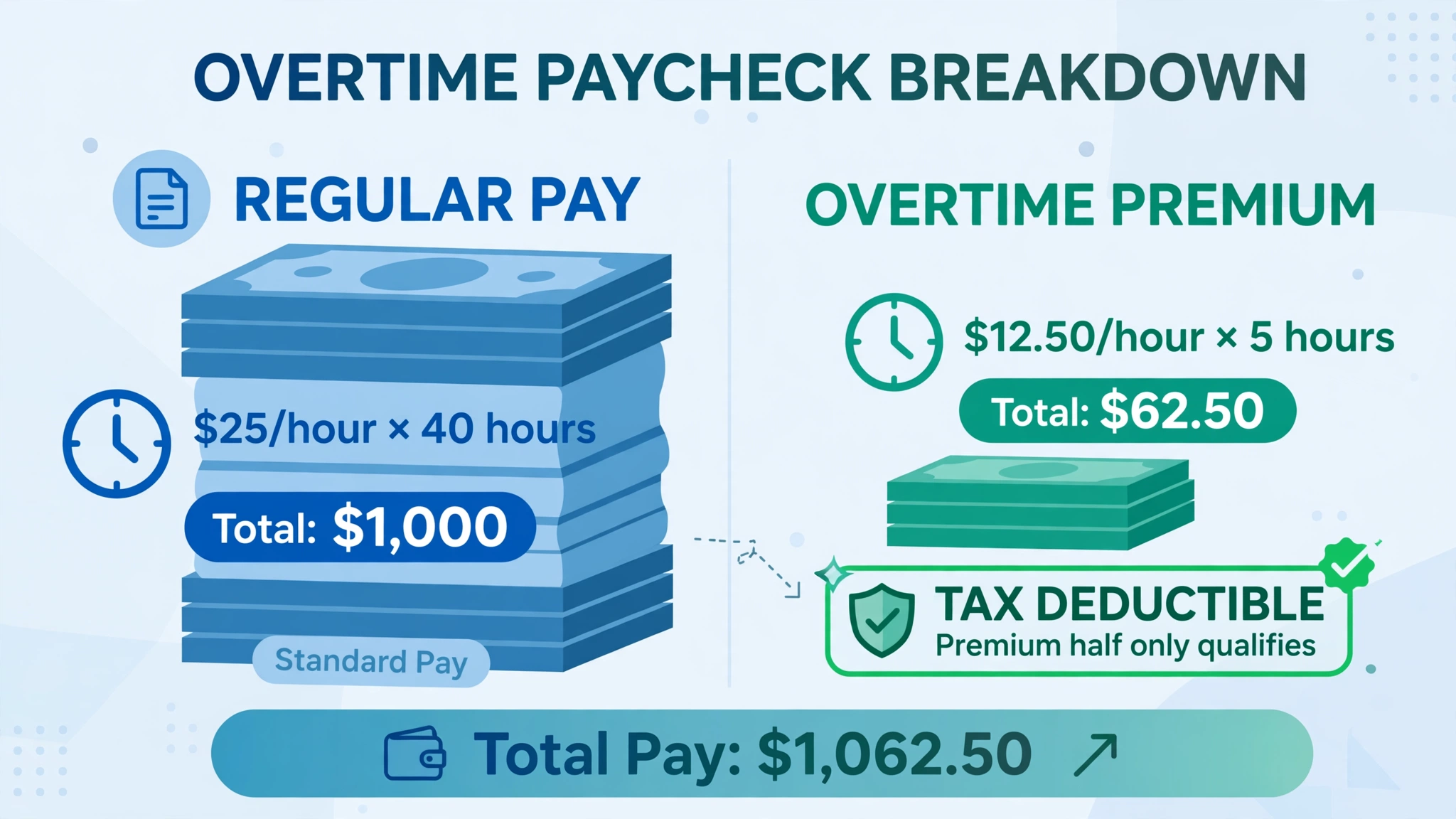
The premium must also be required by the Fair Labor Standards Act, the federal half-time premium for hours over 40 in a workweek. Extra pay your employer offers voluntarily, above what the law requires (double-time on holidays, for example, where the law does not require it), generally does not count as qualified overtime compensation. For when the 2x rate is actually required by law, and when it is purely voluntary, see our guide to double-time pay rules.
The $12,500 / $25,000 Annual Caps Explained
Even the premium that qualifies is capped each tax year:
- Single filers: up to $12,500 of overtime premium per year
- Joint filers: up to $25,000 per year
To put that in perspective: at a $10/hour premium, you would need 1,250 overtime hours in a year to hit the single-filer cap. That is roughly 24 overtime hours every single week. Most workers will never get near the cap, so for typical overtime earners the real limit is simply however much premium they actually earned.

There is also an income phaseout. The deduction starts to shrink above certain income thresholds. The exact thresholds follow IRS guidance, so treat any specific number you see online with caution and check the current instructions for the tax year you are filing.
Why Your Paycheck Still Shows Tax Withholding
The number-one complaint since the law passed: "My paycheck didn't change." Here is why that is exactly how the law was designed to work:
- Employers were not told to change withholding. Payroll systems still withhold federal income tax from overtime using the normal rules.
- Overtime is often withheld at a flat 22% federal supplemental rate, which may be higher or lower than your actual marginal rate. That mismatch was already there before this law.
- The benefit arrives at filing. When you claim the deduction, your taxable income drops, which either shrinks what you owe or grows your refund.
So do not expect a bigger paycheck in July. Expect a smaller tax bill (or bigger refund) next April. If you want the benefit sooner, you could adjust your W-4 withholding to account for the expected deduction. That means estimating your annual overtime premium in advance, though. Most workers are better off letting it land at filing time.
Example: $3,000 of qualifying premium × 22% marginal rate = about $660 less federal income tax. The premium itself was still hit with Social Security, Medicare, and (usually) state tax.
W-2 Reporting: The New Separate Overtime Line
Starting with 2026 W-2s, employers must separately report qualified overtime compensation, breaking out the premium from your total wages. That is the paper trail the IRS uses to check your deduction.
What this means for you:
- Check your W-2 carefully. The separately stated overtime amount is the starting point for your deduction. Keep your own records too, in case something does not match.
- Keep pay stubs. If your employer's reporting is wrong or incomplete, your stubs are your evidence of the premium you earned.
- Tax software will ask for it. Expect a specific input for qualified overtime when you file. Do not lump it in with general wages.

Who Qualifies and Who Does Not
| Situation | Qualifies? |
|---|---|
| Hourly non-exempt worker paid time-and-a-half over 40 hrs/week | Yes — the classic case |
| Salaried non-exempt worker receiving FLSA overtime premium | Yes — if the premium is FLSA-required |
| Holiday or weekend premium pay not required by the FLSA | Generally no — voluntary premiums do not count |
| Exempt salaried employee with no overtime pay at all | No — nothing to deduct |
| Self-employed / gig worker "overtime" | No — no employer-paid FLSA premium exists |
| Comp time taken instead of overtime pay | No — no premium was paid |
What About State Income Taxes?
For most workers, the answer is disappointing but simple: your state still taxes the full overtime amount. The deduction exists only in the federal tax code, and most states have not adopted a matching version.
A few practical notes:
- States with no income tax (Texas, Florida, Washington, and others) are unaffected either way — there was no state tax on the overtime to begin with.
- In states with income tax, assume the premium stays fully taxable unless your state has explicitly conformed. Check before filing rather than assuming.
- State conformity can change year to year, so recheck each filing season instead of relying on last year's answer.
How to Claim the Deduction at Tax Time
The steps are simple, but each one matters:
- 1. Gather your W-2. Find the separately reported qualified overtime compensation figure.
- 2. Cross-check with pay stubs. Confirm the premium total matches your records. Flag any mismatch with your employer early.
- 3. Apply the cap. Use the smaller of your actual premium and the $12,500 / $25,000 cap.
- 4. Enter it on the designated schedule. Follow your tax software's prompts or your preparer's guidance. It goes on a separate schedule with Form 1040, not buried in wages.
- 5. Keep records. Hold on to W-2s and pay stubs for at least three years in case the IRS asks questions.
One caveat: this is general education, not personal tax advice. If your situation involves large overtime amounts, multiple employers, or amended returns for 2025, a tax professional can confirm you are claiming the right figure.
Common Misconceptions to Avoid
- "My whole overtime check is tax-free now." Only the premium half qualifies, roughly a third of a time-and-a-half check.
- "My employer should stop withholding." Withholding rules did not change; the deduction happens at filing.
- "It covers Social Security and Medicare too." FICA taxes apply to the full overtime amount, premium included.
- "My state follows the federal rule automatically." Most states do not conform. Check yours.
- "This is permanent." The provision covers 2025–2028. Plan as if it ends unless Congress acts.
- "I need to itemize." It is above-the-line, so standard-deduction filers qualify too.
How to Use the Calculator
Work out the premium you can deduct in four steps:
- Step 1 — Enter your base hourly rate (the $20 rate from this guide's example, or your own) into the overtime calculator.
- Step 2 — Enter your overtime hours for a typical week — the hours you work past 40.
- Step 3 — Read the overtime total at 1.5×, then take one third of it: at time-and-a-half, exactly one third of the overtime pay is the premium ($50 of the $150 in the example), and the premium is the only part that counts toward the deduction.
- Step 4 — Scale it to your year and check the cap: multiply the weekly premium by your overtime weeks, then compare with the $12,500 single / $25,000 joint cap. Your deductible amount is the smaller of the two.
Limitations
- Temporary window: the deduction exists for tax years 2025–2028 only. Unless Congress extends it, overtime premiums are fully taxable again from 2029.
- Premium only, and only FLSA-required premium: the base-rate portion of overtime hours stays fully taxable, and voluntary premiums the FLSA does not require, such as holiday double time under a company policy, generally do not qualify.
- Caps and phase-out apply: the deduction is capped at $12,500 single / $25,000 joint per year and phases down above income thresholds set by IRS guidance. Verify the current figures for the year you are filing.
- Federal income tax only: Social Security and Medicare tax still apply to the full overtime amount, and most states have not conformed, so state tax usually still applies to the premium as well.
- Nothing changes during the year: withholding continues as before, and the calculator models gross pay only. It does not work out the deduction. The benefit is settled on your return.
- Your W-2 is the anchor: the deduction builds on the qualified overtime your employer reports separately (required from 2026 W-2s). If that figure is wrong or missing, you will need to sort it out with your employer and your pay stubs.
Frequently Asked Questions About No Tax on Overtime
Straight answers to the questions workers ask most about the overtime deduction:
Is overtime taxed at a higher rate than regular pay?
No. Overtime gets taxed at your normal marginal rate, the same rate as the rest of your pay. It can feel higher for two reasons: overtime can push some income into a higher bracket, and employers often withhold at a flat 22% federal supplemental rate that may be more than your real rate. The 2025–2028 overtime deduction does not change your withholding. It lowers your taxable income when you file. See also: Is Overtime Taxed at a Higher Rate? (2026).
Is all of my overtime pay tax-free under the new law?
No, just the overtime premium, the extra half of time-and-a-half pay. Say you earn $20/hour and your overtime rate is $30/hour. Only the $10/hour premium is deductible, not the full $30. The $20/hour base for those hours stays fully taxable.
When did no tax on overtime start, and how long does it last?
It covers tax years 2025 through 2028. That is it, for now. It is a temporary provision, not a permanent change to the tax code. Unless Congress extends it, overtime premiums go back to being fully taxable starting with tax year 2029.
Do I have to itemize deductions to claim it?
No. It is an above-the-line deduction, so you can claim it either way, standard deduction or itemized. You report it on a separate schedule with your federal return.
Why didn’t my paycheck get bigger after the law passed?
Because the law created a deduction you claim when you file, not a change to payroll withholding. Your employer still withholds federal income tax from overtime pay just like before. The benefit shows up as a smaller tax bill or a bigger refund at filing time, not as a bigger paycheck.
Does no tax on overtime apply to state income taxes?
Generally no. Most states have not matched the federal deduction, so overtime premiums are still taxable at the state level in most places. A few states may follow suit in future years, so check your state’s current rules before you file.
Key Takeaways & Action Plan
The overtime deduction is real money, but only if you know where it stops. Here is your action plan:
No Tax on Overtime: Summary Checklist
- Know what qualifies: Only the FLSA-required premium, the extra half of time-and-a-half, not your full overtime check.
- Track the caps: $12,500 single / $25,000 joint per year; the deduction covers 2025–2028.
- Expect it at filing, not payday: Withholding is unchanged. The benefit lands on your tax return.
- Verify your W-2: Starting with 2026, qualified overtime is reported separately. Cross-check it against your pay stubs.
- Model your gross first: Use the overtime calculator below to see your earnings, then estimate the deduction from the premium.
Model Your Gross Overtime Earnings
Type in your rate and overtime hours to work out gross overtime pay right away. The tool shows gross figures only. It does not work out taxes or the overtime deduction.
Calculation Methodology & Sources
Overtime pay examples in this guide use the federal Fair Labor Standards Act baseline: time-and-a-half (1.5×) the regular hourly rate for hours over 40 per workweek. The deduction figures ($12,500 single / $25,000 joint caps; tax years 2025–2028; premium-only qualification) reflect the federal provision as enacted. Thresholds and IRS guidance can change, so check the current IRS instructions before filing. This article is general education, not personal tax advice. To model your gross overtime earnings, use our Overtime Calculator or browse the Calculator Directory.
3 Things to Remember
- It is a deduction, not an exemption. You still owe tax on overtime during the year and deduct part of it when you file.
- Only the premium qualifies: on time-and-a-half pay, just the extra “half” is deductible.
- Federal income tax only. Social Security, Medicare, and most state income taxes still apply to the full amount, and withholding is unchanged.
Methodology & Data Verification
- Basis: Pay figures are gross unless a section states take-home; tax figures use 2026 federal rules where shown.
- Method: Full formulas, baselines, and rounding rules are on our calculation methodology page.
- Coverage: U.S. federal rules; state and local rules vary and are not included.
- Review: Last updated November 3, 2026.
- Disclaimer: Estimates for planning only — not tax or legal advice.