

Quick Answer
No. Overtime is taxed at your normal marginal rate, not a higher one. Overtime checks only look heavily taxed because employers often withhold at a flat 22%.
No. Overtime pay is taxed at exactly the same rate as the rest of your earnings. There is no special "overtime tax rate," and your employer cannot tax overtime hours more heavily than regular hours. If an overtime check looks like it lost a bigger bite to taxes, two ordinary things explain it: the flat 22% withholding employers commonly use on overtime, and the way marginal tax brackets work. Neither one means you actually owe more.
As the technical tools architect at Hourly Wage Converter, I hear this question all the time, usually right after someone works a heavy overtime week and stares at a pay stub that looks wrong. This guide separates what is withheld from your check from what you actually owe, walks through the math with real numbers, and shows where the 2026 overtime deduction fits in.
Calculate Your Overtime Pay First
Type in your hourly rate and overtime hours to see your gross overtime earnings right away. The tool shows gross pay only. It does not work out taxes or withholding.
The Short Answer: No
Overtime pay is ordinary wage income. It is taxed at your marginal income-tax rate, the rate on your last dollar earned, exactly like your regular hourly pay, your salary, your bonuses, and your commissions. Congress has never created a higher tax rate for overtime hours.
So why does it feel true? Two reasons, and both are worth knowing:
- Withholding looks like tax. Most employers withhold federal income tax from overtime at a flat 22%, even if your actual rate is 12%. The stub shows a bigger bite, but the extra comes back when you file.
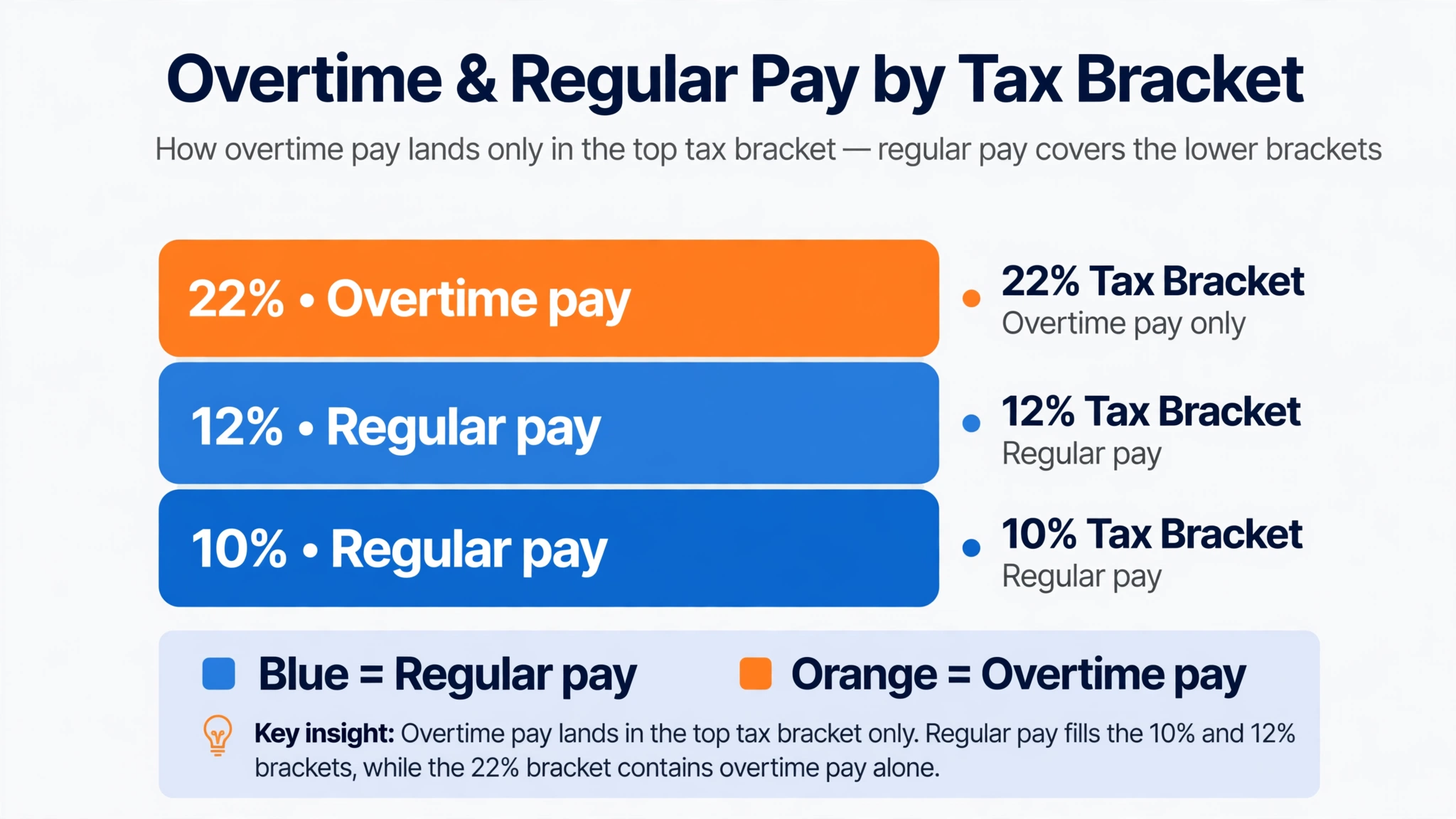
- Brackets confuse everyone. Extra overtime dollars can spill into a higher tax bracket, but only those extra dollars are taxed at the higher rate. Nothing you already earned gets re-taxed.
Keep this split in mind for the rest of the guide: withholding is a down payment; tax is the final bill. They follow different rules, and only the final bill matters.
Why Your Overtime Check Looks So Heavily Taxed
Three things pile up on an overtime-heavy paycheck:
1. The 22% flat withholding. Overtime counts as "supplemental wages," pay outside your regular salary or hourly schedule, like bonuses and commissions. Employers can withhold federal income tax on supplemental wages at a flat 22% instead of using your W-4. If your real marginal rate is 12%, your stub shows nearly double the tax you will actually owe.
2. Bracket spillover. Say your regular pay already fills most of your current tax bracket. Overtime dollars stack on top, and the top slice can land in the next bracket up. That is normal marginal taxation, not an overtime penalty. Only the spillover dollars face the higher rate.
3. Flat payroll taxes. Social Security (6.2% up to the $184,500 wage base for 2026) and Medicare (1.45%) apply to overtime at exactly the same flat rates as regular pay. They do not get "higher" on overtime. They just grow with the bigger check, which adds to the sticker shock.
None of these is a special overtime tax. Put together, though, they reliably make a $375 overtime payout look like it was taxed harder than a $375 regular paycheck.
How the 22% Withholding Rate Actually Works
The IRS gives employers two ways to handle supplemental wages: overtime, bonuses, commissions, and severance.
- Flat-rate method: withhold a flat 22% federal income tax on supplemental wages up to $1 million in a year (37% on amounts above $1 million). Most employers choose this because it is simple.
- Aggregate method: add the overtime to your regular pay for the period and withhold based on your W-4 elections, as if it were one bigger regular paycheck.
Either way, it is only withholding, an estimate of your final tax, not the tax itself. When you file your return, the IRS compares total withholding against what you actually owe:
- Withheld too much (the usual case for 10% and 12% bracket workers) → the excess comes back as a larger refund.
- Withheld too little (possible for 32%+ bracket workers) → you owe the difference at filing.
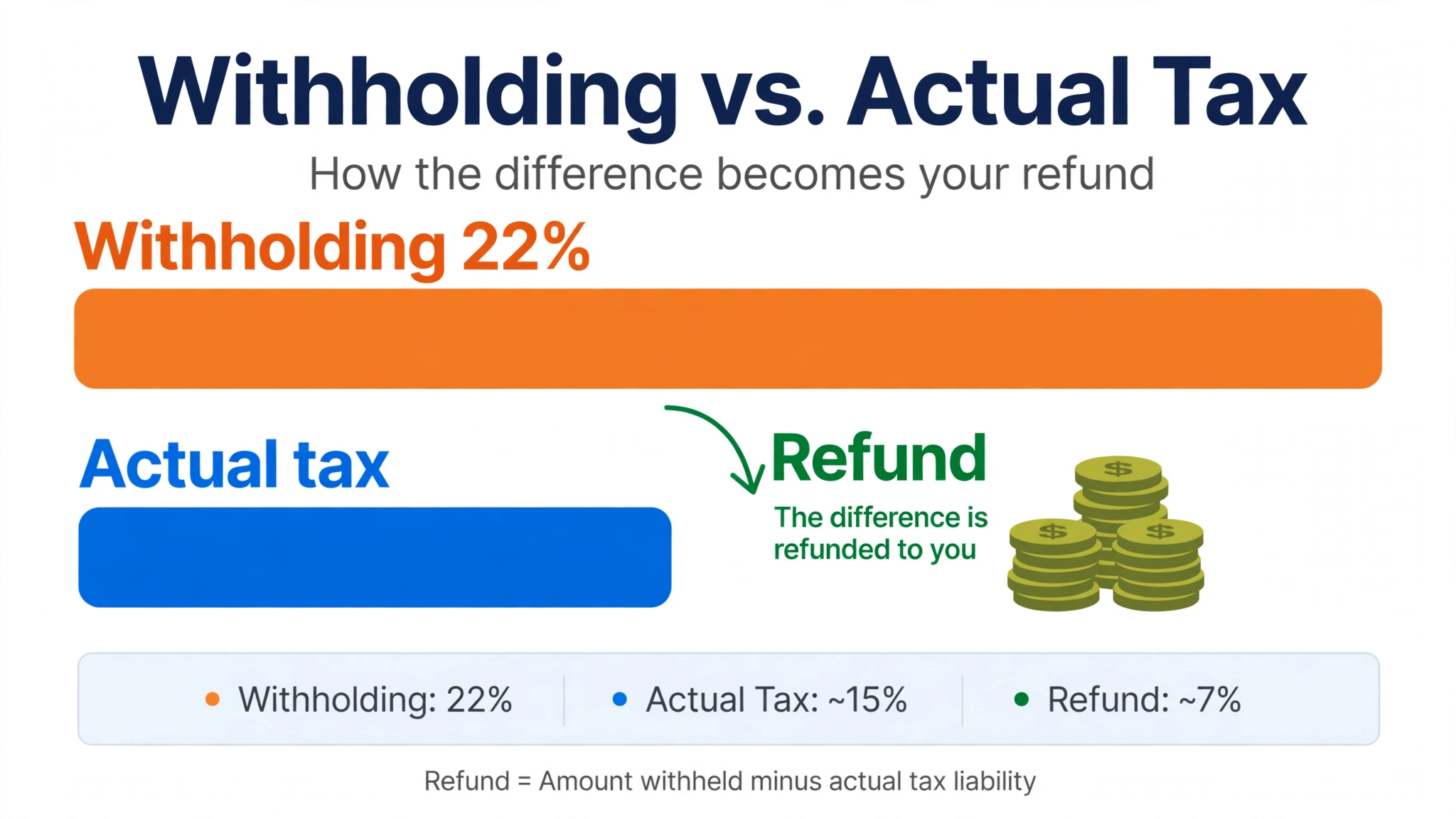
One practical note: if you keep getting large refunds because of overtime withholding, you can adjust your W-4 to withhold less during the year. That puts the money in your paychecks instead of an interest-free loan to the IRS. It means estimating your annual overtime in advance, though, so plenty of workers sensibly leave it alone. Our paycheck tax guide walks through how withholding flows into your stub.
The Math: Withholding vs. Actual Tax
Take a worker earning $25/hour who puts in 10 overtime hours in a week. Overtime pay: $25 × 1.5 × 10 = $375. Here is what happens to that $375 at three different marginal rates:
| Your marginal tax rate | Actual federal income tax on the $375 | Typically withheld (22% flat) | Settles up at filing |
|---|---|---|---|
| 12% | $45.00 | $82.50 | $37.50 back as part of refund |
| 22% | $82.50 | $82.50 | Even — nothing owed, nothing back |
| 32% | $120.00 | $82.50 | $37.50 owed with return |
The 12%-bracket worker is the classic case behind the complaint. The stub shows $82.50 gone, but only $45 was ever owed. The "extra tax" was never tax at all, just timing.
Example: $375 of overtime × 12% marginal rate = $45 of real tax. Compare that with the $82.50 withheld. The $37.50 gap is a timing difference, not a penalty. (Payroll taxes and state income tax are separate and follow their own rates.)
Overtime vs. Bonuses: Which Is Taxed More?
Neither. This is the same mix-up wearing a different hat. Overtime, bonuses, and commissions are all supplemental wages: same 22% flat withholding option, same marginal-rate taxation.
| Overtime pay | Bonus | Commission | |
|---|---|---|---|
| Income-tax rate | Your marginal rate | Your marginal rate | Your marginal rate |
| Common withholding | 22% flat | 22% flat | 22% flat |
| 2026 overtime deduction | Premium only, capped | No | No |
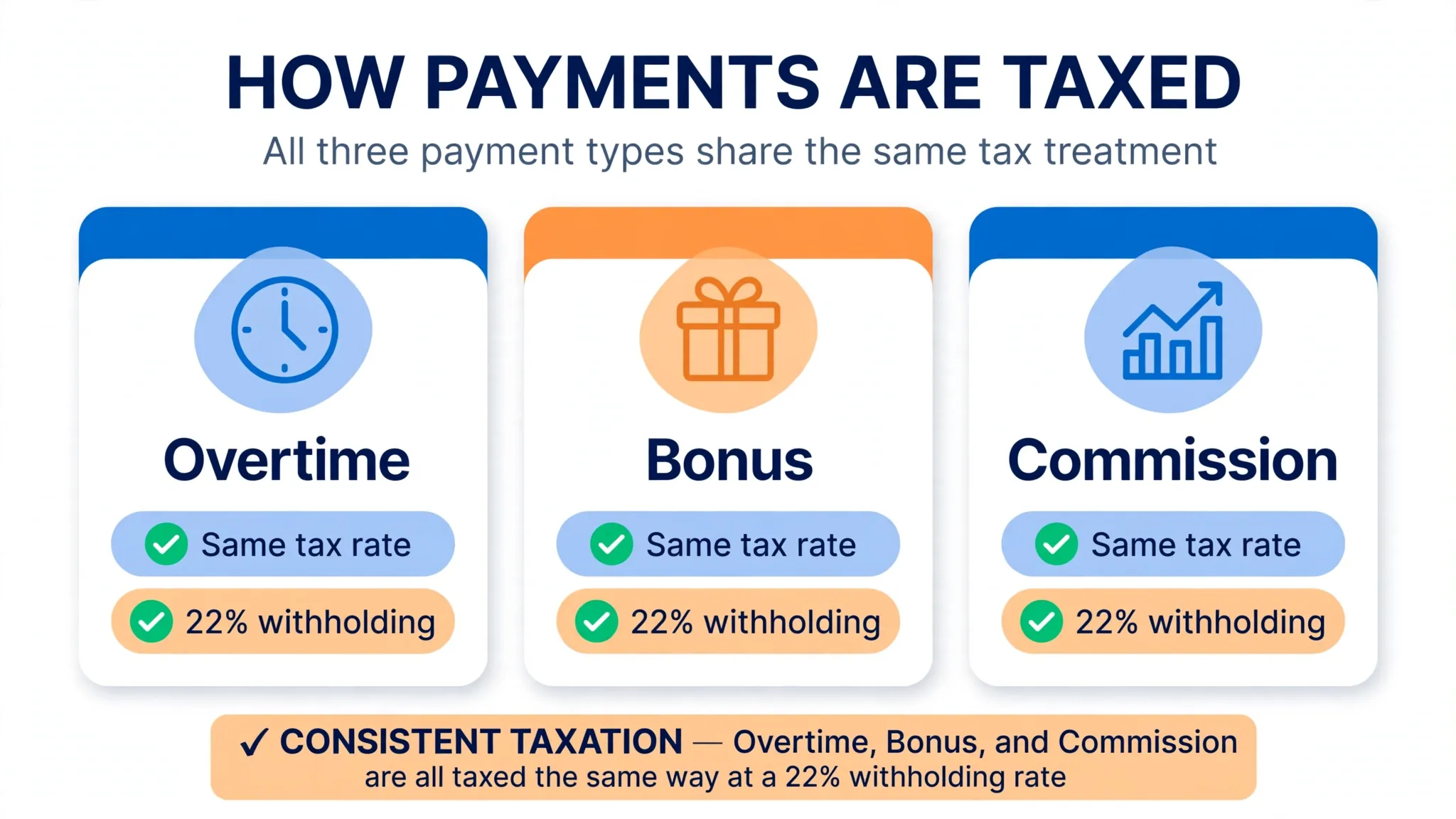
The one genuine difference in 2026: the no-tax-on-overtime deduction can cut the tax on the overtime premium, the extra half of time-and-a-half. Bonuses and commissions get no equivalent break.
Where the 2026 Overtime Deduction Fits In
The 2025 law behind "no tax on overtime" did not change any of the mechanics above. It added one new layer on top:
- It is an above-the-line deduction for the overtime premium only (not your full overtime pay), claimed when you file. It is capped at $12,500 single / $25,000 joint per year, for tax years 2025–2028.
- It does not change withholding: your employer still withholds from overtime during the year exactly as before.
- It does not make overtime tax-free: it shrinks the taxable income the premium creates, saving you tax at your marginal rate.
Put it together for a 12%-bracket worker with $3,000 of qualifying premium in 2026: roughly $360 of real tax on that premium before the deduction. The deduction can wipe most or all of that out at filing, while the 22% withholding during the year stays unchanged, so the refund gets bigger. Full detail on caps, who qualifies, and how to claim it is in our companion guide: No Tax on Overtime in 2026: How the Deduction Really Works.
How to Use the Calculator
Start from the gross number, the same one this guide's withholding table is built on:
- Step 1 — Enter your hourly rate (the $25 rate from the worked example above, or your own) into the overtime calculator.
- Step 2 — Enter your hours: 40 regular hours plus the overtime hours you worked, 10 in the example.
- Step 3 — Keep the multiplier at 1.5× for standard time-and-a-half (switch to 2.0× only if your employer pays double time).
- Step 4 — Read your gross overtime pay, $375 in the example, then hold it against the table in this guide: at a 12% marginal rate the real federal tax on that $375 is $45, even if $82.50 was withheld.
Limitations
- The calculator models gross pay only: it does not calculate taxes or withholding, so it cannot show you the net figure on your stub. That gap is exactly what this guide explains by hand.
- Withholding method varies by employer: the flat 22% supplemental rate is common but not universal. Employers using the aggregate W-4 method will produce a different stub for the same overtime.
- The worked example uses illustrative marginal rates: what you really owe depends on your total income, filing status, deductions, and credits across the whole year, not on one paycheck.
- State income tax is outside the example: states withhold on overtime under their own rules, and most have not adopted the federal overtime deduction.
- Payroll taxes have their own edges: Social Security applies only up to the 2026 wage base of $184,500, so very high earners see a different FICA picture late in the year.
- The deduction is narrow and temporary: the 2025–2028 break covers only the FLSA overtime premium, is capped at $12,500 / $25,000, and leaves withholding untouched during the year.
Frequently Asked Questions About Overtime Taxation
Straight answers to the questions workers ask most:
Is overtime taxed at a higher rate than regular pay?
No. Overtime is taxed at your normal marginal rate, the same rate as the rest of your pay. It can look higher because employers often withhold at a flat 22% supplemental rate, and because extra overtime dollars can spill into a higher bracket. Neither one changes your actual rate.
Why is my overtime check taxed so much?
Three things stack up: (1) your employer likely withholds federal income tax at a flat 22% on overtime, which is more than most workers' actual rates; (2) overtime dollars sit on top of your regular pay, so the top slice can land in a higher bracket; (3) flat Social Security and Medicare taxes grow with the bigger check. The 22% is withholding, not final tax. The extra comes back when you file.
Is overtime always withheld at 22%?
Not always, but usually. Employers can use the flat 22% rate on supplemental wages (overtime, bonuses, commissions) up to $1 million per year, or the aggregate method based on your W-4. Either way, it is just an estimate that gets sorted out on your tax return.
Are bonuses taxed at a higher rate than overtime?
No. Bonuses, overtime, and commissions are all supplemental wages. They are taxed at your marginal rate and commonly withheld at 22%. The only 2026 difference is the overtime-premium deduction, which bonuses do not get.
Does the no-tax-on-overtime law change my withholding?
No. You claim the 2025–2028 deduction when you file your return. It does not change payroll withholding during the year. Your employer keeps withholding from overtime exactly as before, and the benefit shows up as a smaller tax bill or a bigger refund.
Will I get the extra withholding back on my tax return?
If your employer withheld more than you actually owe, yes. That is the usual case for workers in the 10% and 12% brackets, and the extra comes back as part of your refund. If your marginal rate is above the 22% withholding rate, you may owe the difference instead.
Key Takeaways & Action Plan
Overtime is not taxed more. It is withheld more, and only sometimes. Here is what to do with that knowledge:
Overtime Taxation: Summary Checklist
- Know your real rate: Overtime is taxed at your marginal rate, the same as regular pay. There is no overtime penalty rate.
- Read the stub correctly: The 22% is usually withholding, not tax. Compare it with your marginal rate before concluding you were overtaxed.
- Expect the true-up at filing: Over-withheld amounts come back as a refund. Under-withheld amounts are owed with your return.
- Consider a W-4 tweak only if overtime is steady and refunds are consistently large. Otherwise let it ride.
- Claim the 2026 deduction: If you earned FLSA overtime premium, the 2025–2028 deduction can cut the real tax on it. See our no-tax-on-overtime guide.
- Model your gross first: Use the overtime calculator below to see earnings before any tax enters the picture.
Model Your Gross Overtime Earnings
Type in your rate and overtime hours to work out gross overtime pay right away. The tool shows gross figures only. It does not work out taxes or withholding.
Calculation Methodology & Sources
Overtime pay examples in this guide use the federal Fair Labor Standards Act baseline: time-and-a-half (1.5×) the regular hourly rate for hours over 40 per workweek. The 22% figure is the flat federal withholding rate employers commonly apply to supplemental wages (overtime, bonuses, commissions) up to $1 million per year. Actual withholding varies by employer and W-4 elections. Marginal-rate math is illustrative. What you really owe depends on total income, filing status, and deductions. The 2026 Social Security wage base ($184,500) and standard deduction ($16,100 single / $32,200 joint) follow current IRS guidance. This article is general education, not personal tax advice. To model your gross overtime earnings, use our Overtime Calculator or browse the Calculator Directory.
3 Things to Remember
- Withholding is not your tax rate. The flat 22% often withheld from overtime is not necessarily what you owe.
- Extra overtime dollars can spill into a higher bracket, but only those extra dollars are taxed at the higher rate.
- The 2026 deduction for the overtime premium is separate from how overtime itself is taxed.
Methodology & Data Verification
- Basis: Pay figures are gross unless a section states take-home; tax figures use 2026 federal rules where shown.
- Method: Full formulas, baselines, and rounding rules are on our calculation methodology page.
- Coverage: U.S. federal rules; state and local rules vary and are not included.
- Review: Last updated October 20, 2026.
- Disclaimer: Estimates for planning only — not tax or legal advice.