

Quick Answer
No tax on tips is a federal deduction of up to $25,000 for tax years 2025–2028. You still report all your tips as income, then take the deduction when you file.
"No tax on tips" is real, but it works as a deduction, not an exemption. For tax years 2025 through 2028, workers in 71 listed occupations can deduct up to $25,000 of qualified tips. You still report tips as income, they still owe Social Security and Medicare tax, and your paycheck won't change during the year. Your final federal income-tax bill will.
I build the calculators tipped workers use here at Hourly Wage Converter, and this is the tax question they ask most. So this guide puts the whole rule set in one place: who qualifies, what counts, the full 71-occupation list, the phase-out, worked examples, and how to claim it.
See Your Full Paycheck First
Enter your rate, hours, and pay frequency to estimate your gross paycheck, the income your tips sit on top of. The deduction itself gets settled later, on your return.
The Short Answer: A Deduction, Not a Free Pass
The One Big Beautiful Bill Act, signed July 4, 2025, added a deduction (IRC Section 224) for “qualified tips.” The slogan and the fine print aren't the same thing. Here are the four ways they differ:
- It is a deduction, not an exemption. You report all tips as income, then deduct up to $25,000 when you file. What you actually save is the deduction times your marginal rate, not the full $25,000.
- Federal income tax only. Social Security and Medicare tax (7.65%) still applies, and state rules vary.
- It is temporary. Tax years 2025–2028 only, unless Congress extends it.
- It is occupation-based. Only tips earned in one of the 71 listed occupations qualify. See the full list below.
It's a close cousin of the overtime deduction in our no-tax-on-overtime guide. Same window, same claim-it-when-you-file setup. If you earn both, the two deductions stack.
Who Qualifies: Every Rule in One Place
There are five checks to clear before the deduction is yours:
| Requirement | The rule |
|---|---|
| Occupation | Your job is on the IRS list of 71 occupations that customarily and regularly received tips before December 31, 2024 |
| Qualified tips | Voluntary tips in cash or cash equivalents, received directly or through a tip pool, reported on a W-2, a 1099, or Form 4137 |
| The cap | Up to $25,000 per return per year — a married couple shares one cap, even if both earn tips |
| Income phase-out | Shrinks by $100 per $1,000 of modified AGI over $150,000 ($300,000 joint); gone at $400,000 ($550,000 joint) |
| Filing rules | A Social Security number must be on the return; married taxpayers must file jointly — married filing separately cannot claim it |
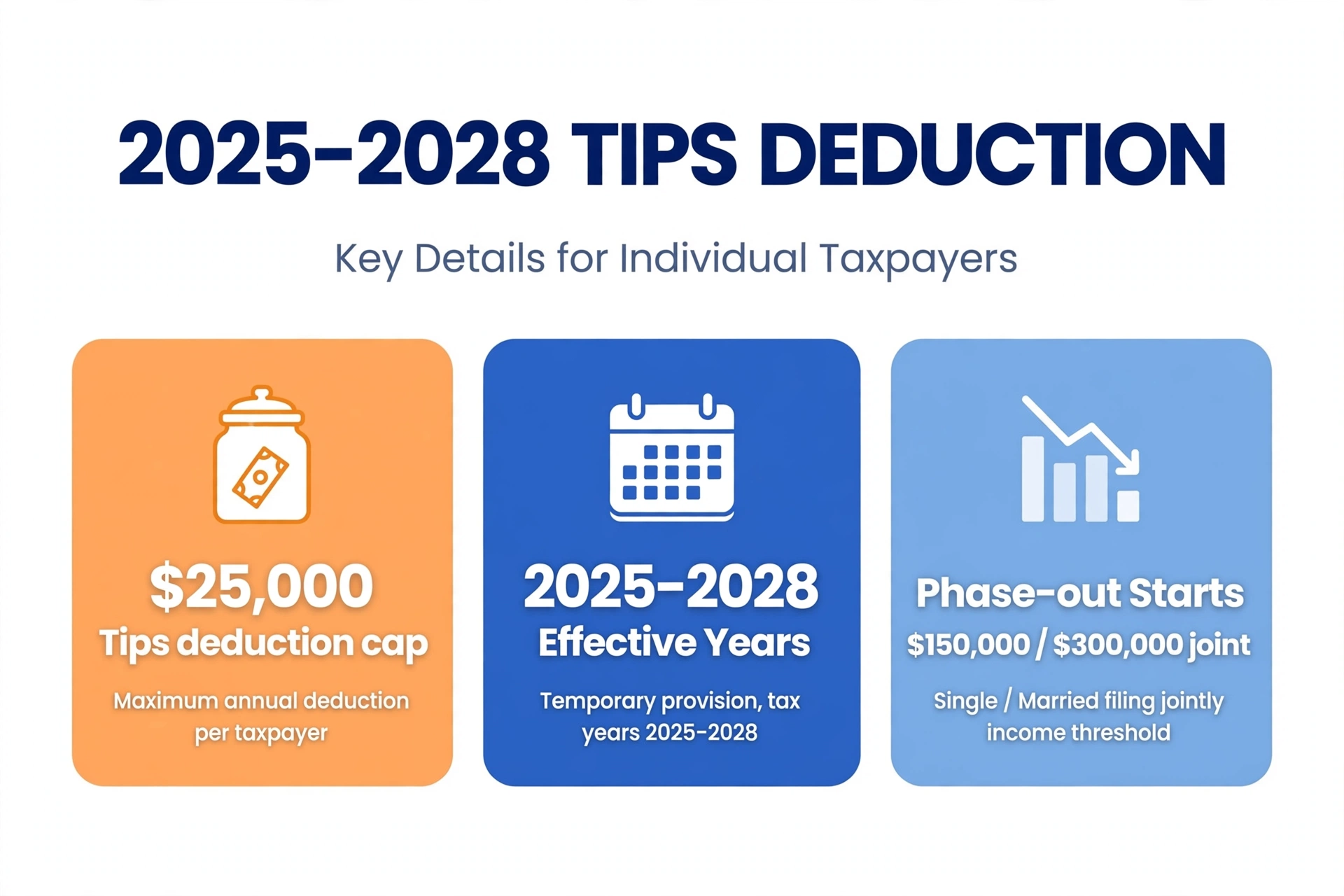
Two details trip people up. First, the phase-out shrinks the deduction itself. At $180,000 of modified AGI, a single filer's maximum drops by $3,000, to $22,000, and it hits zero at $400,000. Second, self-employed workers face one more limit: the deduction can't be bigger than the net income of the business the tips came from.
What Counts as a Qualified Tip (and What Does Not)
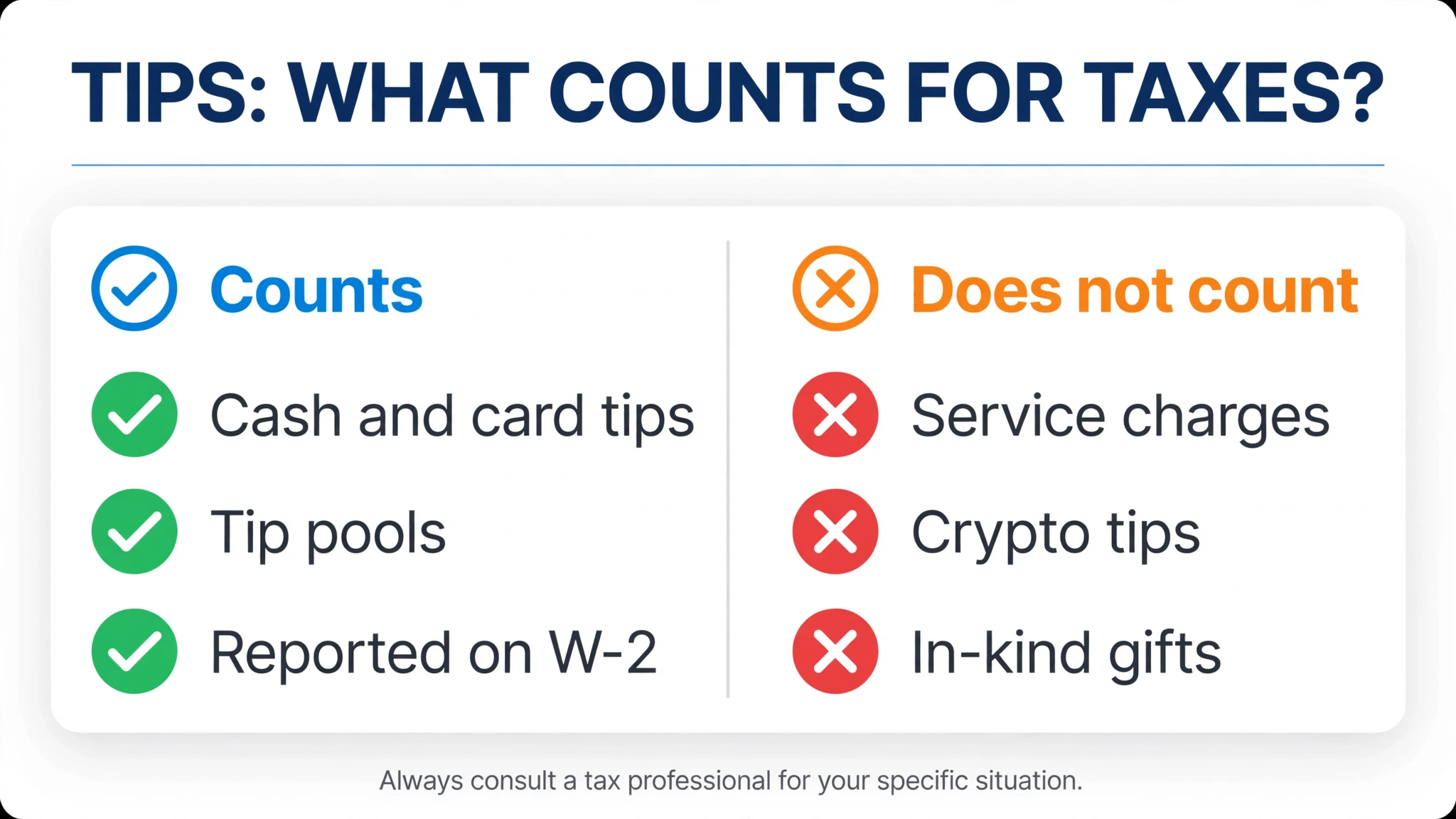
A tip only qualifies if it passes three tests: it's paid in cash or a cash equivalent, the customer chose it freely, and it lands on an information return. The IRS final regulations draw the lines like this:
Counts as a qualified tip:
- Cash, credit and debit card tips, checks, gift cards, and electronic payments
- Tips received through a tip pool — including back-of-house staff such as dishwashers and cooks
- Screen tips, as long as the customer could reduce the amount to zero
- Amounts paid on top of a mandatory charge, for the portion above it
Does not count:
- Mandatory service charges and automatic gratuities. An 18% charge on a large party's bill is wages, not a tip, even if passed to staff
- In-kind gifts. Tickets, meals, or merchandise aren't cash tips.
- Digital assets. Cryptocurrency tips are excluded under the final regulations
- Amounts paid by your own employer, or by a business where you hold a significant ownership interest. The IRS treats those as wages, not tips.
- Tips received in a specified service trade or business (health, law, accounting, performing arts, athletics) or tied to illegal activity
- A manager's or supervisor's tip-pool share. Direct tips for their own service in a listed occupation can qualify, but pool shares can't.
The Full Occupation List: All 71 Jobs in 8 Groups
Every qualifying job carries a Treasury Tipped Occupation Code (TTOC). The 2025 proposal listed 68 occupations, and the final regulations added three more, visual artists, floral designers, and gas pump attendants, bringing the total to 71. What matters is the work you actually do, not the industry label on your job:
| Category | Qualifying occupations |
|---|---|
| Beverage and Food Service (10) | Bartenders; wait staff; food and beverage servers, non-restaurant; dining room and cafeteria attendants and bartender helpers; chefs and cooks; food preparation workers; fast food and counter workers; dishwashers; host staff (restaurant, lounge, and coffee shop); bakers |
| Entertainment and Events (11) | Gambling dealers; gambling change persons and booth cashiers; gambling cage workers; gambling and sports book writers and runners; dancers; musicians and singers; disc jockeys (except radio); entertainers and performers; digital content creators; ushers, lobby attendants, and ticket takers; locker room, coatroom, and dressing room attendants |
| Hospitality and Guest Services (4) | Baggage porters and bellhops; concierges; hotel, motel, and resort desk clerks; maids and housekeeping cleaners |
| Home Services (9) | Home maintenance and repair workers; home landscaping and groundskeeping workers; home electricians; home plumbers; home heating and air conditioning mechanics and installers; home appliance installers and repairers; home cleaning service workers; locksmiths; roadside assistance workers |
| Personal Services (10) | Personal care and service workers; private event planners; private event and portrait photographers; private event videographers; event officiants; pet and show animal caretakers; tutors; nannies and babysitters; visual artists; floral designers |
| Personal Appearance and Wellness (11) | Skincare specialists; massage therapists; barbers, hairdressers, hairstylists, and cosmetologists; shampooers; manicurists and pedicurists; eyebrow and eyelash technicians; makeup artists; exercise trainers and group fitness instructors; tattoo artists and piercers; tailors; shoe and leather workers and repairers |
| Recreation and Instruction (6) | Golf caddies; self-enrichment teachers; recreational and tour pilots; tour guides and escorts; travel guides; sports and recreation instructors |
| Transportation and Delivery (10) | Parking and valet attendants; taxi and rideshare drivers and chauffeurs; shuttle drivers; goods delivery people (including app and platform delivery); personal vehicle and equipment cleaners; private and charter bus drivers; water taxi operators and charter boat workers; rickshaw, pedicab, and carriage drivers; home movers; gas pump attendants |
If your job isn't on this list, your tips don't qualify, even if customers tip you every day. A few entries surprise people. Dishwashers and cooks qualify because tip pools count. Digital content creators qualify for voluntary viewer payments, but not for payments that buy access.
How Much You Save: Worked Examples
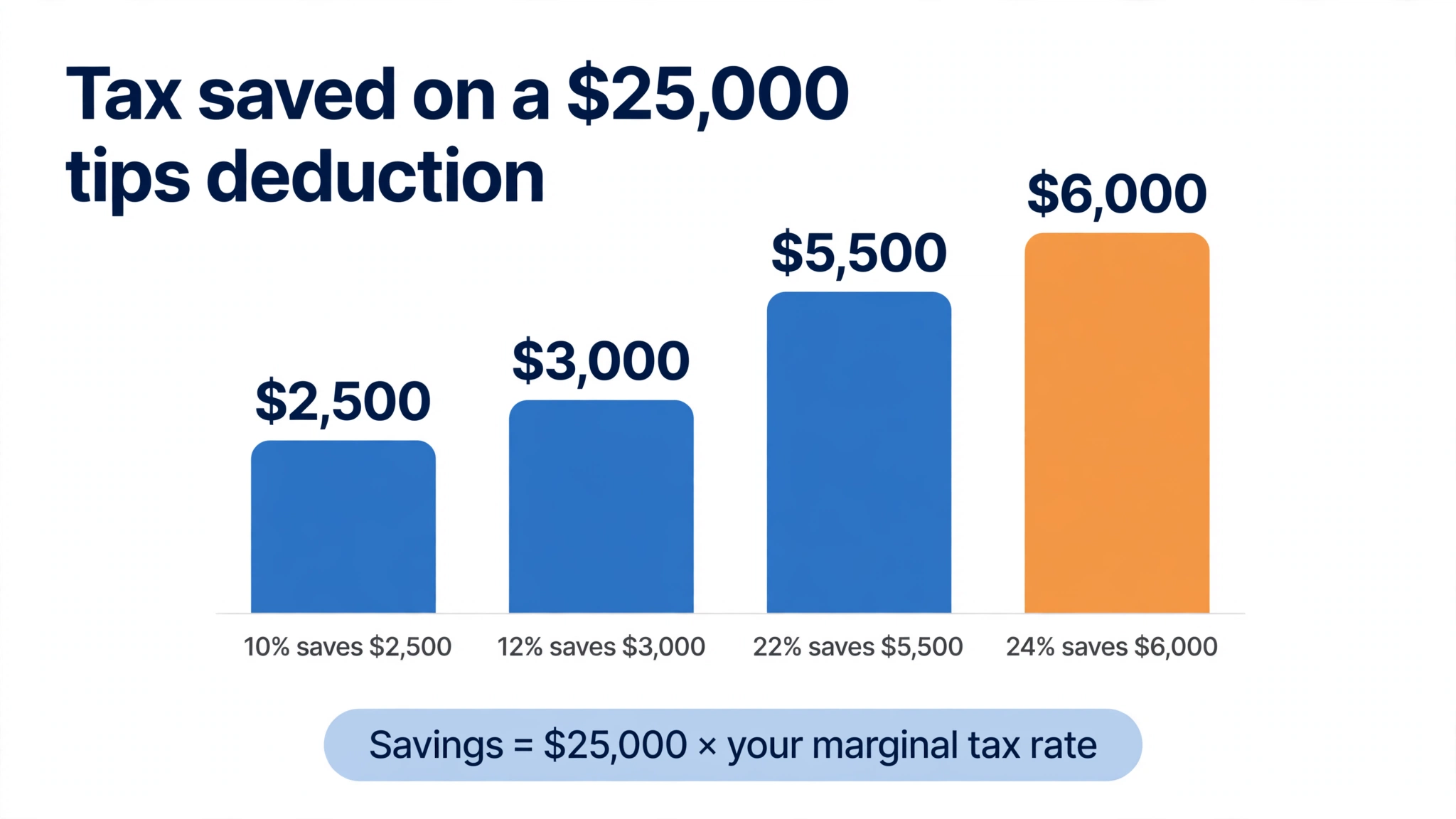
A deduction saves tax at your marginal rate, so the same $25,000 can be worth very different amounts depending on your bracket:
| Qualified tips deducted | Saved at 10% | Saved at 12% | Saved at 22% | Saved at 24% |
|---|---|---|---|---|
| $10,000 | $1,000 | $1,200 | $2,200 | $2,400 |
| $15,000 | $1,500 | $1,800 | $3,300 | $3,600 |
| $25,000 (the cap) | $2,500 | $3,000 | $5,500 | $6,000 |
Example 1 — the full-time server. Maria earns $21,000 in wages and $13,500 in reported tips, all of them qualified, so she deducts the full $13,500. At her 12% marginal rate, that saves about $1,620. Her tips still owed 7.65% Social Security and Medicare tax, roughly $1,033, and the deduction doesn't touch that.
Example 2 — two tipped spouses. Devon, a bartender, reports $19,000 of tips. His spouse Priya, a hairstylist, reports $12,500. Together that's $31,500, but the cap is $25,000 per return, so they deduct $25,000, worth about $3,000 at their 12% rate. That shared cap is the deduction's most common disappointment for tipped couples.
Example 3 — the gig driver. A rideshare driver gets $8,400 in tips and nets $36,000, so the full $8,400 is deductible. If net income had been $7,000 instead, the deduction would cap at $7,000. Either way, the tips still owe self-employment tax.
Example: $13,500 of tips × 12% = about $1,620 saved. At the cap, $25,000 × 22% = $5,500. To see the paycheck those tips ride on, try our Paycheck Calculator.
How to Claim It: Reporting, W-2s, and Your Return
Everything here comes down to reporting. Tips that never reach a W-2, a 1099, or Form 4137 don't qualify:
- Track tips daily. Keep a daily tip diary (Form 4070A). App and card tips get captured automatically. Cash is where your own records matter.
- Report tips to your employer monthly. Employees report tips of $20 or more per month (Form 4070 or the employer's system), so the year-end W-2 lines up with the diary.
- Check your year-end forms. For 2025, employers could show cash tips in Box 14 or on a separate statement (with IRS penalty relief). From 2026, W-2s separately report qualified cash tips and your TTOC code. Gig workers go by their 1099s and platform records.
- Claim it on your federal return. Deduct the qualified amount (up to $25,000, after any phase-out) on Form 1040, itemizing or not. Tips never reported to an employer go on Form 4137.
One thing to get straight now: your paycheck does not change during the year. Withholding and the full 7.65% FICA keep going as before. Like the overtime deduction in Is Overtime Taxed at a Higher Rate?, the benefit shows up at filing time.
State Taxes: Your State May Not Follow
This deduction is federal. Whether your state copies it depends on how closely its tax code follows Washington's:
- Rolling-conformity states adopt federal changes automatically, so the deduction usually flows through. Oregon and North Dakota give tipped workers the break on both returns.
- States with their own versions. New York added its own exclusion of up to $25,000 from tax year 2026; Colorado kept the tips deduction while dropping the overtime one; Michigan and Indiana enacted limited versions.
- Decoupled states. Illinois and Georgia require an add-back, so tips stay fully taxable at state level. California has signaled it won't adopt it.
- No-income-tax states (Alaska, Florida, Nevada, New Hampshire, South Dakota, Tennessee, Texas, Washington, Wyoming) make the question moot.
State positions were still shifting through 2026, so check your state's current rule before counting on the saving twice. Our paycheck tax guide shows where state tax fits in a pay stub.
How to Use the Calculator
Here's how to model the paycheck your tips ride on, in four steps:
- Step 1 — Enter your base hourly wage and hours for a typical pay period into the paycheck calculator. That's the wage side of your pay, before tips.
- Step 2 — Set your pay frequency: weekly or biweekly, whichever matches your employer's schedule.
- Step 3 — Read your gross wage per check, then add your typical tips for the period on top. In Example 1, Maria's $21,000 of wages carries $13,500 of reported tips across the year.
- Step 4 — Estimate the deduction's value: qualified tips up to $25,000, times your marginal rate. Maria's $13,500 at 12% saves about $1,620 at filing time, not in the check itself.
Limitations
- Temporary and capped: the deduction covers tax years 2025–2028 and tops out at $25,000 per return, a cap two tipped spouses share. Married filing separately can't claim it, and a Social Security number must be on the return.
- The phase-out shrinks it: the maximum falls by $100 for every $1,000 of modified AGI above $150,000 ($300,000 joint) and reaches zero at $400,000 ($550,000 joint).
- The occupation list is fixed: only tips earned in one of the 71 listed occupations qualify, and tips tied to a specified service trade or business are excluded, even if customers tip you every day.
- Not every payment is a qualified tip: only voluntary, cash-equivalent tips reported on a W-2, a 1099, or Form 4137 count. Mandatory service charges, automatic gratuities, in-kind gifts, and cryptocurrency tips don't, and unreported tips can't be deducted.
- Income tax only: Social Security and Medicare tax (7.65%) still applies to every tip, and for the self-employed the deduction also can't be bigger than the net income of the business the tips came from.
- States go their own way: some conform automatically, some wrote their own version, and some, Illinois and Georgia among them, require an add-back, so the federal saving doesn't guarantee a state one.
Frequently Asked Questions About No Tax on Tips
Here are straight answers to the questions tipped workers ask most:
Is no tax on tips really tax-free?
Not quite. It’s a federal income-tax deduction of up to $25,000 of qualified tips, and you claim it when you file for 2025–2028. You still report every tip, tips still owe Social Security and Medicare tax, and withholding stays the same. The payoff shows up as a smaller tax bill or a bigger refund.
Who qualifies for the no tax on tips deduction?
You qualify if your job is one of the 71 occupations on the IRS list and your voluntary cash tips show up on a W-2, a 1099, or Form 4137. You also need a Social Security number on your return, you must file jointly if you’re married, and your modified AGI has to stay under the phase-out, which starts at $150,000 ($300,000 joint).
Do cash tips count, or only card tips?
Both. Cash, checks, card tips, gift cards, and electronic payments all count, and so do tip-pool shares. What doesn’t count: mandatory service charges and automatic gratuities (those are wages, not tips), in-kind gifts, and cryptocurrency tips.
Can I claim the tips deduction if I take the standard deduction?
Yes. It works whether you itemize or take the standard deduction, and it cuts your taxable income by up to $25,000 of qualified tips.
Does no tax on tips apply to self-employed and gig workers?
Yes, as long as your occupation is on the list. Rideshare and delivery drivers are the classic example. One extra limit applies: the deduction can’t be bigger than the net income of the business the tips came from. And tips still owe self-employment tax.
Will my state also stop taxing my tips?
It depends on your state. States that follow federal changes automatically usually let the deduction flow through, and a few passed their own versions. New York added a matching exclusion from 2026. Others, including Illinois and Georgia, require an add-back, so tips stay taxable at the state level.
Key Takeaways & Action Plan
It's a valuable break, with more conditions than the slogan suggests. Here's the plan:
No Tax on Tips: Summary Checklist
- Check your occupation first: Only the 71 listed jobs qualify. If yours isn't listed, no tip is deductible.
- Report every tip: Unreported tips can't be deducted. Keep a daily log, especially for cash.
- Know your real saving: Deducted tips × your marginal rate. That's $3,000 at 12% and $5,500 at 22%, at the cap.
- Watch the shared cap: Two tipped spouses split one $25,000 limit; married filing separately gets nothing.
- Expect nothing mid-year: Withholding and FICA carry on as usual. The saving shows up with your refund.
- Check your state separately: Some copy the break, some add it back, nine never taxed tips.
Model the Paycheck Your Tips Ride On
Estimate your gross pay per check, the base your tips and deductions are calculated from.
Calculation Methodology & Sources
The rules here follow Internal Revenue Code Section 224, added by the One Big Beautiful Bill Act (signed July 4, 2025), and the IRS final regulations published April 13, 2026 (effective June 12, 2026). Those set the 71-occupation TTOC list, the $25,000 cap, and the $100-per-$1,000 phase-out over $150,000 ($300,000 joint) of modified AGI. Savings figures are illustrative marginal-rate math, before state taxes and credits. State notes reflect 2026 guidance. This article is general education, not personal tax advice. To model the paycheck your tips are added to, use our Paycheck Calculator or browse the Calculator Directory.
3 Things to Remember
- It's a deduction, not an exemption. Report all tips as income first, then deduct up to $25,000.
- Federal income tax only. Social Security and Medicare tax (7.65%) still applies, and state rules vary.
- It's occupation-based. Only tips earned in one of the 71 listed occupations qualify.
Methodology & Data Verification
- Basis: Pay figures are gross unless a section states take-home; tax figures use 2026 federal rules where shown.
- Method: Full formulas, baselines, and rounding rules are on our calculation methodology page.
- Coverage: U.S. federal rules; state and local rules vary and are not included.
- Review: Last updated October 22, 2026.
- Disclaimer: Estimates for planning only — not tax or legal advice.