

Quick Answer
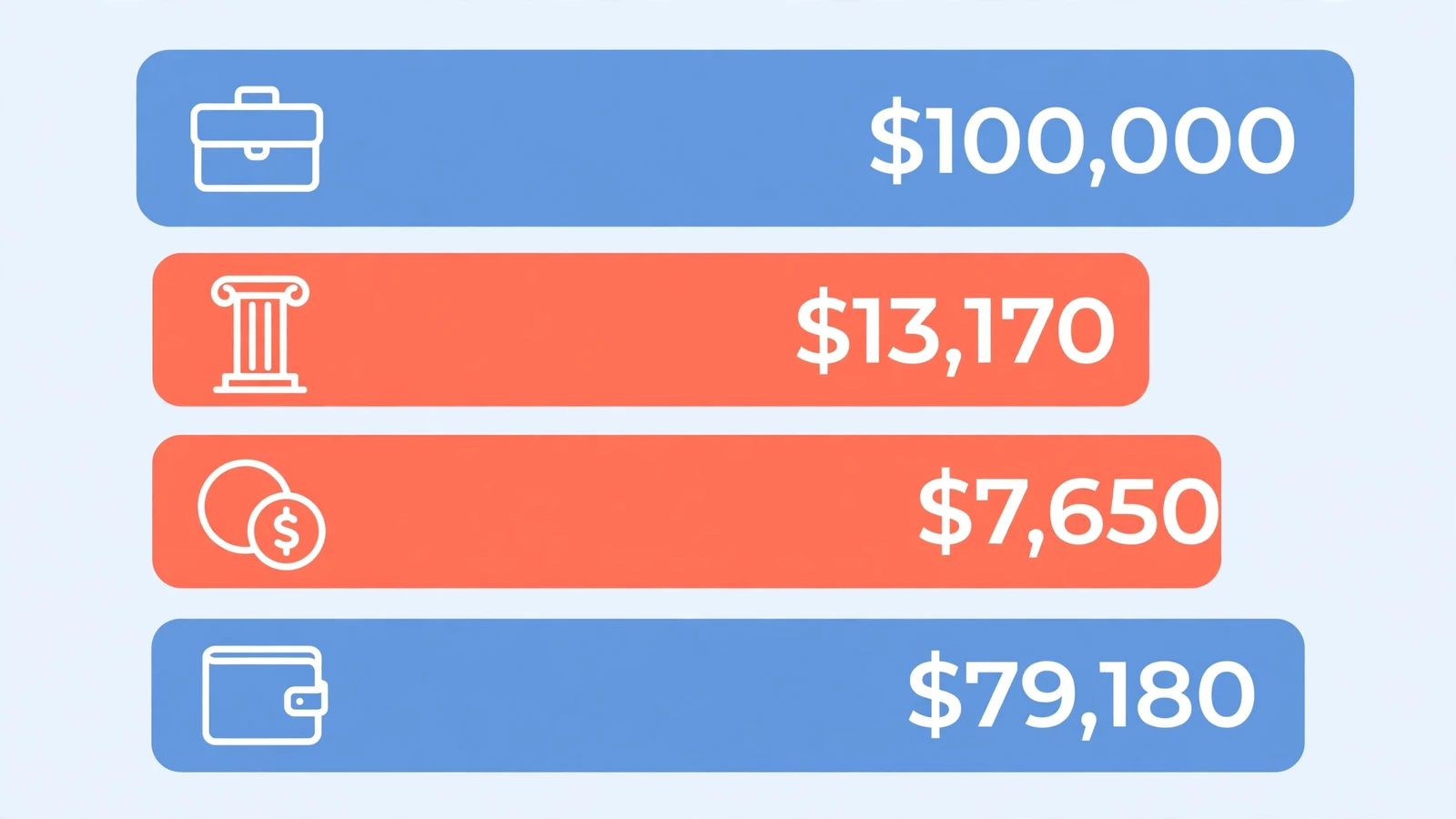
$100,000 a year works out to $79,180 after federal income tax and FICA. That's $6,598.33 a month, or $3,045.38 every two weeks.
A $100,000 salary is $79,180 a year after taxes — $6,598.33 a month, or $3,045.38 every two weeks. That's 79.2% of your gross pay. Before you plan around those numbers, know what they cover: federal tax only, for a single filer taking the standard deduction. State income tax isn't in there, and neither are 401(k) contributions, health premiums, or bonuses. If any of those apply to you, your actual paycheck will be smaller. We walk through each one in the section on why paychecks differ below.
This is the fifth article in our after-tax series. The first covered $25 an hour after taxes ($43,962 take-home), the second covered $50,000 a year after taxes ($42,355 take-home), the third covered $20 an hour after taxes ($35,605.60 take-home), and the fourth covered $60,000 a year after taxes ($50,390 take-home). If you want the ideas behind these numbers — what gross pay and net pay mean, and why the two drift apart — our guide to gross pay vs net pay covers that. This article does one thing: the full take-home math for one salary, $100,000 a year.
Run your own salary
On a different salary? Plug in any number and schedule to see its hourly equivalent, then run the same tax steps from this article.
The Short Answer: $79,180 a Year
| Period | Gross Pay | Take-Home (Federal Only) |
|---|---|---|
| Year | $100,000.00 | $79,180.00 |
| Month (average) | $8,333.33 | $6,598.33 |
| Biweekly paycheck (26/year) | $3,846.15 | $3,045.38 |
| Semi-monthly paycheck (24/year) | $4,166.67 | $3,299.17 |
| Week | $1,923.08 | $1,522.69 |
| Hour | $48.08 | $38.07 |
One thing to know about that biweekly number: $3,045.38 assumes 26 paychecks a year. If you're paid semi-monthly (24 paychecks), the same $79,180 shows up as $3,299.17 per check. The yearly total is the same either way, it's just split differently.
2026 Federal Tax Brackets at a Glance
Here's the key idea: only your last dollar is taxed at your top bracket, not your whole income. These are the 2026 single-filer brackets we use in this guide:
Up to $12,400
Every dollar in this range is taxed at 10%.
$12,400 – $50,400
Every dollar in this range is taxed at 12%.
$50,400 – $105,700
Every dollar in this range is taxed at 22%.
$105,700 – $201,775
Every dollar in this range is taxed at 24%.
For this salary: $100,000 gross becomes $83,900 taxable, which puts you in the 22% marginal bracket. But your effective federal rate is only 13.2% ($13,170 ÷ $100,000), because the first dollars are taxed at the lower rates.
How the Math Works, Step by Step
Five steps, and you can check each one yourself. All figures use 2026 federal rules for a single filer.
| Step | Math | Result |
|---|---|---|
| 1. Gross pay | $100,000 stated salary | $100,000 |
| 2. Taxable income | $100,000 − $16,100 standard deduction | $83,900 |
| 3. Federal income tax | 10% × $12,400 = $1,240, plus 12% × $38,000 = $4,560, plus 22% × $33,500 = $7,370 | $13,170 |
| 4. FICA | Social Security 6.2% × $100,000 = $6,200, plus Medicare 1.45% × $100,000 = $1,450 | $7,650 |
| 5. Take-home | $100,000 − $13,170 − $7,650 | $79,180 |
Step 3 is the one most people get wrong. Your marginal rate is 22%, the rate on your last dollar, but your effective federal rate is only 13.2% ($13,170 ÷ $100,000). That's because the first $12,400 of taxable income is taxed at 10%, the next $38,000 at 12%, and only the remaining $33,500 at 22%. Moving into a higher bracket never taxes your whole income at the higher rate. It only taxes the dollars inside that bracket. FICA works differently: it applies to the full $100,000, since the whole amount sits below the $184,500 Social Security wage base. Put together, federal tax and FICA take $20,820, or 20.8% of gross pay.
Two cutoffs are worth knowing about. First, the 24% bracket doesn't touch this salary at all. It starts at $105,700 of taxable income, which for a single filer means $121,800 of gross pay ($105,700 plus the $16,100 standard deduction). A raise from $100,000 to $121,800 is still taxed at 22% on the margin. Only dollars above $121,800 would face 24%. Second, filing status changes the answer. For a married couple filing jointly, the standard deduction is $32,200, so taxable income on the same $100,000 is $67,800, and the joint brackets (10% to $24,800, then 12%) give federal tax of $7,640 instead of $13,170. FICA stays at $7,650, so joint take-home is $84,710, or $5,530 more than the single-filer figure. If you file jointly, start from $84,710, not $79,180.
Why Your Paycheck May Look Different
- State income tax. The largest missing piece. Some states have no income tax at all, while others take several percent. In a high-tax state, you can lose several hundred dollars a month on top of the federal figures here.
- Retirement contributions. A 401(k) contribution comes out before you ever see it, and it also lowers your taxable income, which trims the federal tax in step 3 a bit. Your paycheck drops, but the money is still yours.
- Health premiums and other deductions. Insurance premiums, dental and vision plans, and similar deductions come out of each paycheck and vary a lot by employer.
- Pay frequency. Biweekly (26 checks) and semi-monthly (24 checks) give you different per-check amounts for the same yearly total, as the short-answer table shows.
- Bonuses. A bonus is taxed as ordinary income plus FICA, so it adds to your yearly tax bill just like salary does. But the withholding on a bonus check can look different from your regular check, which catches people off guard at bonus time.
- Withholding vs actual tax. Your paycheck withholding is an estimate. The real bill gets settled when you file. A refund or a balance due at filing time means your withholding was off from the true yearly figures, not that the math in this article is wrong.
One last thing about your W-4: withholding follows the form you filed with payroll, not this article. If too much comes out, you get the difference back as a refund when you file. If too little comes out, you owe the balance. Either way, the yearly figures above are the target, and a new W-4 is how you move your withholding toward them.
$100,000 vs Nearby Salaries
| Salary | Gross / Year | Federal + FICA | Take-Home / Year | Take-Home / Month |
|---|---|---|---|---|
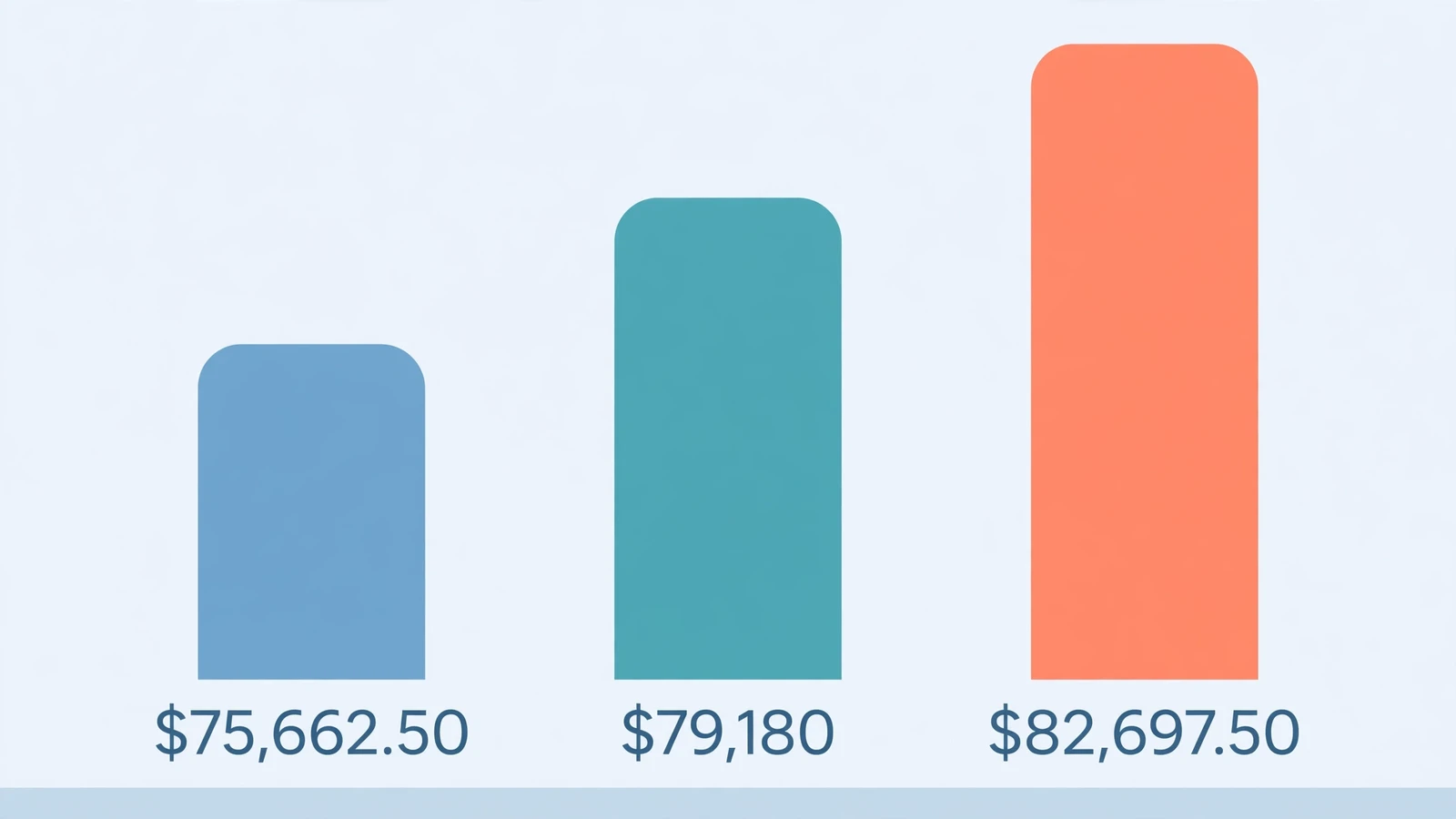
| $95,000 | $95,000 | $19,337.50 | $75,662.50 | $6,305.21 |
| $100,000 | $100,000 | $20,820.00 | $79,180.00 | $6,598.33 |
| $105,000 | $105,000 | $22,302.50 | $82,697.50 | $6,891.46 |
Here's the pattern: take-home goes up by exactly $3,517.50 a year for each $5,000 raise in this range, and the combined federal-plus-FICA burden creeps up slowly: 20.4% at $95,000, 20.8% at $100,000, 21.2% at $105,000. It rises slowly because each extra dollar is taxed at the same 22% marginal rate plus 7.65% FICA. Nothing in this range pushes any dollar into the 24% bracket.
The wider steps show the same thing. Going from $95,000 to $100,000 adds $3,517.50 of take-home for $5,000 of extra gross pay, and going from $100,000 to $105,000 adds the same $3,517.50 for the same $5,000 extra. The ratio is identical both times, about 70 cents kept per extra dollar, because the marginal rate doesn't change anywhere in this range.
What a Raise Is Really Worth
A $5,000 raise in this band is worth $3,517.50 in take-home pay, about 70 cents of each extra dollar. The other 30 cents goes to the 22% marginal rate plus 7.65% FICA on those next dollars, a combined 29.65% bite. Use that number when you compare offers: a $105,000 offer isn't $5,000 better than a $100,000 offer, it's $3,517.50 better after federal tax, before any state tax difference. To price a raise of any size, run both salaries through the salary increase calculator. And if extra hours are part of the deal, check whether the role even qualifies for overtime. Our guide to exempt vs non-exempt employees explains who gets it.
The same take-home thinking sorts out offer comparisons that gross pay can't. A $100,000 offer in a state with no income tax beats a $105,000 offer in a high-tax state if the state tax on the second offer is more than $3,517.50. And it does it without any guesswork about lifestyle, because both sides are measured in the same unit: dollars you actually keep. Whenever two offers differ in salary, hours, or location, turn each one into take-home first, then compare.
Is $100,000 a Good Salary?
There's no national answer to that question, only a local one. Federal-only take-home of $6,598.33 a month stretches very differently depending on rent, transport, and household size where you live. What this article gives you is an honest starting number: $79,180 a year after federal tax, before state tax and deductions. Stack that figure, not the $100,000 gross, against your actual monthly costs, and you have a realistic budget baseline. Anyone quoting the gross figure as spending money is overstating your income by $20,820 a year.
As a quick budget check, the 50/30/20 split of $6,598.33 a month is about $3,299 for needs, $1,980 for wants, and $1,320 for savings. If your needs alone run past $3,299, the salary will feel tight wherever you live. If they fit comfortably inside it, there's room. That's a planning sketch, not a rule, but it's drawn from take-home pay, which is the only number you can actually spend.
How to Use the Calculator
Try it with your own numbers. Four steps:
- Step 1 — Enter your annual salary into the salary-to-hourly calculator.
- Step 2 — Set your schedule: adjust hours per week and paid weeks to match your job.
- Step 3 — Check the receipt: the panel under the tool shows your inputs, the formula, and the result.
- Step 4 — Compare: try the nearby salaries in this guide to see how a different pay level changes the result.
Limitations
Before you treat any figure above as a budget, keep these limits in mind:
- State income tax isn't included: most states tax income too, so your real take-home is lower.
- Retirement and health deductions aren't counted: 401(k) contributions and health premiums come out of your check too.
- Schedule assumption: these figures use the schedule stated in this guide. Fewer hours or unpaid weeks change every number.
- Not tax advice: figures use 2026 federal rules for a single filer taking the standard deduction. Credits, other income, and filing status change your real return.
Frequently Asked Questions
The questions people ask most about a $100,000 salary after taxes, answered straight.
How much is $100,000 a year after taxes?
For a single filer, a $100,000 salary leaves $79,180 after 2026 federal taxes. At this income, federal income tax is the big one: $13,170, well ahead of the $7,650 FICA. That works out to $6,598.33 a month, or $3,045.38 every two weeks. State income tax, 401(k) contributions, and health premiums are not in this number, and they would shrink it further.
How much is $100,000 a year monthly after taxes?
On average, $6,598.33 a month. That is $79,180 a year divided by 12. With biweekly pay the money does not arrive evenly, though: at $3,045.38 a check, most months bring in $6,090.76, and the two three-paycheck months bring in $9,136.14. If you budget to the $6,598.33 average, those swings even out.
How much is $100,000 a year biweekly after taxes?
Each biweekly paycheck is $3,045.38. That is the $79,180 annual take-home split across 26 paydays, before state tax and benefit deductions. On a semi-monthly schedule, the same $79,180 becomes 24 checks of $3,299.17. The yearly total never changes, just how it is split up.
What is the take-home hourly rate for a $100,000 salary?
It is $38.07 an hour after tax. The gross rate is $48.08 an hour, but $20,820 of federal income tax and FICA takes $10.01 an hour off that over a 2,080-hour year. If your state has an income tax, the real hourly take-home would be lower still.
Does this include state taxes?
No. The $79,180 here covers federal income tax ($13,170) and FICA ($7,650) and nothing else. State tax is left out because it varies so much at this income: zero in states with no income tax, but it can bite hard in high-tax states, where a six-figure salary reaches deeper into graduated state brackets. Until you apply your own state's rules, treat $79,180 as the best case.
How much more do I keep if my salary rises to $105,000?
Only about 70 cents of each extra dollar makes it to your pocket. Take-home goes from $79,180 to $82,697.50, so the $5,000 raise is worth $3,517.50 a year. The bite is bigger than it is at $60,000 because the new dollars land in the 22% federal bracket: 22% income tax plus 7.65% FICA takes 29.65% before any state tax.
Key Takeaways & Action Plan
What to Remember
- $100,000 a year is $79,180 after federal tax: $6,598.33 a month, $3,045.38 biweekly, $38.07 an hour take-home.
- Marginal isn't the same as effective: your top bracket is 22%, but your effective federal rate is 13.2%. Only the dollars inside a bracket pay that bracket's rate.
- These are federal-only figures. State tax, 401(k), and premiums come out on top of that, so budget from the take-home number, not the gross.
- Each $5,000 raise is worth about $3,517.50 in take-home pay here, about 70 cents of each extra dollar.
- Gross pay overstates your spending money by $20,820 a year. Compare offers and budgets on take-home, always.
Sources & Method
We ran these numbers on 2026 federal rules for a single filer taking the standard deduction: a $16,100 standard deduction, the 10% bracket up to $12,400 of taxable income, 12% up to $50,400, and 22% up to $105,700, per IRS Revenue Procedure 2025-32. FICA is 7.65% (Social Security 6.2% up to the $184,500 wage base, Medicare 1.45%), and the full $100,000 sits below the wage base. The married-filing-jointly comparison uses the $32,200 joint standard deduction and the joint brackets (10% to $24,800, then 12%). Yearly figures use 52 weeks and 2,080 hours, and monthly figures are the yearly total divided by 12. State income tax, retirement contributions, health premiums, bonuses, and overtime are all left out. This article is general information, not tax advice.
Check your own salary
Put in your salary and schedule to see its hourly equivalent, then walk through the same five tax steps.
3 Things to Remember
- Take-home is $79,180 a year, or 79.2% of gross pay.
- Federal tax and FICA only, single filer, standard deduction. State tax isn't included.
- 401(k), health premiums, and other benefit deductions aren't included.
Methodology & Data Verification
- Basis: Pay figures are gross unless a section states take-home; tax figures use 2026 federal rules where shown.
- Method: Full formulas, baselines, and rounding rules are on our calculation methodology page.
- Coverage: U.S. federal rules; state and local rules vary and are not included.
- Review: Last updated October 27, 2026.
- Disclaimer: Estimates for planning only — not tax or legal advice.