

Quick Answer
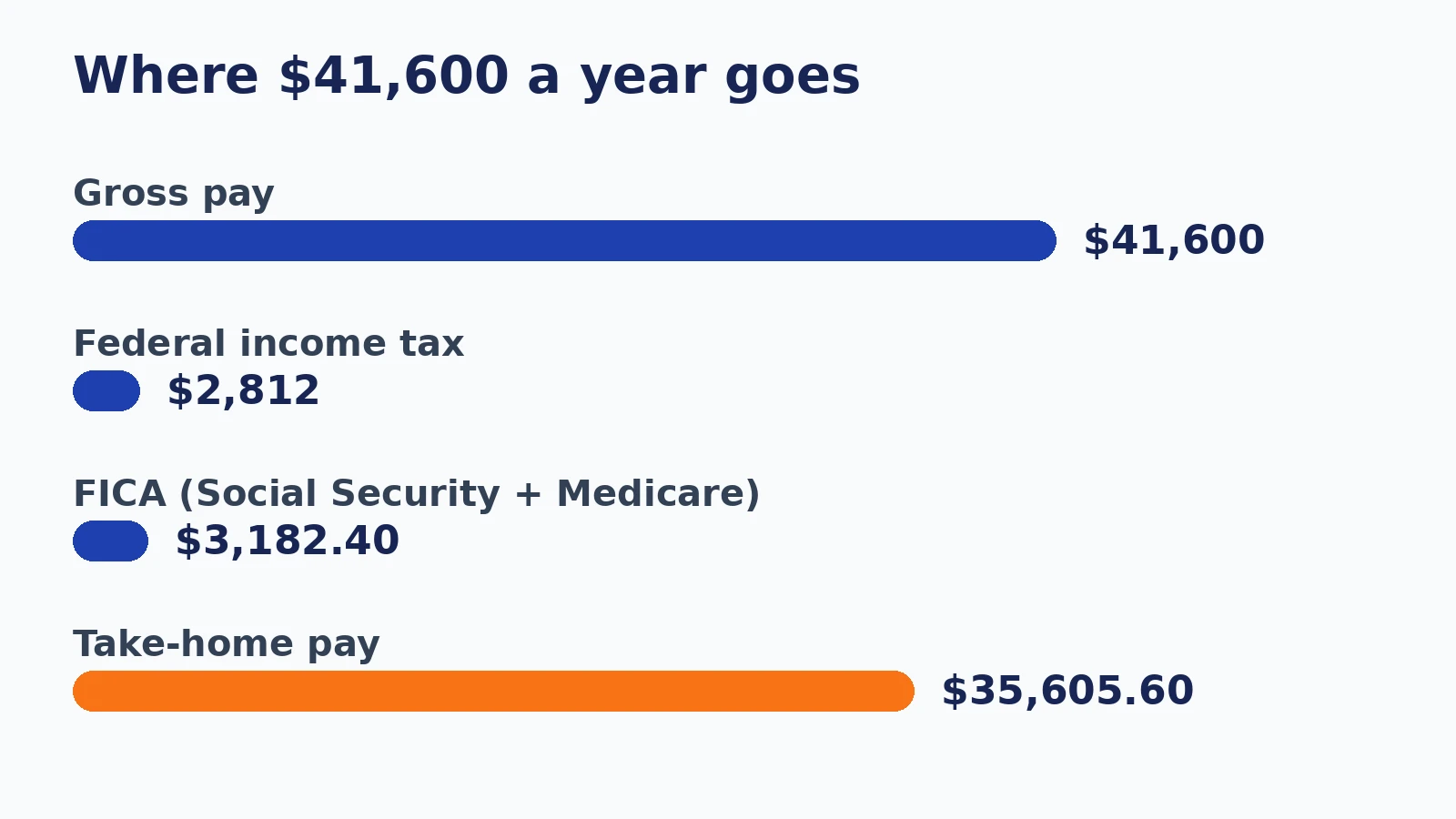
$20 an hour is $41,600 a year gross. After 2026 federal income tax and FICA, you keep $35,605.60 — $2,967.13 a month, or $1,369.45 every two weeks.
At $20 an hour on a standard full-time schedule, you earn $41,600 a year before taxes. After 2026 federal income tax and FICA, you keep $35,605.60 — $2,967.13 a month, or $1,369.45 every two weeks. That is 85.6% of your gross pay. One thing to know before you use these numbers: they are federal tax only, for a single filer taking the standard deduction. State income tax is not counted, and neither are 401(k) contributions, health premiums, or overtime. If any of those apply to you, your actual paycheck will be smaller — the section on why paychecks differ goes through each one.
This is the third article in our after-tax series. The first covered $25 an hour after taxes ($43,962 take-home) and the second covered $50,000 a year after taxes ($42,355 take-home). If the ideas behind the numbers are what you want — what gross pay and net pay mean, and why they pull apart — our guide to gross pay vs net pay lays it out. This article does one job: the complete take-home math for $20 an hour.
Run your own rate
On a different rate? Enter it to see the annual gross first, then follow the same tax steps we use below.
The Short Answer: $35,605.60 a Year
| Period | Gross Pay | Take-Home (Federal Only) |
|---|---|---|
| Year | $41,600.00 | $35,605.60 |
| Month (average) | $3,466.67 | $2,967.13 |
| Biweekly paycheck (26/year) | $1,600.00 | $1,369.45 |
| Week | $800.00 | $684.72 |
| Hour | $20.00 | $17.12 |
About that biweekly figure: $1,369.45 assumes 26 paychecks. On a semi-monthly schedule (24 paychecks), the same $35,605.60 lands as $1,483.57 per check. The annual total does not change, only how it is split up.
2026 Federal Tax Brackets at a Glance
The key idea: only your last dollar is taxed at your top bracket. The rest is taxed at lower rates. These are the 2026 single-filer brackets used in this guide:
Up to $12,400
The first $12,400 of taxable income is taxed at 10%.
$12,400 – $50,400
Taxable income between $12,400 and $50,400 is taxed at 12%.
$50,400 – $105,700
Taxable income between $50,400 and $105,700 is taxed at 22%.
$105,700 – $201,775
Taxable income between $105,700 and $201,775 is taxed at 24%.
At $20 an hour: $41,600 gross → $25,500 taxable → 12% marginal bracket, but just a 6.8% effective federal rate ($2,812 ÷ $41,600), because the first dollars are taxed at 10%.
How the Math Works, Step by Step
Five steps, all of them easy to check. Every figure uses 2026 federal rules for a single filer.
| Step | Math | Result |
|---|---|---|
| 1. Gross pay | $20 × 40 hours × 52 weeks | $41,600 |
| 2. Taxable income | $41,600 − $16,100 standard deduction | $25,500 |
| 3. Federal income tax | 10% × $12,400 = $1,240, plus 12% × $13,100 = $1,572 | $2,812 |
| 4. FICA | Social Security 6.2% × $41,600 = $2,579.20, plus Medicare 1.45% × $41,600 = $603.20 | $3,182.40 |
| 5. Take-home | $41,600 − $2,812 − $3,182.40 | $35,605.60 |
Step 3 confuses people more than any other. Your marginal rate is 12%, the rate on your last dollar. But your effective federal rate is only 6.8% ($2,812 ÷ $41,600): the first $12,400 of taxable income is taxed at 10%, and only the remaining $13,100 at 12%. A higher bracket never taxes your whole income at the higher rate. It only applies to the dollars inside that bracket. FICA is different. It applies to the full $41,600, because the whole amount falls below the $184,500 Social Security wage base.
Why Your Paycheck May Look Different
- State income tax. This is the biggest piece we left out. Some states have no income tax. Others take several percent, and in a high-tax state that can mean several hundred dollars a month beyond the federal figures here.
- Retirement contributions. Money you put in a 401(k) never reaches your paycheck, and it also lowers your taxable income, which trims the federal tax in step 3 a bit. The check gets smaller, but the money is still yours.
- Health premiums and other deductions. Insurance premiums, dental and vision plans, and similar deductions come out of every check, and the amounts vary by employer.
- Pay frequency. Biweekly pay means 26 checks a year; semi-monthly means 24. Same annual total, different check size, as the short-answer table shows.
- Withholding vs actual tax. Paycheck withholding is a guess payroll makes. The final number gets settled when you file. If you get a refund or owe a balance, it means withholding was off from the true annual figures. The math in this article is still right.
$20 an Hour vs Nearby Rates
| Hourly Rate | Gross / Year | Federal + FICA | Take-Home / Year | Take-Home / Month |
|---|---|---|---|---|
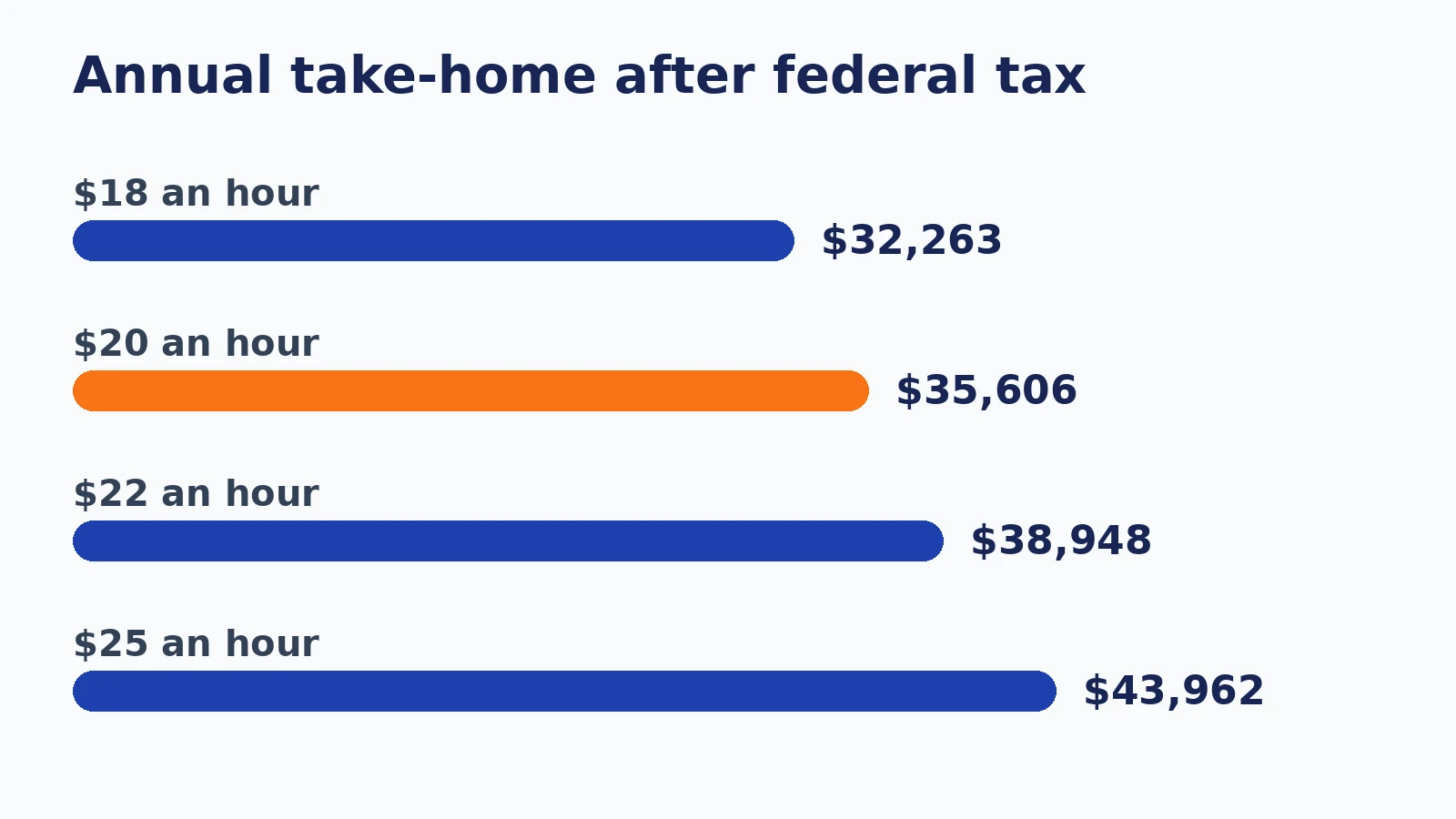
| $18 an hour | $37,440 | $5,176.96 | $32,263.04 | $2,688.59 |
| $20 an hour | $41,600 | $5,994.40 | $35,605.60 | $2,967.13 |
| $22 an hour | $45,760 | $6,811.84 | $38,948.16 | $3,245.68 |
| $25 an hour | $52,000 | $8,038.00 | $43,962.00 | $3,663.50 |
What jumps out here: each $2-an-hour raise adds about $3,343 a year to take-home pay, and the combined federal-plus-FICA bite stays near 14–16% of gross across the whole range. Tax barely creeps up in this band, because everything sits inside the 10% and 12% brackets.
The Overtime Corner
All of the above assumes a straight 40-hour week with no overtime. Overtime shifts the picture two ways: the extra hours pay time-and-a-half, and that extra pay is taxed as ordinary income at your marginal rate plus FICA. At $20 an hour, 5 overtime hours a week add $150.00 a week in gross pay — $7,800 over a full year — before tax on that extra amount. Whether you get overtime at all depends on your status: our guide to exempt vs non-exempt employees explains who qualifies, and the overtime calculator prices the extra hours for you. The 40-hour baseline is a convention, not a legal definition — see how many hours a week count as full-time.
Is $20 an Hour a Good Wage?
There is no one-size-fits-all answer. It comes down to where you live. A federal-only take-home of $2,967.13 a month covers the bills comfortably in some places and falls short in others, depending on rent, transport, and household size. What this article gives you is a solid starting number: $35,605.60 a year after federal tax, before state tax and deductions. Measure that against your actual monthly costs — not the $41,600 gross — and you get a realistic budget baseline. Anyone quoting the gross as spending money is overstating your income by $5,994.40 a year.
How to Use the Calculator
Try your own numbers in four steps:
- Step 1 — Enter your hourly rate in the hourly-to-salary calculator.
- Step 2 — Set your schedule: set the hours per week and paid weeks to match your job.
- Step 3 — Check the receipt: the panel under the tool shows your inputs, the formula, and the result.
- Step 4 — Compare: try the nearby rates in this guide to see what a different pay level does to the result.
Limitations
A few limits to keep in mind before you treat any figure above as a budget:
- State income tax is not included: most states tax income too, so real take-home is lower.
- Retirement and health deductions are not included: 401(k) contributions and health premiums come out of your check and are not counted here.
- The schedule is an assumption: the figures use the schedule stated in this guide. Fewer hours or unpaid weeks change every number.
- Not tax advice: these figures use 2026 federal rules for a single filer taking the standard deduction. Credits, other income, and filing status change your real return.
Frequently Asked Questions
Short answers to the questions readers ask most about $20 an hour after taxes.
How much is $20 an hour after taxes?
$20 an hour at 40 hours a week is $41,600 a year before tax. A single filer taking the 2026 standard deduction keeps $35,605.60 of it: federal income tax takes $2,812, and FICA takes $3,182.40. Notice that FICA is the bigger bite here — that happens at lower wages, because income tax only starts after the standard deduction while FICA starts with the first dollar. That leaves $2,967.13 a month, or $1,369.45 every two weeks, before state tax, a 401(k) contribution, or health premiums come out.
How much is $20 an hour biweekly after taxes?
You would bring home $1,369.45 every two weeks. That is the $35,605.60 of annual take-home split across 26 biweekly paychecks, with no state tax or benefit deductions taken out yet. Paid semi-monthly, the same money shows up as 24 checks of $1,483.57. The checks look bigger, but the year-end total is exactly the same.
How much is $20 an hour monthly after taxes?
Use $2,967.13 a month as your planning number. It is just the $35,605.60 annual take-home divided by 12, so think of it as an average: two months a year have a third biweekly paycheck and feel richer, while the other ten run on two checks. If you plan rent and bills around the $2,967.13 average, the leaner months will not catch you off guard.
What is the take-home hourly rate for $20 an hour?
$17.12 of each $20.00 hour ends up in your pocket. FICA takes $1.53 an hour and federal income tax $1.35 an hour — $2.88 an hour between them — leaving $35,605.60 of take-home over a 2,080-hour year. State income tax would shave a bit more off the $17.12.
Does this include state taxes?
No. The $35,605.60 here is after federal income tax ($2,812) and FICA ($3,182.40) only. State income tax is left out, and at a $41,600 income it is often the smallest of the three taxes: some states have no income tax at all, and many others shield much of a lower income behind their own standard deductions and bottom brackets. If your state taxes wages, your take-home will come in below $35,605.60, but at this level the gap is usually modest.
Why is my paycheck less than $1,369.45 biweekly?
Look first at the deductions this article did not model. The $1,369.45 assumes only federal income tax and FICA come out. Most real paychecks also lose money to state withholding, health premiums, and any 401(k) contribution. Then check the calendar: $1,369.45 is a biweekly figure, so a semi-monthly or monthly pay schedule looks different even at the same salary. If the shortfall is bigger than those items explain, compare the federal withholding line on your stub with the $2,812 annual figure in this article, and ask payroll to check your W-4.
Key Takeaways & Action Plan
What to Remember
- $20 an hour is $35,605.60 a year after federal tax — $2,967.13 a month, $1,369.45 biweekly, $17.12 an hour in your pocket.
- Marginal is not effective: your top bracket is 12%, but your effective federal rate is 6.8%. Only dollars inside a bracket pay that bracket's rate.
- Federal only. State tax, 401(k), and premiums come out on top. Budget from the take-home number, not the gross.
- Each $2-an-hour raise is worth about $3,343 a year in take-home pay in this range.
- Overtime is separate: 5 extra hours a week at $20 add $7,800 a year gross, taxed as ordinary income, if your role qualifies.
Sources & Method
Here is how we got these numbers: 2026 federal rules for a single filer taking the standard deduction — a $16,100 standard deduction, the 10% bracket up to $12,400 of taxable income, and the 12% bracket up to $50,400, per IRS Revenue Procedure 2025-32. FICA is 7.65% (Social Security 6.2% up to the $184,500 wage base, Medicare 1.45%), and the full $41,600 falls below that wage base. Annual figures use 52 weeks and 2,080 hours; monthly figures are the annual total divided by 12. State income tax, retirement contributions, health premiums, and overtime are excluded. This article is general information, not tax advice.
Check your own rate
Enter your hourly rate and schedule to see the annual gross, then run through the same five tax steps.
3 Things to Remember
- You keep $35,605.60 a year — 85.6% of gross pay.
- Federal tax only, single filer, standard deduction. State tax is not included.
- Benefit deductions like 401(k) and health premiums are not included either.
Methodology & Data Verification
- Basis: Pay figures are gross unless a section states take-home; tax figures use 2026 federal rules where shown.
- Method: Full formulas, baselines, and rounding rules are on our calculation methodology page.
- Coverage: U.S. federal rules; state and local rules vary and are not included.
- Review: Last updated October 26, 2026.
- Disclaimer: Estimates for planning only — not tax or legal advice.