

Quick Answer
Full-time at $20 an hour, you make $41,600 a year before taxes. That's $800 a week, gross.
Got a job offer for $20.00 an hour? The quick math is easy: $20 times 40 hours is $800 a week. But the number that matters for rent, groceries, and bills is a different one. How much is $20 an hour annually, what actually lands in your checking account after 2026 taxes, and what kind of life does it buy you? Let's work it out.
Twenty dollars an hour is a big milestone for a lot of people: admin assistants, warehouse and logistics workers, retail supervisors, apprentices. But turning an hourly rate into a monthly budget takes more than one multiplication. How often you get paid, whether your time off is paid, and what comes out for FICA and state taxes all decide what you can actually spend.
This guide walks through the exact numbers for $20 an hour across every pay schedule, why the usual monthly estimate sells you short, 2026 federal and state taxes, what overtime at $30 an hour adds, and a realistic 50/30/20 monthly budget.
Calculate Your Exact $20/Hour Paycheck
Try your own hours and unpaid days off, and see what $20 an hour comes to by the day, week, paycheck, and year.
$20 an Hour at a Glance: The Quick Answer
Work 40 hours a week, all 52 weeks of the year (that's 2,080 hours), and $20 an hour equals an annual gross salary of $41,600.00 before taxes or benefit deductions come out.
Paychecks land on different schedules, so here's what a $20 hourly wage looks like in each pay period, with a rough take-home estimate for a single filer in a state with no income tax:
| Pay Period | Hours Worked | Gross Earnings | Est. Take-Home (No State Tax) | Est. Take-Home (~4.5% State Tax) |
|---|---|---|---|---|
| Hourly | 1 Hour | $20.00 | ~$17.12 | ~$16.22 |
| Daily (8 Hours) | 8 Hours | $160.00 | ~$136.94 | ~$129.74 |
| Weekly (52 Weeks) | 40 Hours | $800.00 | ~$684.72 | ~$648.71 |
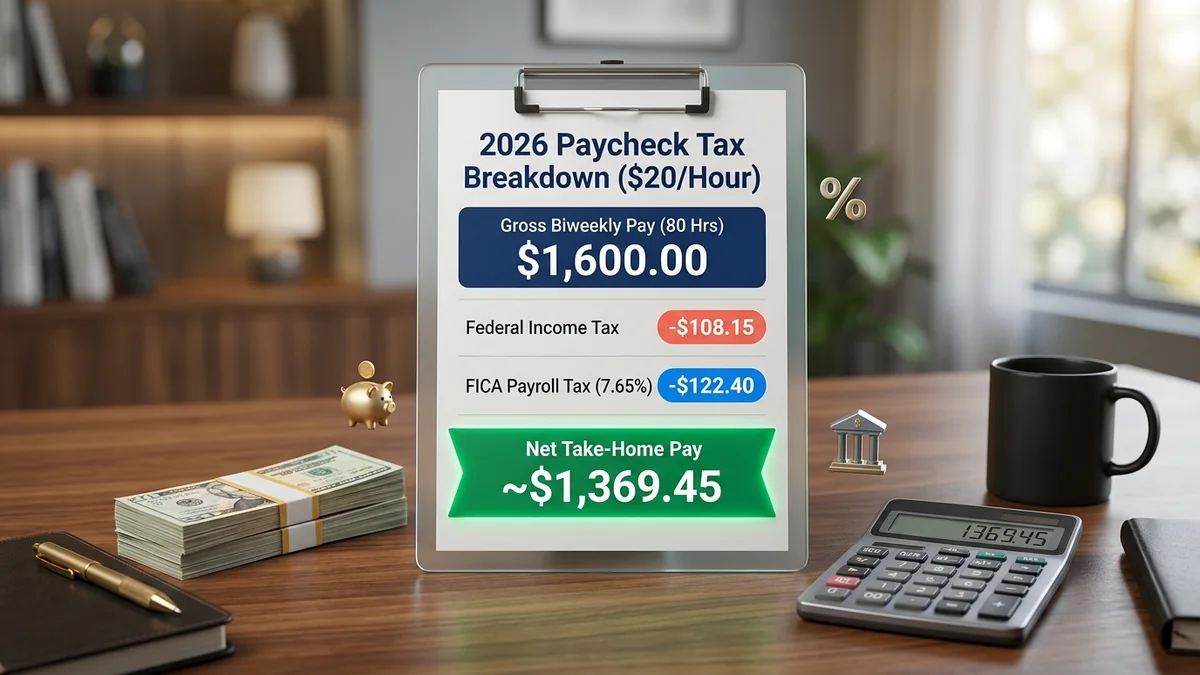
| Biweekly (26 Paychecks) | 80 Hours | $1,600.00 | ~$1,369.45 | ~$1,297.42 |
| Semi-Monthly (24 Paychecks) | 86.67 Hours | $1,733.33 | ~$1,483.57 | ~$1,405.54 |
| Monthly (12 Months) | 173.33 Hours | $3,466.67 | ~$2,967.13 | ~$2,811.08 |
| Annual (2,080 Hours) | 2,080 Hours | $41,600.00 | ~$35,605.60 | ~$33,733.00 |
These estimates use 2026 federal tax rates, the $16,100 standard deduction for single filers, and FICA at 7.65%. Want to compare a different rate? See our breakdown of $23 an hour.
The 2,080-Hour Rule: How $20/Hour Converts Across Every Pay Period
In payroll, full-time work is built around the 2,080-Hour Benchmark: 40 hours a week times 52 weeks a year ($40 imes 52 = 2,080$).
With that number, the math is simple:
If you get paid biweekly (every other Friday), you receive 26 paychecks per year rather than 24. That means two months out of every calendar year bring three paychecks instead of two, a handy windfall for rent, savings, or paying down debt.

The 4-Week Myth: Why $800 × 4 Undercounts Your Monthly Earnings
Here's a mistake almost everyone makes when budgeting an hourly job: multiplying weekly pay by four. If you earn $800 a week ($20 × 40), it is tempting to calculate: $800 imes 4 = $3,200.00 ext{ per month}$.
That shortcut is wrong, and it sells you short by $3,200 every single year ($266.67 per month). Here is why:
The 4.33-Week Reality:
Only February has exactly 28 days (four 7-day weeks). Every other calendar month has 30 or 31 days. Divide 52 weeks by 12 months and the average calendar month works out to 4.333 weeks. Multiply $800 by 4.333 and you get your real average monthly gross earnings of $3,466.67.
Budgeting your fixed monthly costs against $3,200 instead of $3,466 keeps your plan on the safe side, and those two "extra" paychecks in a biweekly year can go straight to savings or debt payoff. To learn more about the conversion, see our guide on how to convert hourly pay to annual salary.
How Unpaid Time Off & Holidays Change Your Real Take-Home
The standard $41,600 figure assumes every holiday, sick day, and vacation day is paid. But a lot of hourly jobs in hospitality, staffing, construction, or contracting don't include paid leave.
Take unpaid time off and every missed hour costs you exactly $20.00:
52 Paid Weeks (Zero Leave)
$41,600 / Year
2,080 paid hours. The usual full-time setup, with paid holidays and PTO you build up over time.
50 Paid Weeks (2 Weeks Unpaid)
$40,000 / Year
2,000 paid hours. Two weeks unpaid knocks exactly $1,600 off your gross.
48 Paid Weeks (4 Weeks Unpaid)
$38,400 / Year
1,920 paid hours. Common for seasonal work, contract jobs, or shutdowns over the holidays.
Say your employer gives six unpaid federal holidays plus five unpaid sick days a year. That's 88 unpaid hours, or $1,760 off your gross, leaving $39,840 for the year. Always ask about the holiday and PTO policy before you sign an hourly contract.
Where Do Your Taxes Go? 2026 Paycheck & FICA Breakdown
Gross pay is what your employer pays before anything comes out. To see what actually lands in your bank account, here's a 2026 tax walk-through for a single filer taking the standard deduction.
2026 Federal & FICA Tax Breakdown ($41,600 Gross):
- Apply the 2026 Standard Deduction: For 2026, the IRS standard deduction for single filers is $16,100. That brings your taxable income down to $25,500.00 ($41,600 − $16,100).
- Federal Income Tax Calculation:
- 10% bracket on the first $12,400 = $1,240.00
- 12% bracket on remaining $13,100 ($12,401 to $25,500) = $1,572.00
- Total Federal Income Tax: $1,240 + $1,572 = $2,812.00 (effective federal rate: ~6.76%)
- Mandatory FICA Payroll Taxes (7.65%):
- Social Security (6.2% on full $41,600) = $2,579.20
- Medicare (1.45% on full $41,600) = $603.20
- Total FICA Taxes: $2,579.20 + $603.20 = $3,182.40
- Total Federal & FICA Withholding: $2,812.00 + $3,182.40 = $5,994.40 per year (~14.41% of gross).
Where you live decides the last piece of your take-home pay:
- No-Income-Tax States (TX, FL, WA, TN, NV, AK, SD, WY): Zero state income tax. Your annual net pay is $35,605.60 ($2,967.13/month or $1,369.45 biweekly).
- Moderate-Tax States (PA, IN, OH, AZ, NC ~4.5% effective): State tax takes about $1,872/year, leaving annual net take-home of $33,733.00 ($2,811.08/month or $1,297.42 biweekly).
- Higher-Tax States (CA, NY, NJ, OR ~6.0% effective): State tax takes roughly $2,498/year, leaving annual net take-home of $33,107.00 ($2,758.92/month or $1,273.35 biweekly).
Want to check your own pay stub line by line? Our step-by-step guide on how to calculate taxes on a paycheck walks through it.
The Overtime Multiplier ($30/Hour): Boosting Your Income
Under the federal Fair Labor Standards Act (FLSA), non-exempt hourly workers earn time-and-a-half (1.5×) for any hours over 40 in a 7-day workweek. On a $20.00 base wage, your overtime hourly rate is $30.00 per hour ($20 × 1.5).
A few extra hours a week add up fast over a year:
| Schedule | Weekly Hours | Gross Weekly Pay | Annual Gross Pay | Annual Pre-Tax Boost |
|---|---|---|---|---|
| Standard (Zero OT) | 40 Hours | $800.00 | $41,600.00 | Baseline |
| Light OT (+2 Hrs/Wk) | 42 Hours | $860.00 | $44,720.00 | +$3,120.00/yr |
| Moderate OT (+5 Hrs/Wk) | 45 Hours | $950.00 | $49,400.00 | +$7,800.00/yr |
| Heavy OT (+10 Hrs/Wk) | 50 Hours | $1,100.00 | $57,200.00 | +$15,600.00/yr |
Annual totals assume 52 weeks worked. Try your own overtime rate and daily double-time rules in our free Overtime Calculator.
Real-Life Monthly Budget on $20 an Hour (50/30/20 Plan)
So what does $20 an hour actually buy you month to month? Say you take home about $2,850 to $2,967 per month (it depends on your state). The popular 50/30/20 budget framework is a good way to split it up:
Essential Living Costs
- Rent & Utilities: $950 – $1,050 (shared 2-bedroom or modest studio)
- Groceries & Essentials: $300 – $350
- Transportation (Gas/Insurance/Transit): $180 – $220
Lifestyle & Flexibility
- Dining Out & Coffee: $250 – $300
- Phone Plan & Streaming: $100 – $120
- Hobbies & Social Outings: $250 – $300
- Personal Discretionary: $150 – $170
Future Security
- Emergency Fund (HYSA): $250 – $300
- Retirement (401k/Roth IRA): $200 – $250
- Debt Reduction / Sinking Funds: $120 – $143
The Housing Reality at $20/Hour: The common 30% rule says housing should stay under 30% of gross income, which puts your target rent at $1,040 per month ($41,600 × 0.30 ÷ 12). In pricey cities, finding your own place at that price is tough. Most people earning $20 an hour in a big city split rent with a roommate or partner, keeping their share between $800 and $1,050 so there's money left over.

Common Budgeting & Paycheck Math Traps to Avoid
Here are the budgeting traps that catch a lot of hourly workers off guard:
- Budgeting Off Gross Income: Don't set your monthly spending off the $3,466 gross figure. Budget from what actually hits your account ($2,750 to $2,960).
- Miscalculating Monthly Direct Deposits: Biweekly pay means two paychecks in 10 months and three in 2 months. Cover your regular bills with two paychecks ($2,600–$2,740 net) and send the two extra ones straight to savings.
- Ignoring Healthcare & Benefit Premiums: Sign up for your employer's health plan or put money in a traditional 401(k), and your biweekly check comes in lower than the tax-only numbers here, though your taxable income drops too.
- Skipping Sinking Funds for Car Care: One surprise $800 car repair can wreck a tight budget. Putting $75 to $100 aside every month for car trouble keeps it off your credit card.
How to Use the Calculator
Run your own numbers in four steps:
- Step 1 — Enter your hourly rate ($20, or the rate on your offer) into the hourly-to-salary calculator.
- Step 2 — Set the schedule you will really work: many $20-an-hour roles are scheduled under 40 hours, so enter your actual weekly hours and paid weeks, not the full-time default.
- Step 3 — Read the biweekly line: most hourly jobs pay every two weeks, and that per-check figure — not the annual total — is what your budget has to run on.
- Step 4 — Compare a second scenario: rerun with a few overtime hours or a higher-hours schedule to see what a fuller week would actually add over a year.
Limitations
- Take-home is shown as a range for a reason: this guide's net-pay figures are estimates that move with your state's income tax (or lack of one), your filing status, and your benefit elections — your own check will land at one specific point, not on the guide's midpoint.
- The $41,600 headline assumes full-time: it needs 40 paid hours in all 52 weeks. At 35 scheduled hours the same $20 rate pays $36,400 — schedules at this wage vary more than the headline suggests.
- Federal sketch only: the tax figures use 2026 federal rules for a single filer taking the standard deduction. Credits that matter a great deal at this income — earned income and child credits — are outside the sketch and can change the result by thousands.
- Budget rules are guidelines: the 30% housing rule and the 50/30/20 split in this guide are planning heuristics, not personal financial advice; in high-rent metros they describe a target many $20-an-hour workers cannot hit alone.
- Overtime and tips are unstable income: scenarios built on premium hours assume the employer offers them all year; seasonal and retail schedules rarely do.
- Local wages differ: state and city minimum wages, and local labor markets, decide what $20 an hour means where you live — the national comparisons here cannot capture that.
Frequently Asked Questions About $20 an Hour
How much is $20 an hour annually?
Full-time, 40 hours a week for 52 paid weeks (2,080 hours), $20 an hour works out to $41,600 a year before taxes and deductions. Take 2 weeks of unpaid vacation (50 paid weeks, or 2,000 hours) and your gross pay drops to $40,000.
How much is $20 an hour monthly?
At 40 hours a week, $20 an hour averages $3,466.67 a month before taxes ($41,600 divided by 12). A lot of people multiply their $800 weekly pay by 4 and get $3,200, but that undersells you by $266.67 a month, because the average month is 4.33 weeks long.
How much is $20 an hour biweekly after taxes?
Biweekly pay (every two weeks, 26 paychecks a year) gives you a gross check of $1,600.00 for 80 hours. After 2026 federal income tax and FICA (7.65%), a single filer in a state with no income tax takes home about $1,369 per check (around $2,967 a month). In a state with moderate income taxes (about 4.5%), take-home drops to about $1,297 per check (around $2,811 a month).
Is $20 an hour a livable wage in 2026?
Yes, in a lot of places. At $41,600 a year gross, $20 an hour works as a livable wage in low- to moderate-cost areas, especially if you're single, keep fixed costs low, or share housing. The 30% housing rule puts your rent ceiling at $1,040 a month, which covers a shared apartment or an affordable studio while still leaving room for an emergency fund.
Can I buy a car earning $20 an hour?
Yes, but keep it modest. Financial planners suggest total car costs (payment, insurance, gas, and maintenance) stay under 10% to 15% of your take-home pay. On $20 an hour, that's about $2,800 to $2,960 a month net, so your car budget should stay between $280 and $440 a month. A reliable used car with a small loan, or bought with cash, is usually the smart move.
How much extra do you earn with overtime at $20 an hour?
Your overtime rate at $20 an hour is $30 an hour (time-and-a-half). Work 5 overtime hours every week and that's $150 extra a week, or $7,800 over 52 weeks, taking your annual gross from $41,600 to $49,400. Even 2 overtime hours a week adds $60 a week, or $3,120 a year, which makes overtime one of the fastest ways to earn more at this wage.
Key Takeaways & Next Steps
At $20 an hour ($41,600 gross a year), you've got a solid base to build on. Making it work comes down to knowing your net numbers:
Your $20/Hour Paycheck Action Plan:
- Know your true net pay: Plan your spending around ~$1,300 to $1,369 per biweekly check, not the gross number.
- Cap rent at $1,040/month: That's the 30% rule on your $3,467 gross monthly income, and it keeps you from being house-poor.
- Use overtime on purpose: At $30/hour, 5 extra hours a week add $7,800/year, which can speed up your savings goals fast.
- Personalize your schedule: Plug your exact hours into our free Hourly Wage Converter to see what different hours do to your yearly pay.
Curious how other rates stack up? See our guides for $23 an hour, $30 an hour, and $45 an hour.
Disclaimer: This article is provided for educational and illustrative purposes only and does not constitute individual tax, financial, or legal advice. Individual take-home pay varies based on Form W-4 elections, pre-tax health insurance premiums, municipal taxes, and retirement contributions. Consult a qualified certified public accountant (CPA) or financial advisor for personalized advice.
3 Things to Remember
- Full-time gross pay is $41,600 a year — $800 a week (20 × 40).
- The guide also works through biweekly and monthly paycheck math, 2026 federal and FICA taxes, and a realistic take-home budget.
- Gross pay is the starting point — what lands in your checking account after 2026 taxes is the number to budget on.
Methodology & Data Verification
- Basis: Pay figures are gross unless a section states take-home; tax figures use 2026 federal rules where shown.
- Method: Full formulas, baselines, and rounding rules are on our calculation methodology page.
- Coverage: U.S. federal rules; state and local rules vary and are not included.
- Review: Last updated October 16, 2026.
- Disclaimer: Estimates for planning only — not tax or legal advice.